
Doubling $1 vs. $10 Daily for a Month: Unveiling the Results
What if you could turn $1 into a fortune? Or even $10? Sounds like a fairy tale, doesn’t it? But what if we told you it’s possible, at least theoretically? It’s basic compounding at its full potential! We’ll show you how much $1 Vs. $10 doubled daily for a month end up being.
Excited yet?
In this post, we’ll take a simple idea and watch it grow into something incredible. We’ll compare the growth of $1 vs. $10 and see where this takes us. Let’s take a look at the potential power of compounding.
What is Compounding?
Compounding is a simple concept – it’s when you earn interest on your interest.
In other words, instead of just earning money on your initial investment, you also earn money on the interest that has accumulated over time.
For example, let’s say you have $1000 in a savings account with an annual interest rate of 5%.
After one year, you will have earned $50 in interest – now, if you let that interest stay in the account and continue to earn 5% on it each year, your $50 in interest will grow to $52.50 by the end of the second year.
After ten years, that initial $1000 investment would have grown to over $1,628! And this is just with a 5% annual interest rate – imagine the growth potential with higher rates or more frequent compounding periods.
How Will Compounding Work on $1 vs. $10?
In the previous example, you were getting interest on a fixed initial investment of $1000. But in this case, we will be doubling our investment daily for a month. So, you are basically getting a 100% return on your investment every day.
For example, let’s say you start with $1 and double it every day for a month. For the first day, you will have $1, the next day $2, then $4, then $8, and so on.
The same thing goes with $10 as well – for the first day, you will have $10, the next day $20, then $40, and so on.
So now that we have a basic idea of how compounding works let’s see how much $1 and $10 end up being after a month of doubling daily.
Real-Life Example of Doubling
Here are some examples of real-life events that involve doubling:
1. Doubling Time in Populations: Population is a good example of doubling. For example, if one person has two children, and those two children have two more each year, the population will keep doubling every year.
2. Everyday Math Applications: We often use doubling in everyday situations without realizing it. For example, we can calculate the price of two items by doubling the price of one item.
3. Investment: As shown in our example above, investing can also involve doubling. The return on investment is essentially earning twice as much as what you initially put in.
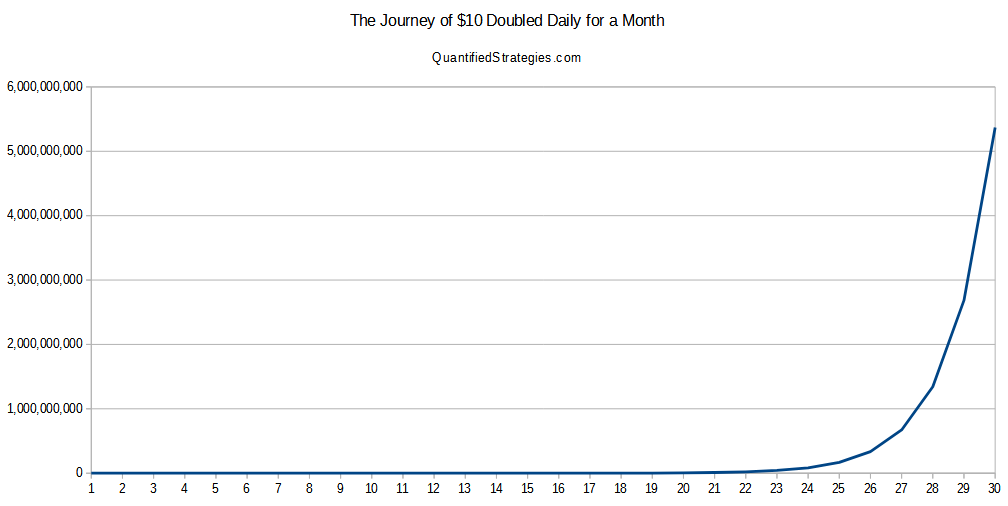
The Journey of $10 Doubled Daily for a Month
Let’s take a look at the journey of $10. Imagine you have $10, and each day you’re able to double it. Sounds exciting, right? So let’s break it down.
Day 1: $10
Day 2: $20
Day 3: $40
Day 4: $80
Day 5: Your money grows to $160
Day 6: $320
Day 7: It’s now $640 – that’s a big change
By the end of the first week, your initial $10 has grown to $640. Not bad! But hold on, because things are about to get even more interesting
Day 8: You now have over $1,000 – $1,280 to be exact
Day 9: $2,560
Day 10: $5,120
Day 11: It’s $10,240. Yes, you read that right
Day 12: $20,480
Day 13: $40,960
Day 14: $81,920
Two weeks in, and you’re already close to $100K! Let’s keep going
Day 15: Your money has now grown to $163,840
Day 16: $327,680
Day 17: $655,360
Day 18: You now have over a million dollars – $1,310,720 to be exact
Day 19: $2,621,440
Day 20: $5,242,880
Day 21: $10,485,760
Day 22: Your money has now surpassed $20 million – $20,971,520 to be exact
Day 23: $41,943,040 to be exact
Day 24: $83,886,080
Day 25: Your money just hit 100 million – $167,772,160 to be exact
Day 26: $335,544,320
Day 27: $671,088,640!
Day 28: You are a billionaire now – $1,342,177,280
Day 29: $2,684,354,560
Day 30: The grand total after a month of doubling is an astonishing $5,368,709,120. That’s over 5 billion dollars!
Let’s show you how this looks on a linear graph to illustrate the compounding process:
The Journey of $1 Doubled Daily for a Month
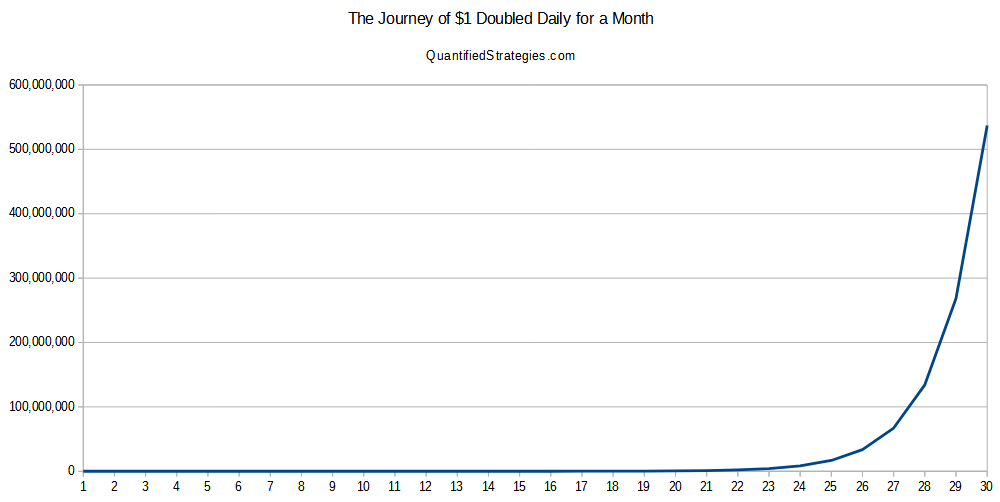
Now that we have learned about the journey of $10, let’s see what happens when we start with just $1.
Day 1: $1
Day 2: $2
Day 3: $4
Day 4: Still just $8 here
Day 5: Your money has now grown to $16 – not too shabby
Day 6: $32
Day 7: $64
By the end of the first week, your initial $1 has grown to $64. Now, let’s see what happens in the second week.
Day 8: You now have over a hundred dollars – $128 to be exact
Day 9: $256
Day 10: It’s now $512
Day 11: $1,024
Day 12: $2,048
Day 13: $4,096
Day 14: It’s now $8,192.
Two weeks in, and you’re already close to ten thousand dollars! Let’s continue.
Day 15: Your money has now grown to $16,384
Day 16: $32,768
Day 17: $65,536
Day 18: It’s now over a hundred thousand dollars – $131,072, to be exact
Day 19: $262,144
Day 20: $524,288
Day 21: $1,048,576 – you are now a millionaire
Day 22: $2,097,152
Day 23: $4,194,304
Day 24: $8,388,608
Day 25: $16,777,216
Day 26: $33,554,432
Day 27: $67,108,864
Day 28: It’s now over a hundred million dollars – $134,217,728 to be exact
Day 29: $268,435,456
Day 30: The grand total after a month of doubling is $536,870,912.
Again, we put in a chart to see why time is so important for compounding:
Comparison Between $1 and $10 Doubling
Let’s now compare our previous examples: starting with $1 and doubling it daily for 30 days versus starting with $10 and doing the same.
When you start with just $1 and double it every day for 30 days, you end up with an impressive sum of over $536 million. It’s a staggering amount, considering you started with a single dollar bill.
Now, imagine starting with $10 instead. Following the same doubling principle over 30 days, you would amass over $5 billion! That’s ten times the amount you’d have if you started with $1.
So, what does this comparison tell us?
It underscores the power of starting with a larger sum. The more you start with, the more you end up with when your money grows at the same rate.
While these examples are theoretical and the daily doubling scenario is unlikely in real life, they show the real power of compounding. Always keep this in the back of your head when you are developing trading strategies.
The initial amount – or principal – matters a lot. So, whether it’s saving for retirement or investing in the stock market, starting with a larger sum can significantly boost your final outcome.
Remember, every extra dollar you can put towards your savings or investment today could potentially multiply over time, thanks to the power of compounding!
How Much Does $1 Vs. $10 Doubled Daily For a Month End Up Being? Conclusion
So there you have it. Now you know how doubling works and how it can lead to significant growth in your finances over time. Whether you’re starting with $1 or $10, the key is to start early and let compounding do its magic. It may take some time, but with patience and consistency, you can potentially see your money multiply in impressive ways. So start saving and investing today, and enjoy looking at your growing wealth!
Related reading:
- How Much Does A Dollar Doubled Every Day For A Month End Up Being?
- How Much Does A Penny Doubled Every Day For A Month End Up Being?
- The Rule of 72: A Comprehensive Guide
- What Happens When You Double $1000 Every Year?
- Doubling Your Money Annually For A Century
- Can You Turn $1 Million into a Billion by Doubling It Every Century?
- $10 vs $100 Doubled Monthly For A Decade
- $100 vs. $1000 Doubles Daily For A Year
- How to Grow Your Wealth by Doubling Your Investments Quarterly
- How Much Can You Save by Doubling Your Pennies for a Year
- Turning $10,000 into a Comfortable Nest Egg with Annual Doubling
- How To Turn $1000 Into A Billion With Daily Doubling
- How Much Does Doubling Your Money Daily For A Year End Up Being