The Friday Jobs Report Trading Strategy For Stocks and Bonds – Facts, Statistics, Backtests
It’s possible to make a Friday Jobs Report trading strategy. One of this planet’s most important macro numbers is the monthly US job report. The employment report sets the bond traders on fire and, subsequently, the stock market because the interest rates are the main determinant of the valuation of stocks. Thus, any equity trader should at least be aware when this number is published: the first Friday of the month at 0830 ET – one hour before the opening of NYSE.
This article explains a couple of Friday Jobs report trading strategies, what the monthly job report is, why it’s important, and finally, we do some backtests on how stocks and bonds perform after the job report – both on the same day and the following week. Our backtests indicate that the day of the jobs report shows abnormal positive returns, but the effect disappears after the first day.
What is the Friday job report?
The Friday job/employment report is published monthly and usually on the first Friday of the month. The US Department of Labor publishes it.
The report’s main numbers are nonfarm payroll employment and the general unemployment rate.
However, the report has many numbers and is several pages long. It’s regarded as the most important macro number.
Why the Job/employment report is important
The Friday job report is essential because a hot job market usually leads to rising interest rates and vice versa. Rising rates are unfavorable for stocks because most equity investors demand a higher risk premium for owning stocks. Hence, stocks go down.
Opposite, lower rates are positive for stocks. This is observed via the earnings multiple: over the last four decades, we have witnessed an extraordinary multiple expansion since the US interest level topped in the early 1980s (P/E).
The valuation varies from sector to sector, but the average P/E in the S&P 500 is currently (October 2021) around 25. This implies a 4% estimated return for owning (risky) stocks (this is the earnings yield). Historically, this earnings yield has been meager. As of writing, in February 2023, the earnings yield minus the current inflation rate is negative. This is rare.
Backtesting the Friday jobs report trading strategy
Let’s test several potential trading strategies for the Friday jobs report:
First, we test the intraday movement from the open to the close in stocks and bonds (day trade). We buy the S&P 500 on the open and sell at the close on each Friday jobs report (from inception in 1993 until today):
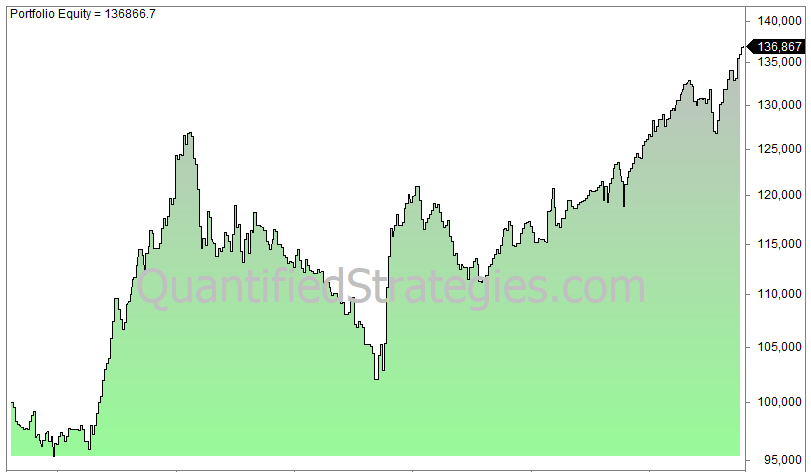
The test is done by investing 100 000 in the ETF with the ticker code SPY (S&P 500) from its inception in 1993 up to and including today. We buy the open and sell at the close. The average gain is 0.09% which is much better than any random day. The win ratio is 55% and the average winner is slightly bigger than the average loser.
Most of the gain over the last decades has come from owning stocks from the close until the next day’s open. During the last 25 years, the gain from the open to the close is practically zero. This highlights the strong performance in stocks this particular day. We have separated the different gains from the close to open and open to close in a previous article:
Readers might argue the strong intraday performance is because interest rates have fallen. Indeed, they have, but how has TLT performed on the Friday jobs report? TLT is the ETF for the 20-year Treasury Bonds:
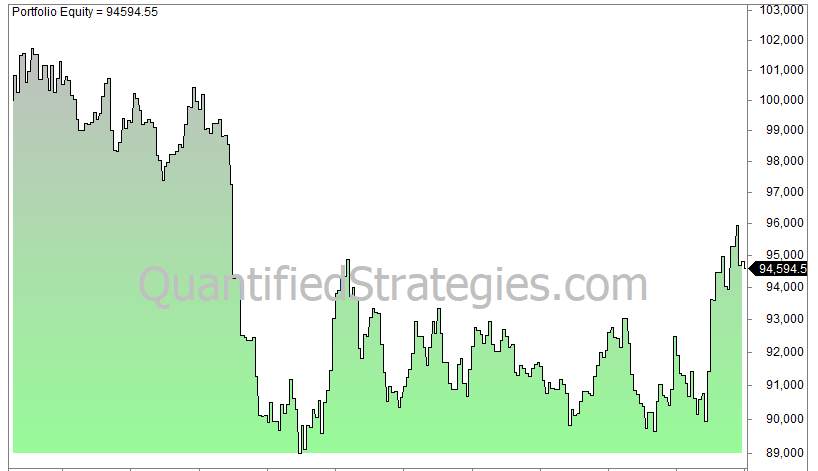
We only have data back to 2003 for TLT, but we can clearly see the negative drift: the average gain is minus 0.04%. This means that the rates, on average, have gone up on the Friday jobs report (falling bond prices mean the coupon goes up in relation to the price, and thus a lower price equals a higher yield).
How does the stock market perform in the week following the Friday job report?
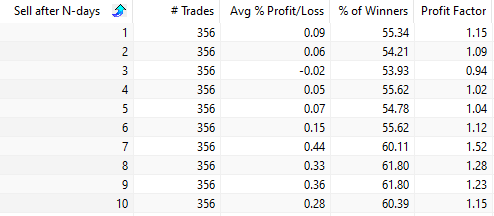
Our backtest buys SPY at Friday’s open and sells at the close x days later: