
Overnight Trading: Strategies for Making Money and Insights
How do you do overnight trading? Is it possible to make money via overnight trading? Can you make money by owning stocks or indices for just one day? Is overnight trading good?
You do overnight trading by buying the close and either selling at the next day’s open or close. We have previously covered how you can buy at the close and sell at the next day’s open in the S&P 500. This article looks at how you can expand the time frame and hold for a few hours more.
The overnight edge
The overnight trading edge in the stock market is a well-known edge and has been covered on this website multiple times. The edge is mainly from the close until the next open (you can find several of these edges among our free trading strategies and in our paid subscription for monthly trading edges).
Why buy the close and sell the next day’s open?
We exit (or sell) on the open because the average gain from the open to the close has been zero during the last 30 years. Below is the chart showing the equity curve if you bought the open and sold on the close (ie, day trading):
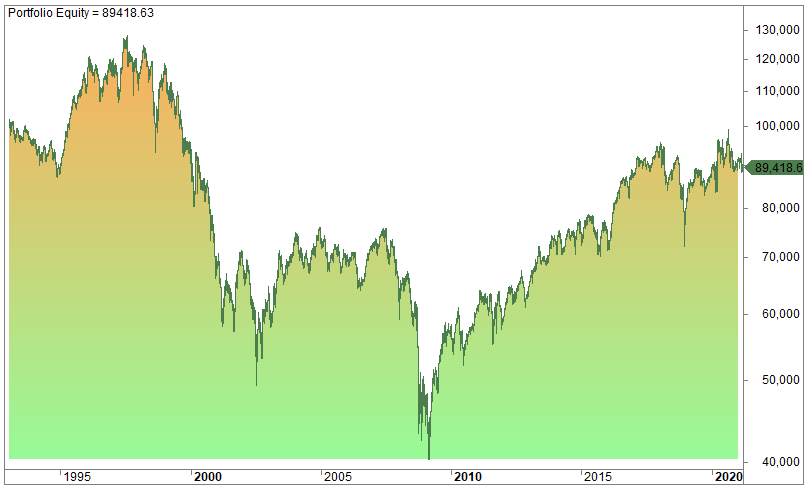
But averages are just averages and generalizations. We are not interested in averages, but we are interested in the more infrequent excessive returns that happen when certain conditions occur.
Is it possible to find trading edges that have a better edge by selling at the close (and not on the open) in S&P 500?
Yes, there are quite a few of them. If you develop many of them, it’s possible to mix a nice portfolio of these short-term edges and make a decent risk-adjusted return.
Below we show some equity charts of a few ideas we have, and a few of them will later be published to our subscribing members. All the backtests have been done in the ETF with ticker code SPY since its inception in 1993. You’ll get more or less the same results by using the ES future.
In the examples below we enter at the close, and we sell at the close the day after, thus holding for 24 hours (or over the weekend if it’s a Friday). To better understand how we buy and sell at the close in live trading, we recommend reading this article:
The equity charts below assume no leverage and 100% of equity invested and compounded.
The Turnaround Tuesday trading strategy
We start with the well-known Turnaround Tuesday trading strategy. Despite being well-known for about four decades, it’s still working well. Because this strategy is covered earlier, we’ll only show an example of the Turnaround Tuesday variants: