Is Selling Put Options A Good Trading Strategy? | Backtests And Examples
There are plenty of potential option strategies, and one of them is selling puts. In this article, we look at how you can make money by writing or selling puts.
Is selling puts a good trading strategy? Selling puts might be good for you if you know what you are doing, and it could be used in addition to other strategies. It’s hard to conclude whether it’s a bad or good strategy – the beauty is in the eye of the beholder.
Why is the beauty in the eye of the beholder? Because it depends on many factors, your aims being the most important. When you sell a put, you have agreed to buy a stock or index at an agreed price (strike). If the price rises, you can pocket the premium received. Opposite, if the price falls, you might be forced to buy at higher levels than the market. Thus, a put seller might want the market to go up or sideways to avoid having to buy above the market price. Because of this, only you can decide if this is a fit for you.
Let’s start the article by explaining what a put option is:
What is a put option?
A put option is the opposite of a call option (please also read our take on covered calls and the wheel trading strategy). A call option involves the right to buy a stock at a certain price (strike) within a certain time frame (expiration).
A put option has a buyer and a seller. The buyer of a put option takes a bearish view (or uses it as a hedge), while the seller is a bit more optimistic.
If the price of the underlying instrument drops in value, the buyer of the put option can sell at the strike price if the current price of the underlying security is lower, while the seller is forced to buy at the strike price. If the option expires worthless, the buyer has lost the premium while the seller can pocket the premium (and can rinse and repeat).
Puts are almost like insurance: the buyer buys protection, while the seller (insurer) sells the insurance. The buyer has a limited risk (only the premium paid for the option), while the seller (insurer) takes on a much bigger risk because he is forced to buy at the strike price.
Thus, a put option involves the right to sell a stock at a certain price within a certain time frame. You can profit from a drop in price while you at the same time have limited risk (if you buy a put).
If you are selling short, you might face unlimited risk, because a stock can theoretically increase in price endlessly. This is why many prefer to buy puts instead of selling short.
Why would you sell puts?
Let’s make an example of why you would sell (write or issue) puts:
You are currently considering investing in Microsoft shares. The current price is 300, but you believe this is too high, but you are interested in buying if the price was 275.
You check the options market and discover that put options with strike 275 expiring in 9 months are trading at 10 USD.
(This price is just taken out of the air. Option prices are determined by many factors, among them volatility, interest rates, and time. We will not go into details about those factors in this article.)
What does this mean? This means that you receive 1 000 USD when you sell the puts (because one option equals 100 shares). The premium is yours to own. However, you need to put up margin or collateral.
Why would you need collateral? Because you are forced to buy the shares at 275 if the price of Microsoft drops – because the seller has the right to sell at that price (or you can close the put position at a loss). Obviously, at 300, the option is out-of-the-money, because no one would sell at 275 when you can sell at 300. If the option is not exercised within the expiry date, the money is yours to keep. Then you can rinse and repeat endlessly until you sooner or later are forced to take delivery and buy the shares.
Is selling puts a good trading strategy?
If you can rinse and repeat, is this perhaps a possible trading strategy?
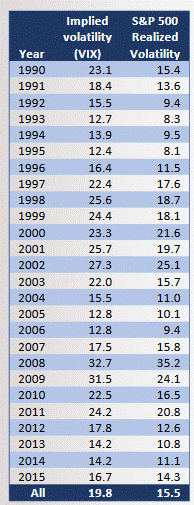
First, some words on volatility. Research shows that implied volatility in option pricing is bigger than the real volatility. Because volatility is one of the main determinants of the option price, we might argue that it pays off to sell puts (and not buy because the premium decays over time).
Oleg Bondarenko wrote a paper on how to sell put and its performance a few years back called An Analysis Of Index Option Writing With Monthly And Weekly Rollover. Despite the article’s relatively difficult headline, the results are quite interesting. Bondarenko’s research concluded that real volatility was 15% while the options’ implied volatility was a lot higher at 19.8%. The study covers 1990 until 2015: