
Are These Stock Profits During War Truly Justifiable? | (Historical Backtests During Conflicts)
How does war affect the stock market? Can we expect poor returns and increased volatility? Or is it a good time to buy when you hear the sound of cannons?
Perhaps counterintuitive, history suggests that stock markets show less volatility during wars and geopolitical conflicts, and Nathan Rothschild’s famous quote “buy to the sound of cannons, sell to the sound of trumpets” might be somewhat true. US stocks have performed reasonably well during wars. However, wars on home soil might change the picture dramatically.
That you should buy to the sound of cannons might come as a surprise for many because a war normally has immense uncertainty about the outcome – defeat or win. Uncertainty is what the stock market dislikes the most! Let’s look at some evidence from the past:
Stock market performance during wars
Buy to the sound of cannons, sell to the sound of trumpets.
The above quote, presumably said by the famous banker Nathan Rothschild, is repeatedly quoted when a new conflict pops up. Is it any truth in it? Let’s start by finding out how stocks have performed during conflicts and war. We use the US stock market as a proxy because the US has long datasets. However, keep in mind that the US has not had a war on home soil for a very long time. Luckily, many have researched the performance before.
For example, LPL Research conducted a thorough backtest in 2020:
Trading Rules
[am4show have=’p2;p3;p58;p59;p130;p138;’ user_error=’Premium Post Access’ guest_error=’Premium Posts’]
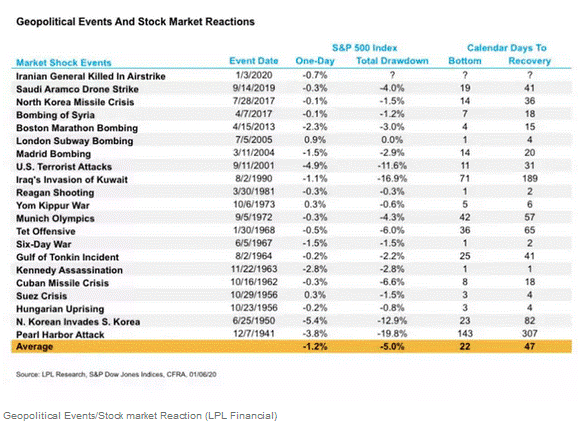
The table measures the performance from the day the conflict started or became public knowledge. As you can see, the drawdown is probably a lot less than you would imagine. The second column to the right indicates that the bottom happen not long after the conflict started. Likewise, the days to recovery have always been less than a year (recovery is the same level when the conflict started). This is an indication it might be a good idea to buy not long after you hear the sound of cannons.
[/am4show]
How does war affect the stock market? WW2
The famous stock market strategist Barton Biggs wrote a book in 2008 called Wealth, War & Wisdom. In the book Biggs published a very interesting chart showing the performance of Dow Jones during WW2:

When the first bombs landed at Pearl Harbor, the stock market initially fell almost 20%. However, the setback was temporary as the bottom was set just a few months after the Japanese attack. Before the end of the war, the Dow Jones rose over 60% before the Germans and the Japanese surrendered (in real returns). If we look at the S&P 500 we find these monthly returns from 1941 to the end of 1945 (S&P 500 didn’t exist at the time but it has been constructed retrospectively):

For clarification: The US joined the war in December 1941. Prior to this, the stock market had a drawdown, probably in anticipation of the US being dragged into the conflict, but clearly had a solid performance in 1942 and the first half of 1943. The source is officialdata.org. Let’s look at another anecdotal evidence: the Iraqi invasion of Kuwait on the 2nd of August 1990:
