
AAII and Market Sentiment Indicators – Trading Strategies with Index and Backtests
Can you make money on a bullish or bearish AAII market sentiment indicator? When the pessimists turn optimistic and the optimists turn pessimistic, a bottom or top is formed. If you understand market sentiment and where traders and investors feel the most pain or euphoria, you have gained a wealth of knowledge about potential turning points. Reading the aggregate market mood can be very valuable and profitable. What are market sentiment indicators and how can you trade them?
You can trade on market sentiment indicators by using the AAII sentiment index. When the AAII index is very bullish, you can expect mediocre or below-average returns in the next four weeks. When the AAII index is very bearish, you can expect above-average returns over the next four weeks. That said, we believe there are better ways and indicators to trade the market.
Let’s get going, and we start with the basics by explaining what market sentiment is:
What is market sentiment?
Let’s first start by explaining how we define market sentiment:
Market sentiment refers to the attitude of the players in the market. Are they bullish, neutral, or bearish? We can argue that market sentiment measures the aggregate mood of investors and traders.
Benjamin Graham made a fantastic analogy of the market in his legendary book called The Intelligent Investor, a book we recommend whether you are a trader or a long-term investor. Benjamin Graham refers to the sum of the market as Mr. Market. Graham argues that Mr. Market is manic-depressive. Sometimes he is in a good mood, and sometimes he is in a bad mood. It swings back and forth between these two levels all the time.
Market sentiment is crowd psychology. When the overall market is bearish, we have a bearish market sentiment, and vice versa.
What is a sentiment indicator?
A sentiment indicator is an indicator that measures the sentiment of Mr. Market. Is Mr. Market bullish, neutral, or bearish? The sentiment indicator is an oscillating indicator that goes up and down.
What are the most used sentiment indicators?
To our knowledge, the AAII sentiment index is both the most used and referred to. This is the sentiment indicator we have used in our backtests below. Another popular sentiment indicator is the Investors Intelligence Bulls & Bears.
However, we might argue the VIX indicator is also a sentiment indicator, and the VIX is, of course, both more known and used.
We can also argue that stocks hitting 52 weeks high and low can be used as a market sentiment indicator, but it might as well shows the market breadth (please read our article on the Zweig Breadth Thrust Indicator. Market breadth trading strategies are working).
How do you calculate a market sentiment indicator?
Now that you understand that a sentiment indicator is a measure of the overall mood of Mr. Market, you might wonder how we can calculate an intangible thing like mood.
There are no shortcuts, and asking participants is the only way to find out the mood. To show you how it’s done, we use a specific market sentiment indicator called the AAII index:
AAII market sentiment index
One of the most used and referred sentiment indicators is the AAII index. We’ll use this index in the rest of the article in our backtests.
AAII is an abbreviation of the American Association of Individual Investors. Once a week since the 1980s, the AAII has published a survey showing how the members view the future prospects of the stock market. The question AAII ask is simple:
What direction do AAII members feel the stock market will be in the next 6 months?
Here is a screenshot from their homepage:
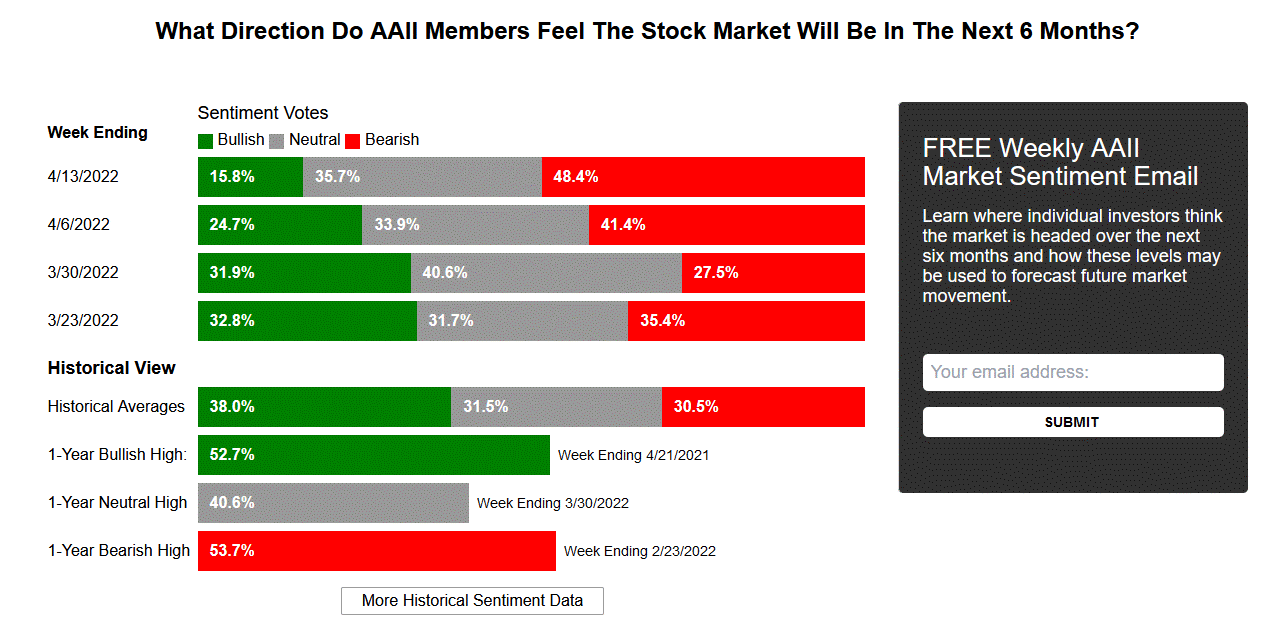
If you are a member, you log in and vote for your “feel” of where the stock market will be in 6 months.
This is all there is to it.
Why would a market sentiment indicator work?
You might ask yourself why a market sentiment indicator should work. The logic behind the market sentiment is easy:
When the market sentiment is very bullish, we can expect most market participants to have already positioned themselves for a further rise in the market price. Thus, will anyone be left to drive the prices higher when the majority already have bought?
Opposite, when the market participants are very bearish, we must expect them to have sold or even be short-selling the market. When most players already have that view, what will it take for the market to turn around? Most likely, very little. Any slight positive news might make the bearish traders flip and buy.
As you can imagine, the mood of Mr. Market is a constant battle between those bearish and bullish. If the pendulum goes from very bullish to bearish, players sell their positions and force prices down.