
Shareholder Yield – Advanced Dividend Investing
What is shareholder yield?
Shareholder yield is a form of dividend investing but we add two other variables to the mix: buyback yield and debt reduction.
The famous money manager Meb Faber defines shareholder yield like this:
Shareholder yield is the sum of the dividend yield + percentage of shares bought back + the debt repaid yield. According to Meb Faber’s research, this has produced much better returns than most, if not all, dividend investing strategies, according to his backtests.
What is shareholder yield?
Paying a dividend is just one of several ways that the management and board can return profits back to shareholders.
For example, buybacks are one other method of handing back capital to shareholders and “rewarding” them.
Paying down debt is also some form of returning capital to shareholders, according to Faber, because you increase the intangible and tangible values of the company, although it’s a much subtler way of “rewarding shareholders”. Faber went on to define these three methods of rewarding shareholders as shareholder yield.
Hence, shareholder yield is the total amount spent on dividends, share repurchases, and paid back debt. It’s not as easy to calculate as the dividend yield, but still fairly easy, in our opinion.
However, most backtests don’t include debt reduction because it’s slightly more complicated to find and calculate than dividend and buyback yields.
Why add buyback yield?
Faber argued that dividend yield looks at only one method of rewarding shareholders.
Meb Faber suggested a more “holistic” version that also looked at buybacks and the reduction of debt. Why include more factors when dividend stocks have outperformed?
If you limit yourself to only dividend investing and dividend stocks, you are likely to overlook a lot of other factors that might be highly relevant.
For example, Berkshire Hathaway, Facebook, and Google have been exceptional good investments, yet they have never paid a dividend (except once in the 1960s when Warren Buffett remarkably agreed to pay a small dividend – the first and last time).
Berkshire has been a fantastic investment precisely because it doesn’t pay a dividend! Berkshire has been able to reinvest earnings at very high returns, and hence it doesn’t make sense to pay a dividend unless you are a better investor than Warren Buffett (and you are likely not). We have explained the pros and cons of dividend investing in separate articles.
A backtest of shareholder yield:
The money manager Jim O’Shaughnessy backtested the shareholder yield strategy in an article called 7 Traits For Investing Greatness published in 2017. The results were really impressive:
During all the 3-year rolling returns periods, the top 10% shareholder yield companies beat large caps 81% of the time with an average outperformance of 3.24% annually. That is a massive outperformance! Over any 10-year rolling period the shareholder yield portfolio outperformed 97% of the time.
For example, 100 000 invested returning 10% annually is worth 672 000 after 20 years. But with 13.24% the value is 1.2 million after 20 years. Twice as much!
Shareholder yield ETF
Meb Faber and his Cambria Investments manage an ETF based on shareholder yield. The ticker code is SYLD.
How has the fund performed? The last five years show the following returns:
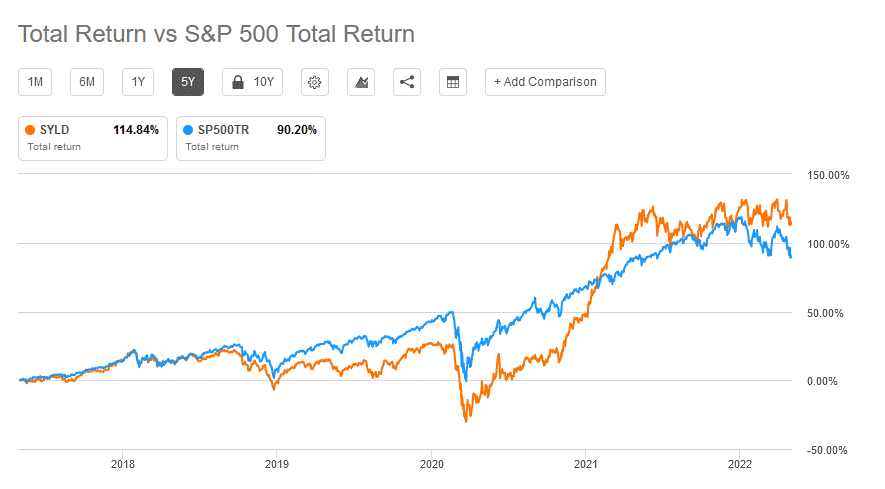
Conclusions:
In many ways, shareholder yield is a bit more logical and intuitive than dividend investing. The drawback is that shareholder yield is a bit more complex to backtest. However, most data providers give you easy access to the numbers you get so you can scan the market for shareholder yield yourself.