
The Easter Holiday Effect in Trading (Holy Thursday – Is It The Best Day Of The Year For Stocks?)
Easter is a Christian holiday celebrated across the world. But does it affect trading on the U.S. stock exchanges and other financial markets? We look at how the stock market performs before and after the Easter holiday. Additionally, we specifically look at the performance of stocks the day before Good Friday – Holy Thursday.
Easter is a Christian holiday celebrated on a Sunday. It is not a federal holiday in the US, so no weekday is marked to observe the holiday. As such, it does not affect trading on the weekday before or after it (except for Good Friday which is a non-trading day). The Easter Holiday week is very positive while the week after Good Friday performs more or less like any random week. Holy Thursday, the day before Good Friday, is an exceptionally strong day for stocks.
Let’s look at how the S&P 500 performs before and after the Easter holiday:
The Easter holiday
Easter is a Christian holiday that celebrates the belief in the resurrection of Jesus Christ, the founder of the Christian religion. The holiday concludes the commemoration of “the Passion of Jesus Christ” — a series of events and celebrations that begins with Lent (a 40-day period of fasting, prayer, and sacrifice) and ends with Holy Week, which includes Good Friday (the day Jesus died) and Easter Sunday.
While Good Friday is a federal holiday in the US, Easter is not. Easter is celebrated on that Easter Sunday by Christians who observe it, but no weekday is set aside for its observance.
When is it?
Easter is celebrated on the first Sunday following the Paschal Full Moon that occurs on or just after the ecclesiastical spring equinox — March 21. Easter 2022 took place on Sunday, April 17, 2022. The Easter holiday of 2023 will be on Sunday, April 9, 2023.
Is the day before or after it a trading day?
Easter is a Christian holiday celebrated on a Sunday. It is not a federal holiday in the US, so no weekday is marked to observe the holiday. As such, the day after it, Easter Monday, is a trading day.
However, the weekday before it is the Good Friday, which is a federal holiday in the US and, therefore, not a trading day.
What is Holy Thursday?
Holy Thursday, also called Maundy Thursday, is a Christian observance day in the United States and also a public holiday in a few protestant countries, like Norway for example. In the US this is a trading day and a very good one for that.
Backtesting the Holy Thursday strategy
Let’s first backtest the day before Good Friday: Holy Thursday. Our backtest is really simple:
We buy at the close of the Wednesday before Holy Thursday and sell at the close on Holy Thursday. This is all there is to it! We use the S&P 500 as a proxy for the stock market.
The equity curve since 1960 looks like this:
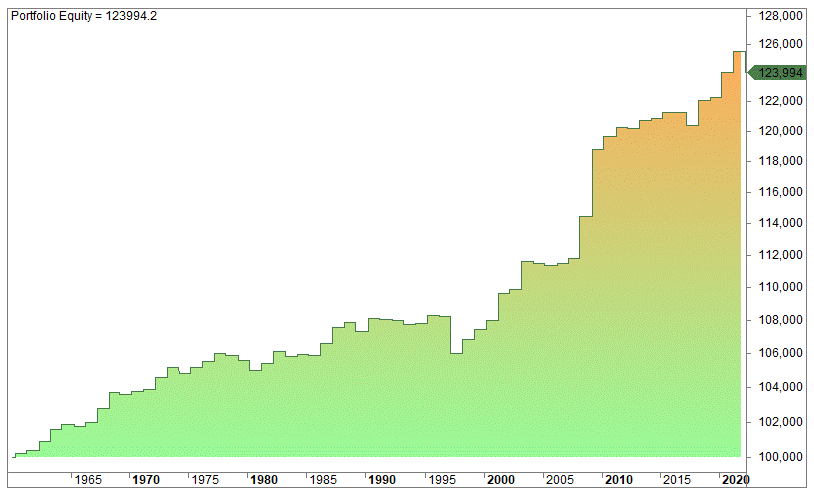
There are 63 trades (once per year), the average gain per trade is 0.35%, the win rate is 68%, the profit factor is 4.1, and the max drawdown is a tiny 2%. These are pretty good trading metrics! We would assume that Holy Thursday is one of the best trading days of the year.
Let’s also backtest if we buy at the close on Wednesday and sell at the open on Holy Thursday. We don’t have opening quotes before 1993 and thus test from 1993: