
Short Squeeze Trading Strategy (Backtest, Setup, Rules and Example)
There are times when the prices of stocks move as a result of what other investors are doing rather than based on the company’s underlying business fundamentals. One such event is the short squeeze.
A short squeeze happens when there is a high volume of short positions (betting that the stock would decline), but instead, the stock’s price shoots up, forcing the short sellers to exit their positions by buying back the shares, which in turn causes the price to jump higher. A short squeeze can make the price of a relatively unknown stock skyrocket over a short period. Backtests reveal that short squeezes are rare and it’s very difficult to find any short squeeze strategy.
Want to learn more about short squeezes, keep reading!
What is a short squeeze?
I signed my first client and proceeded to short my first stock. It almost proved to be my last. Over the next few weeks, I watched the stock trade up to 20, then 30, then 40, finally breaking through 50…..But when the stock climbed past 50, I started to cover, unable to stand the pain. It was too late, however, a major bear squeeze was on. I covered the last of my position between 90 and 95. I lost the entire initial $25 000 stake plus $50 000 more…..A month after we closed out our position, RH Doe declared bankruptcy. One day, shortly after the Hoe debacle, I was moping along Broadway when I ran into Wilton (“Wink”) Jaffee, and old Wall Street hand and a veteran of many campaigns. As we talked, I blurted out something about “The biggest boom and bust cycle I’ve ever seen in a stock was in Hoe”. Wink replied with a chuckle, “Oh yeah, we had some fun squeezing the shorts on that one. Really took some of those midwestern hayseeds to the cleaners.”
– Victor Niederhoffer, The Education of A Speculator, page 267-268.
A short squeeze is when a heavily shorted stock’s price goes up instead of down, forcing the short seller to exit their positions by buying back the shares at the new higher price so they can return the borrowed stocks, thereby enduring heavy losses. Thus, short sellers add fuel to the fire and make short squeezes extremely painful for those short. That said, these painful moves are, in general, pretty rare.
Short squeezes can make short sellers lose a lot of money on their trades because unlike price declines, which are capped when the share price reaches $0, price advances theoretically have no limits.
Short squeeze example
Let’s say some investors believe that stock XYZ is overvalued at its current share price of $50, and they borrow other’s shares of the stock and sell (short selling), with the hope that the share price would drop to say $30. However, instead of the share price dropping, it rises to $65 and keeps rising, probably following a better-than-expected earnings report.
Since the short sellers would have to return those borrowed shares to the lenders, they would need to buy back the shares at a higher price. Assuming there are many short sellers who want to buy back shares before they lose even more money as the stock rises, they would have to compete with each other in a sense, because others are also clamoring to get rid of their stock.
It’s kind of a FOMO effect. This scramble to buy the stock further pushes the share price up, and there’s no fundamental limit to how high the stock could climb as brokers initiate margin calls forcing shorts to buy to cover.
Here is a short squeeze example in Gamestop (GME):
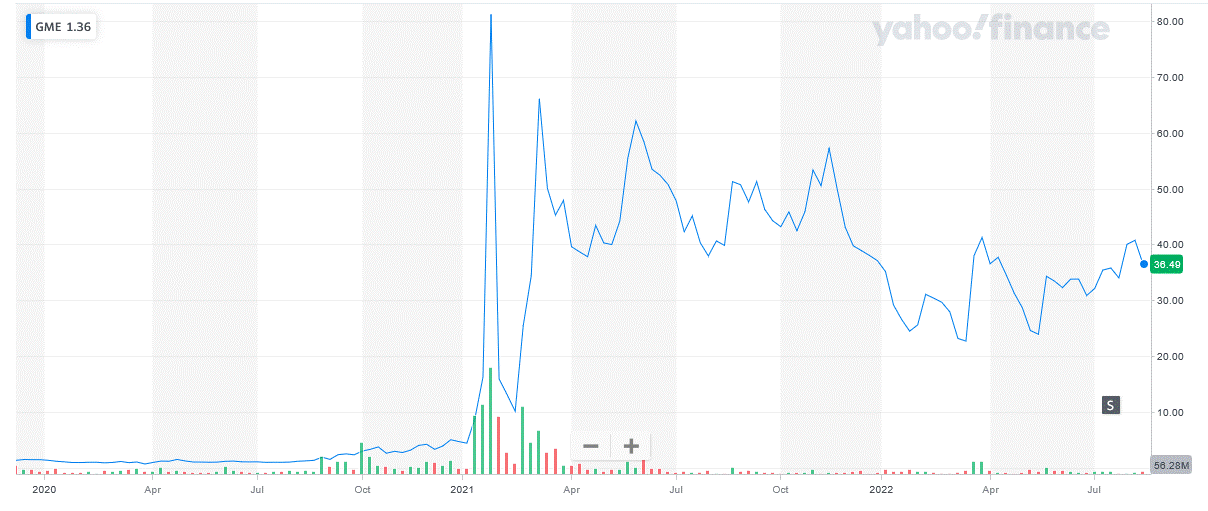
In