
Wyckoff Trading Strategy — What Is It? (Backtest Results)
As a trader or investor, you want to know the best ways to pick winning stocks, the most advantageous times to buy them, and the most effective risk management techniques to use. This is where the Wyckoff trading strategy comes in.
The Wyckoff strategy is a series of market classification, rules, and methodology developed by the legendary technical analyst, Richard Wyckoff, which investors can use to determine what stocks to buy and when to buy them. It consists of the Wyckoff market cycle, Wyckoff’s laws, and the Wyckoff Method.
To learn the Wyckoff method to stock trading, read on! After we explain the Wyckoff strategy, we make a backtest to see if the theory works in practice.
What is the Wyckoff trading strategy?
In the early decades of the 20th century, Richard Wyckoff, a renowned market technician, wrote about financial markets, documenting his observations on price action. His pioneering approach to technical analysis survived into the modern era and is now known as the Wyckoff strategy.
The Wyckoff trading strategy is a series of market classification, rules, and methodology developed by the legendary technical analyst, Richard Wyckoff, which investors can use to determine what stocks to buy and when to buy them. His technical analysis approach has been distilled into the following elements:
Wyckoff’s price cycle
The Wyckoff market cycle is the most popular element of the Wyckoff trading strategy.
It’s based on Wyckoff’s observations of supply and demand. It explains how and why stocks and other securities move and the significance of price within the broad spectrum of uptrends, downtrends, and sideways markets.
The price cycle shows that the market moves in a cyclical pattern of four distinct phases — accumulation, markup, distribution, and markdown.
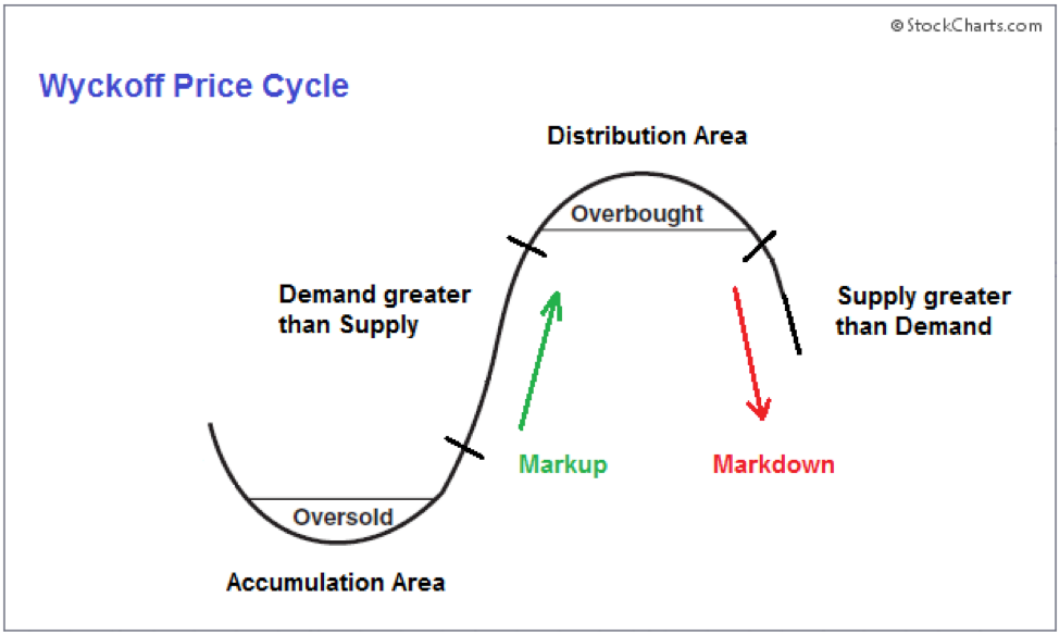
In essence, the phases represent the behavior of traders and can reveal the direction of a stock’s future price movement. Investors and traders use Wyckoff’s market cycle to identify a market’s direction, the likelihood of a reversal, and when large investors are accumulating and selling positions.
Here are the four phases in detail:
- Accumulation phase: The market cycle begins with an accumulation phase. Here the price is in a trading range, as institutional investors are quietly accumulating long positions in the stock. With time, they increase their buying and drive demand, and as more interest develops, the trading range displays higher lows as prices position themselves to move higher. Eventually, the price pushes through the upper level of the trading range.
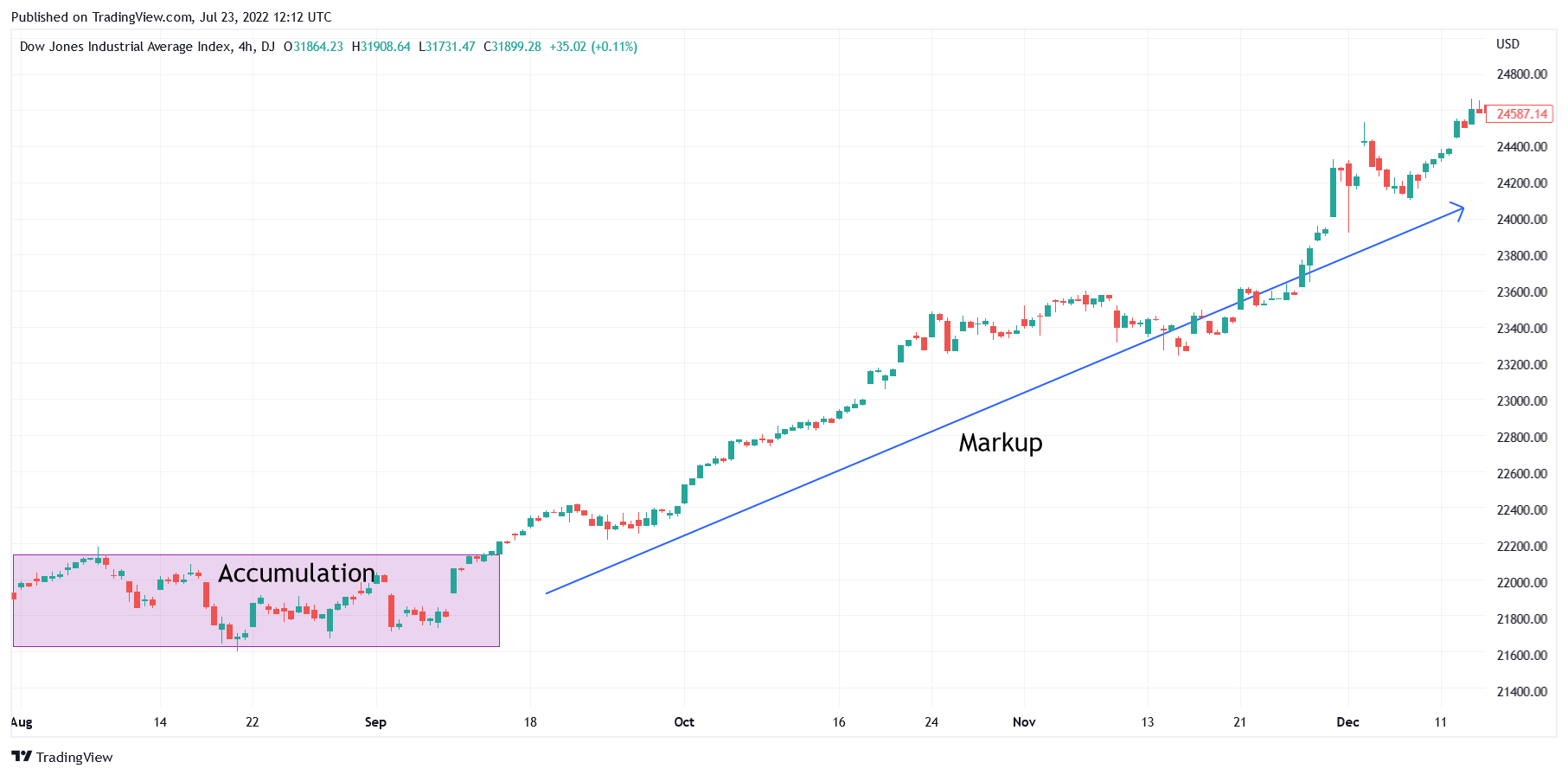
- Markup phase (uptrend): After breaking out of the trading range that characterizes the accumulation phase, the price shows a consistent upward trend, which is known as the markup phase. In this phase, pullbacks to new support offer buying opportunities that Wyckoff calls throwbacks (what investors now call buy-the-dip). Small re-accumulation phases interrupt markup. These are price consolidation patterns within an uptrend. There are also steeper pullbacks which Wyckoff calls corrections. The markup phase continues with upswings and corrections/consolidations until the price fails to generate new highs.
- Distribution phase: The failure to generate new highs signals the start of the distribution phase, which is characterized by a range bound price action similar to the accumulation phase. It is a period when smart money is taking profits and heading to the sidelines. With sellers eventually gaining the upper hand, the horizontal trading range in this phase will display lower price tops and a lack of higher bottoms. This leaves the security in weak hands that are forced to sell when the range fails in a breakdown that begins a new markdown phase.
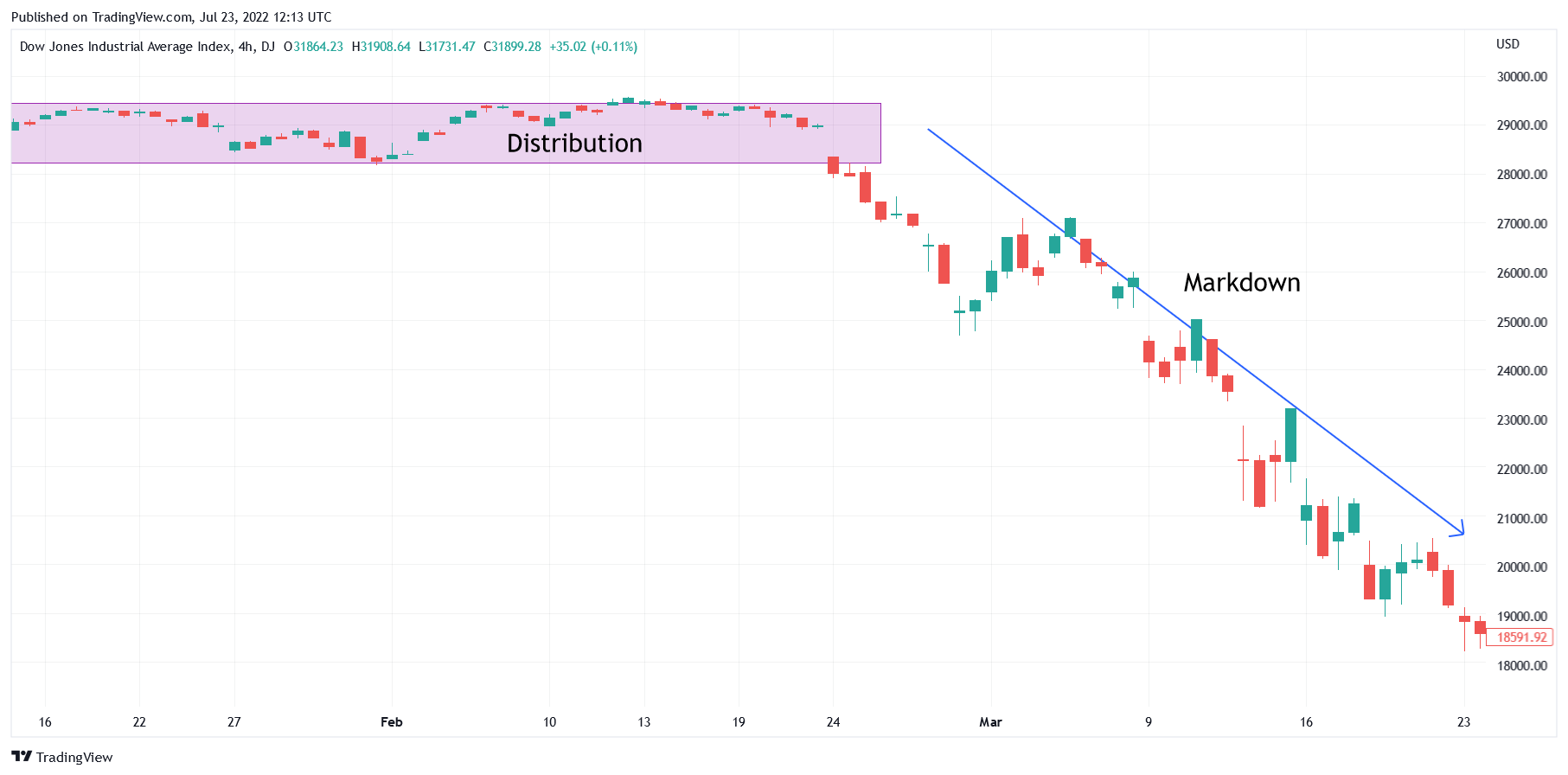
- Markdown phase (Downtrend): The markdown phase is a time of greater selling, which drives the price lower. This bearish period generates throwbacks to new resistance that can be used to establish timely short sales. Wyckoff calls steep small rallies within the markdown phase corrections, using the same terminology as the uptrend phase. There are also small consolidations or redistribution segments, where the trend pauses while the security attracts a new set of positions that will eventually get sold. The markdown phase finally ends when a broad trading range or base signals the start of a new accumulation phase — the beginning of a new cycle.
Wyckoff’s laws
Wyckoff’s market cycle and his chart-based trading method are based on three fundamental “laws” that govern many aspects of his analysis, such as determining the market’s and individual stocks’ current and potential future directional bias, selecting the best stocks to trade long or short, identifying the readiness of a stock to leave a trading range and projecting price targets in a trend from a stock’s behavior in a trading range. Let’s take a look at each of those laws:
1. The law of supply and demand
This principle is central to Wyckoff’s method of trading and investing, as it determines the pri