Australian Trading Strategies – Formulation, Backtest, and Performance Assessment
As the world has become more connected online and many regions are opening up their financial markets to the global investing community, diversifying your investment portfolio into other economies has never been easier. The Australian market is a simple choice for portfolio diversification. Can we make profitable Australian trading strategies?
Yes, backtesting reveals a few very profitable Australian trading strategies. Let’s show you the trading rules.
There are several ways to gain access to Australian financial markets. The most common ways are through exchange-traded funds (ETFs) that track the Australian market and the American Depository Receipts which trade on the OTC markets and can easily be purchased through a broker. You can also buy Australian stocks directly through international brokers such as Interactive Brokers. If you just want to speculate, you can trade stock CFDs via an Australian CFD broker that offers the instrument.
In this post, we take a look at Australian trading strategies. We end the article with several backtests. We use the US-traded ETF EWA as a proxy for the Australian stock market.
Also, if you want access to free profitable short term trading strategies, you might want to check out that clickable link. We have hundreds of strategies with specific trading rules and backtests.
How can you trade Australian markets?
Diversifying portfolios into different industries and sectors in one’s native stock market is a strategy shrewd investors use nowadays. Exposure to global markets lowers risk, and the Australian market gives investors access to some of the world’s most distinctive mining companies. The country’s abundant mineral and energy resources also make its equities markets a stand-in for the cycles of the world’s commodities.
Thanks to financial market deregulation and online trading platforms, you can readily access the Australian market. The four typical methods are as follows:
- Exchange-traded funds (ETFs): Purchasing ETFs that track the Australian stock market indexes is one of the simplest methods to invest in the Australian market. Such ETFs invest in equities of businesses that have their headquarters or conduct a substantial portion of their operations in Australia. ETFs that track Australian market indexes offer an already diversified portfolio. Investing in such index ETFs is much cheaper than trying to build your own portfolio of Australian stocks.
- Depository Receipts: Purchasing depository receipts of Australian stocks from a major bank in your home nation is another simple option to invest in the Australian market. A depositary receipt (DR) is a physical certificate that a bank issues to represent shares of a foreign corporation that are traded on a domestic stock exchange. The depositary receipt offers an alternative to trading on an international market and enables you to hold equity in other nations. One of the most popular kinds of DRs is the American depositary receipt (ADR), which offers businesses, investors, and traders opportunities to invest in international markets. If you reside in the US, you can simply purchase an ADR of any Australian stock of choice from the OTC marketplace through your broker. In this article, we use the ETF with the ticker code EWA. It’s liquid, has a history back to 1996, and is thus suitable for backtesting.
- Directly trading the stocks: Another option is to directly buy Australian stocks. Although it is more challenging than buying ADRs, you can buy and sell stocks directly on a few international stock exchanges thanks to the particular services offered by a number of online brokerages. Interactive Brokers is one broker that provides access to the majority of stock exchanges worldwide. There may be other brokers, such as TradeStation and E*Trade. Ask your broker about direct access to Australian equities if you are interested in that market; you may be surprised they offer them.
- Australian stock CFDs: While this is not usually recommended, it is a good option for speculation purposes. You can trade Australian stock CFDs via a CFD broker, such as IG, eToro, and so on; an Australian CFD broker, such as Fusion Markets, is more likely to offer Australian stock CFDs than other ones. If your interest is just to gain from price movements rather than own the underlying stocks, explore this option. It is best used for short-term trading and speculation, not investing, as it does not offer you the ability to own the asset. Always keep in the back of your mind that the majority of CFD traders lose money.
Australian trading strategies backtest (strategy)
Backtests are a great way to assess the risk associated with a particular strategy and identify potential opportunities for increased profitability. By using the backtest tool, traders can develop more informed and profitable strategies for their portfolios. Backtesting trading strategies is the best tool for making informed investment decisions, although it’s far from perfect.
With that said, let’s look at some specific Australian trading strategies for stocks by using the ETF with the ticker code EWA:
First, the Australian market has much more exposure to commodities than most markets, like Canada and Norway. This makes these markets slightly different and sometimes harder to trade than the US stock market.
Let’s show you an example of the difference by using the following trading rules:
Trading Rules
[am4show have=’p2;p3;p58;p59;p130;p138;’ user_error=’Premium Post Access’ guest_error=’Premium Posts’]
- We buy when the 2-day RSI drops below 10, and
- We sell when the 2-day RSI rises above 70.
[/am4show]
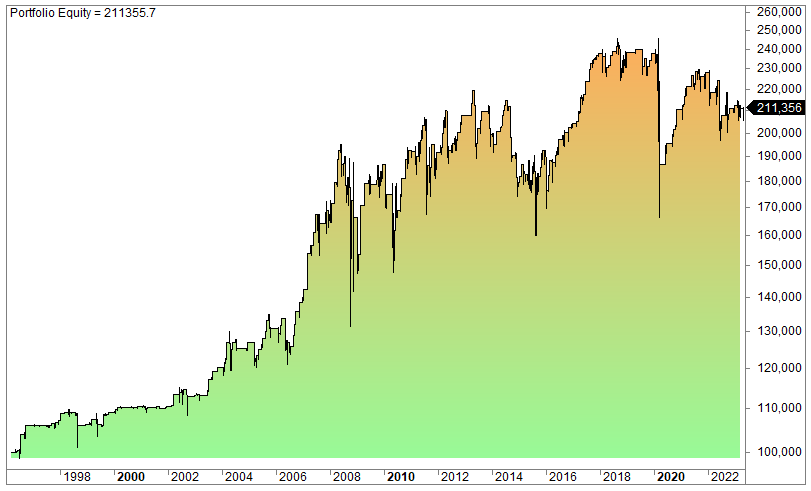
Pretty simple, and we get the following equity curve for EWA: