
Valentine’s Day Rally: Romance’s Impact on Stock Prices
The Valentine’s Day rally is an annual event in which stock prices tend to increase in anticipation of the romantic holiday. The rally has been studied extensively by investors and economists alike, with a variety of conclusions drawn from the data. Is there a Valentine’s Day Rally in stocks?
Yes, the evidence seems to confirm that stocks show abnormal returns in the days leading up to Valentine’s day. Our backtests indicate that S&P 500 rises at least twice the return compared to any random day.
Let’s dig a little deeper:
What is Valentine’s Day?
Valentine’s Day is an annual holiday celebrated on February 14th. It is a day to express love and appreciation for loved ones, typically through giving cards, flowers, chocolates, or other gifts.
Valentine’s Day is also known as Saint Valentine’s Day or the Feast of Saint Valentine. It is a celebration of romance and love, and is believed to have originated from the ancient Roman festival of Lupercalia.
The day is now celebrated in many countries around the world, although the way it is celebrated varies depending on the culture.
Valentine’s Day is not a holiday
Valentine’s Day is not a public holiday. All markets are open.
Is there a Valentine’s Day rally or effect?
Academic research argues there is a strong Valentine’s Day rally in stock markets all over the world.
Some believe that the rally is simply a result of investors buying in anticipation of a positive sentiment in the markets, while others suggest that there is a more fundamental impact of romance on stock prices.
The first evidence of the Valentine’s Day rally dates back to the early 1900s, when the stock market experienced a surge in activity around February 14th. The rally was attributed to a variety of factors, including an increase in consumer spending in anticipation of the holiday, and a general feeling of optimism in the markets.
Since then, the rally has been a recurring phenomenon in the markets, with prices tending to rise in the days leading up to Valentine’s Day.
Is it any rational explanation for this rally?
One explanation for the rally is the “romantic” sentiment that is associated with Valentine’s Day. Investors tend to be more optimistic and willing to take risks when in a happy and romantic mood, which could lead to higher stock prices.
The holiday could also be associated with increased consumer spending, leading to higher corporate profits and, in turn, higher stock prices.
On the other hand, some critics have argued that the Valentine’s Day rally is simply a result of investors buying in anticipation of positive market sentiment. This argument suggests that investors are simply buying into the hype surrounding the holiday and that romance has no real fundamental impact on stock prices.
Overall, there is still much debate surrounding the Valentine’s Day rally and its potential impact on the markets. Ultimately, more research is needed to fully understand the implications of the Valentine’s Day rally and its impact on stock prices.
Valentine’s Day rally backtest
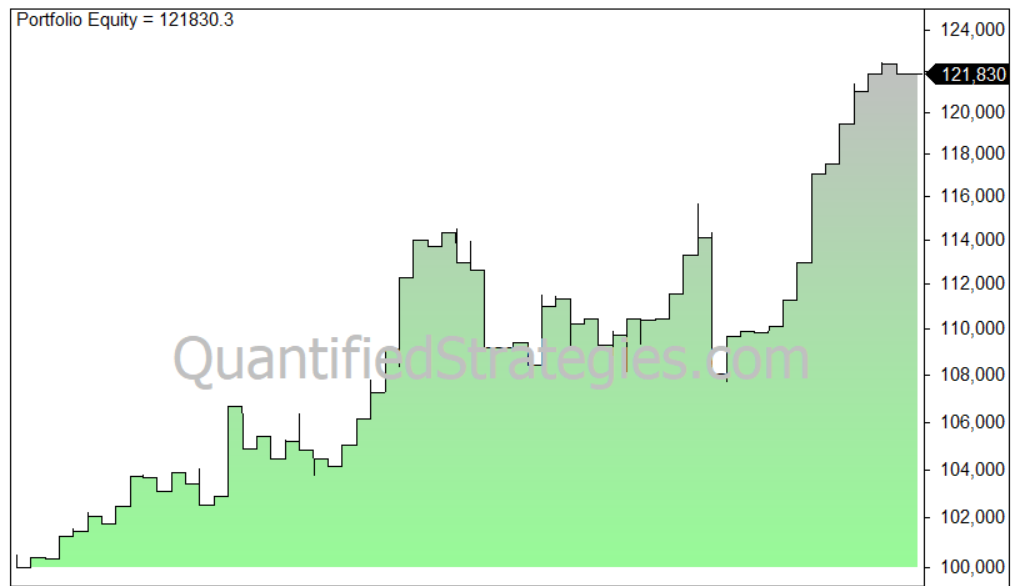
The research concludes that the effect starts a few days before February 14th. We make the following trading rules:
- The month is February.
- We buy at the close on the tenth calendar day (or later if a non-trading day).
- We sell at the close on the 14th of February or the next trading day.
Let’s look at the statistics and trading metrics. We start with the equity curve of S&P 500 from 1960 until today:
The trades returned