
Ramadan Holiday Trading Strategy (Anomaly Backtest Findings)
Holiday effects (or as they are also known calendar effects) are very well-known anomalies in trading. Around these dates, like the 4th of July or Thanksgiving, for example, the market tends to perform better over a short period of time. This can be for several reasons, such as low liquidity or lack of macro news.
Ramadan is one of the most celebrated religious holidays in the world. It is a Muslim holiday that can last an entire month. So a question arises: Do stocks perform better during Ramadan? We present a Ramadan trading strategy in this article.
In this article, we will be looking at what Ramadan is, backtesting a trading strategy on the S&P 500, and comparing it to other ETFs of Muslim countries.
What is the Ramadan holiday?
Ramadan is a Muslim holiday in the ninth month of the Muslim calendar where they celebrate the revelation of the Quran to Prophet Muhammad. It involves fasting including water from dawn upon sunset, praying, and gathering with family members and friends for celebration at night.
Although both Sunni and Shia celebrate Ramadan, there are differences such as when it starts and ends. Sunni Muslims follow the lunar calendar to determine the beginning and end of Ramadan, whereas Shia Muslims follow the sighting of the moon in their local area. For this article, we will follow the lunar calendar like the Sunnis.
Countries such as Saudi Arabia, Turkey, and Egypt are among many that celebrate this holiday. It is estimated that around 1.9 billion people celebrate this holiday worldwide.
Ramadan trading strategy – trading rules
The strategy is pretty simple: we buy and hold the S&P 500 when Ramadan starts, and we sell it when it ends.
Remember that Ramadan is in the ninth month of the Muslim calendar, so the dates change every year in the Gregorian calendar. For example, in 2022, Ramadan started on the 1st of April and finished on the 1st of May, while in 2023, it started on the 22nd of March and will end the 21st of April.
If Ramadan started or ended on the weekend, we buy or sell the S&P 500 the following trading day. This means that if Ramadan started on Sunday, we would buy the S&P 500 on Monday.
Ramadan trading strategy backtest – does it work?
For the backtest, we use the SPY ETF since its inception in 1993. The data is adjusted for dividends and splits. Here is the equity curve:
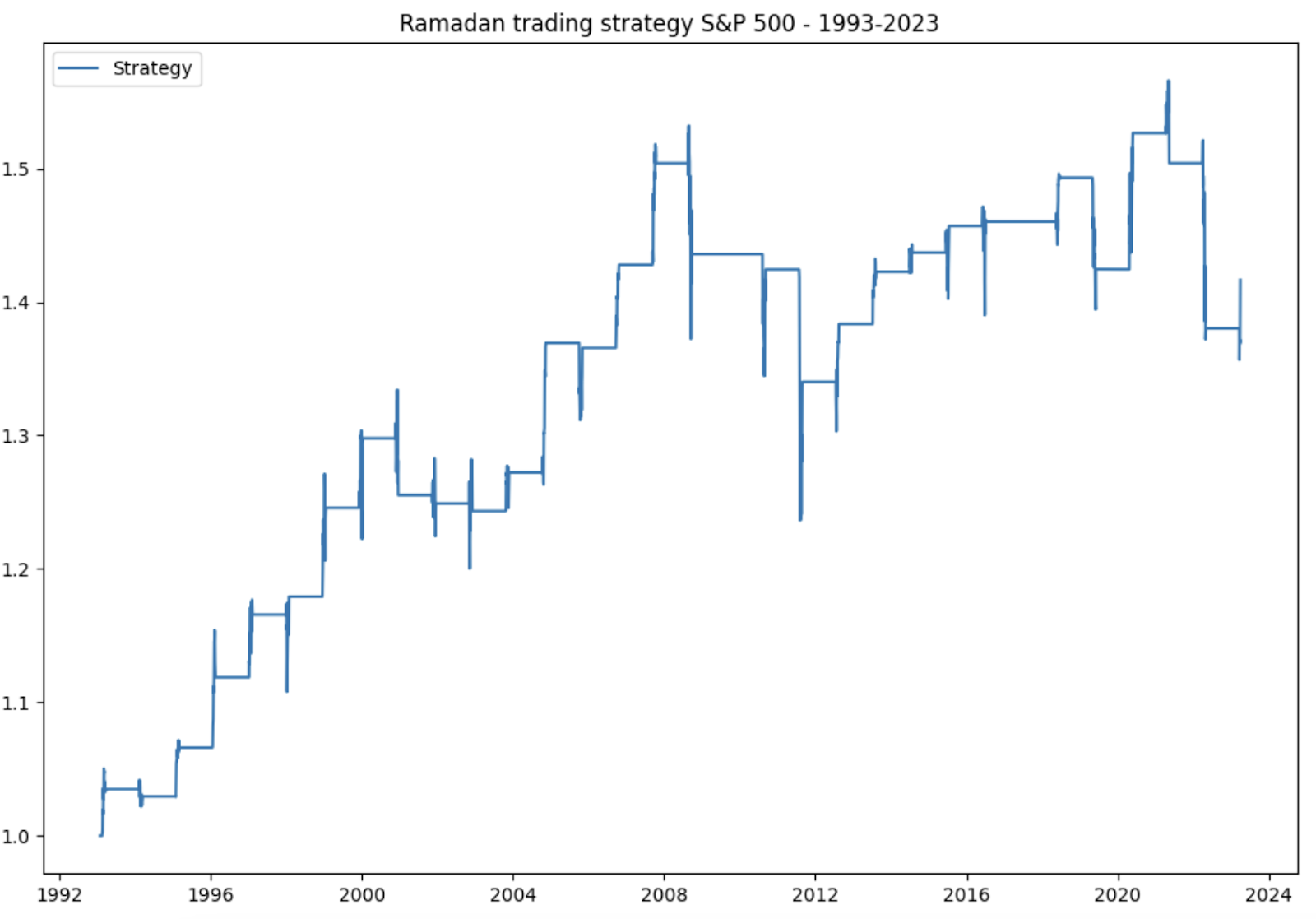
The returns look decent, but not spectacular. Here are the