
Market Timing Strategies | (Setups, Regime Filters & Backtest)
What are Market Timing Strategies? Plenty of investors try to time the market. Most are unsuccessful due to a number of reasons. Thus, most investors should not time the market. However, most of the failures can be attributed to a few reasons. In this article, we look at some elements that we believe are required for successful market timing.
At the end of the article, we give you several market timing systems and strategies we have backtested that can be used for aspiring market timers. (and work well).
What is a timing model?
Market timing involves attempting to predict the future movement of an asset. However, predicting the future can be challenging to do accurately and is subject to many subjective factors.
To avoid this problem, we prefer timing models that are built using quantitative methods to make trading more mechanical and less discretionary. The rules for buying and selling are based on previously specified criteria, and personal opinions and predictions are not included in the model (obviously). We have written about this before:
- Mechanical Trading Strategies Vs. Discretionary Trading Strategies
- Mechanical Trading Strategies – Advantages with Mechanical Rules and Edges
The key to successfully trading a timing model is to closely follow the system and your strategy, assuming you have e a proper backtested market timing system. Even if you have an outstanding timing model, it will be useless unless you commit your money and follow ALL the signals. You don’t know beforehand which signal will be good or bad. Unfortunately, many abandon or override their system sooner or later, primarily due to biases.
Giving the model enough time to work is essential to achieve the best results. Short-term fluctuations can be unpredictable, so focusing on the long-term results of carefully chosen strategies/allocations and the model’s trading rules is crucial. If you stick to your plan and trading rules, you will likely be rewarded in the long run (again, assuming you have a valid strategy or system).
Let’s give you an example of a market timing system:
Market timing strategy example and backtest
An example of a market timing system is the 200-day moving average (a very simple system):
Trading Rules
[am4show have=’p2;p3;p58;p59;p130;p138;’ user_error=’Premium Post Access’ guest_error=’Premium Posts’]
When the price breaks above the average, you buy. When it breaks below the 200-day average, you sell.
[/am4show]
This strategy has performed well over many decades for stocks. Here is the return (log chart) of investing 100 000 in 1960 and reinvesting and compounding:
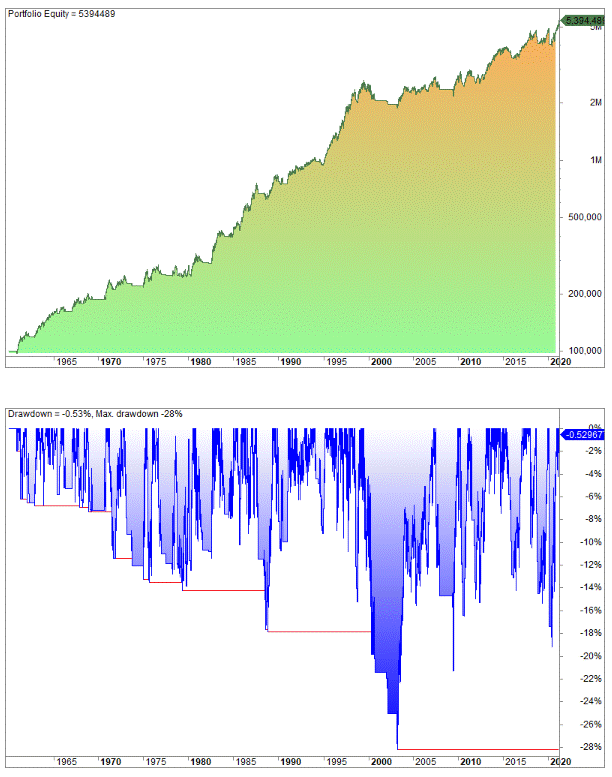
The 200-day moving average strategy has displayed decent results:
- There have been 187 trades since 1960.
- The Compound Annual Growth Rate (CAGR) is 6.7%, while the CAGR of buy and hold is 7.1% (excluding reinvested dividends).
- There is an average gain of 2.5% per trade.
- The maximum drawdown is 28%, compared to the 56% drawdown with buy and hold.
The 200-day moving average strategy has nearly kept pace with the S&P 500 while experiencing significantly lower drawdowns and spending significantly less time in the market. However, one potential drawback is encountering tax liabilities due to non-deferred capital gains.
Market timing Definition
First, let’s start with defining what market timing is all about: