
Bond MOVE Index and TLT Trading Strategy: Backtest Analysis
In 2022 the bond market experienced the worst drawdown in its history, and since then volatility has been off the charts. It seems like rates are moving like tech stocks did in 2000. Luckily, this can be seen through the volatility index of the bond market, the MOVE index.
The MOVE index is to the bond market what the VIX index is to the stock market. It measures the volatility of rates through the options market. But what we really want to know is: Is it useful to develop a profitable strategy to trade bonds?
In this article, we are going to see what the MOVE index is, how bonds perform when volatility is high and backtest a trading strategy using the MOVE index and long-term bonds.
Also, if you are looking for a profitable investment strategy, you might want to check out that link. We have hundreds of strategies with specific trading rules and backtests.
What is the MOVE index?
The MOVE Index measures U.S. interest rate volatility through the volatility implied by current prices of 1-month OTC options.
It is commonly referred to as the “VIX of the bond market”. It was created in 1998 by Merrill Lynch but acquired by Intercontinental Exchange (ICE) in 2019, along with a family of fixed income volatility indices. MOVE stands for “Merrill option volatility estimate”.
Recently, the MOVE index has risen dramatically amid the rapid increase in interest rates by the FED and banking crisis. It started the year at 120 and spiked to 199 in March. For context, the MOVE index all-time high was reached during October 2008 when the index touched the 264 level. Now it is trading at 118, while its average since 2000 has been around 85.
How does TLT perform when the MOVE index spikes?
Usually, when the VIX achieves highly unusual levels it is because the market is crashing, but it also signals that it may be a good time to buy to buy stocks.
- VIX strategies (video)
- 4 VIX trading strategies
- Using VIX To Trade SPY And The S&P 500
- WilliamsVixFix strategies
However, it is not quite the same with the MOVE index and bonds.
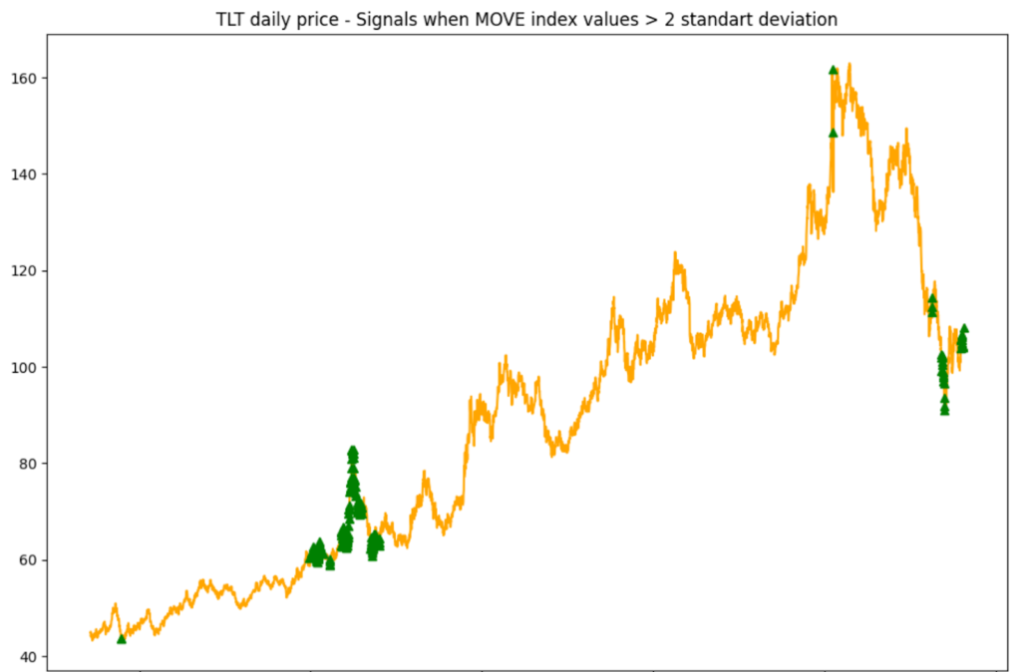
As you can see, when the MOVE index reaches high levels, measured as two times its standard deviation, it generally does not mean that it is a good time to buy bonds. Also, it generates very few signals.
This is the exact opposite of what happens with the VIX and the S&P 500, where high