
Robotics and AI Trading Strategies (BOTZ ETF Backtest – Rules, Settings Analysis)
The advent of Artificial Intelligence is here, and is forecast to combine with and revolutionize many industries in the years to come. One such combined industry is ‘Robotics and AI’, and traders are increasingly seeking ways to position themselves to make use of this trend as adoption rates of robotics and AI increase. What can we do, if we want to trade robotics and AI trading strategies?
In this article, we use optimization to find profitable robotics and AI trading strategies (for the AI industry).
Related reading: – Looking for a library of trading systems? (We have hundreds)
Global X Robotics and Artificial Intelligence ETF (BOTZ)
As of yet, there are few good trading vehicles available for traders wishing to participate in the robotics and AI industry. Trading the stocks of startup companies is possible, but these usually have a very short price history and are very volatile, making them unsuitable for trading and besides, most IPOs fail.
In order to find a viable trading edge, we need to find a way to trade the industry as a whole. This is where exchange-traded funds (ETFs) come into play. An ETF contains a variety of assets, and can thus track an entire industry by including many different assets from that industry.
The Global X Robotics & Artificial Intelligence ETF (ticker name BOTZ) is an ETF that invests in companies that stand to benefit from increased adoption of robotics and artificial intelligence.
The BOTZ ETF was founded in 2016. Contrary to many new robotics and AI startup companies, BOTZ now has enough price data and trading volume for us to start designing a functioning trading strategy around it.
Donchian Channels Strategy Overview
The BOTZ trading strategy in this article uses the indicator from our Donchian Channels article. We recommend you read that article for further details on the strategy itself.
Donchian Channels (DC) is normally a trend following indicator, with a length setting of 20 (for example). In this article, we experiment with using short-term settings that are more appropriate for the price fluctuations in BOTZ, turning it into something closer to a momentum indicator.
Exponential Moving Average (EMA)
The second component of our BOTZ trading strategy is to use an Exponential Moving Average to reduce the number of false signals we encounter. Our previous article on the EMA goes into details on its calculation and use cases.
In this article we experiment with various long-term settings, and use the EMA as a complement to filter bad trades from our short-term Donchian Channels strategy.
BOTZ Strategy Trading Rules
The trading logic and rules for the BOTZ Donchian Channel/EMA Strategy is as follows:
Trading Rules
[am4show have=’p2;p3;p58;p59;p130;p138;’ user_error=’Premium Post Access’ guest_error=’Premium Posts’]
- When the intra-day price crosses above the upper band of the Donchian Channels, and the price is above the EMA, we go long (buy) immediately.
- When the intra-day price crosses below the lower band of the Donchian Channels, we close our position (sell) immediately.
[/am4show]
This is a long only strategy, where we only take long (bullish) trades.
Displayed on a chart the trading strategy will look something like this:
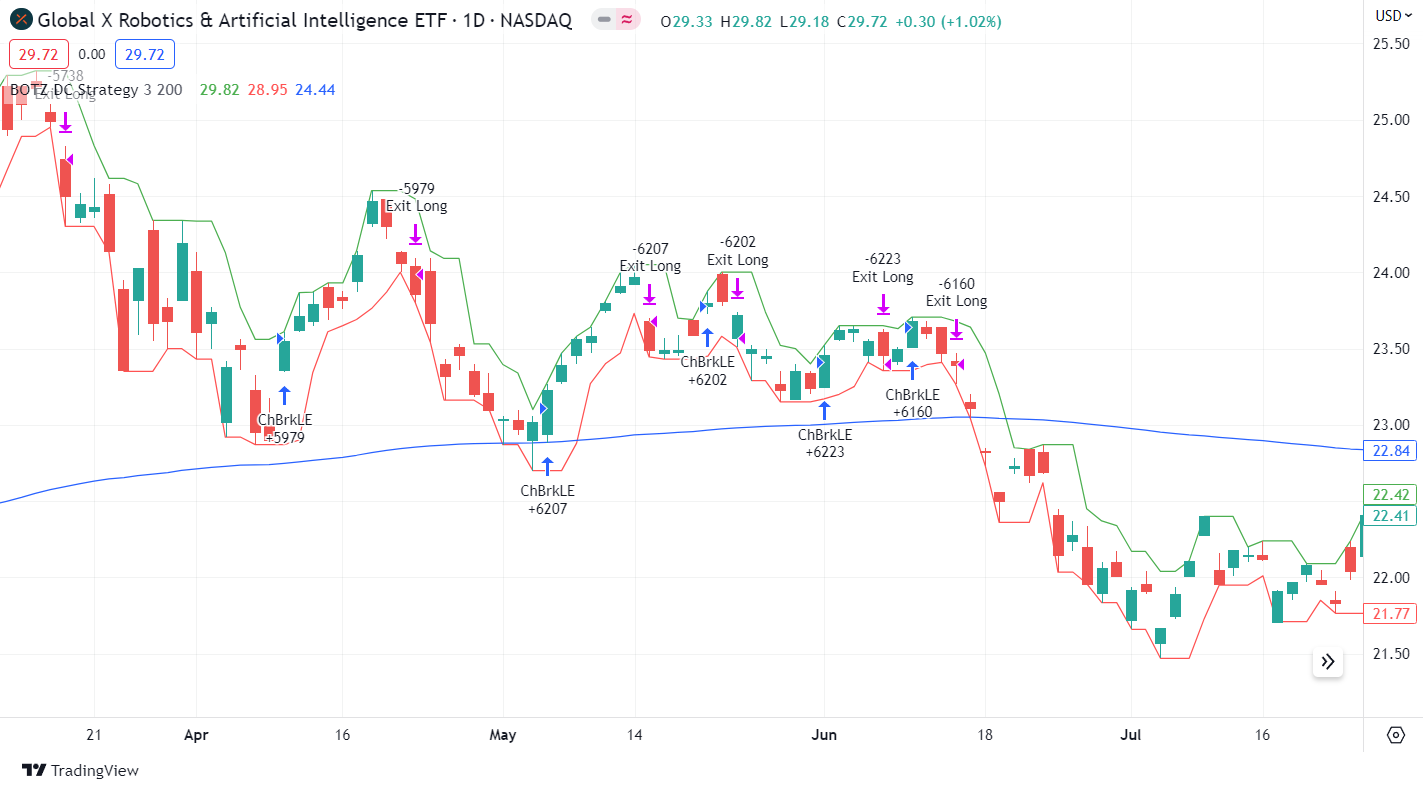
The green and red lines are the Donchian Channels. The blue line is t