
Options Trading Statistics 2024: Data And Facts
Options trading adds an exciting layer of dynamism to your trading strategy. To succeed as an option trader you need to make sure you know the basic options trading statistics.
Options trading reserves the right to sell or buy a financial instrument at a specified price or time. Options contracts help financial market traders do business and interact in the market in ways that were impossible in the past.
With this strategy, options contracts can be as short as a few hours. When you hold the right to call options, you’re not always obligated to assign them, but if you choose to assign them, the process is called “exercising your options.” On the other hand, while selling options, you’re almost always obligated to fulfill your part of an agreement, and the risks are higher as a seller. We’ll get back to this further down in the article.
You might also find our guide to trading statistics, crypto statistics, and day trading facts interesting.
Options are derivatives. They are not tangible assets but financial contracts between buyers and sellers. Let’s look at some statistics and facts about options trading:
How likely are you to succeed as an option trader?
A few of the frequently asked questions by intending and new day traders are: “How many day traders make money? What percentage make money? What is the success rate and options trading statistics?”
Options trading is no different than other types of trading. With trading, you can earn so much money and feel like you’re on top of the world, but unfortunately, you’re more likely to lose money as a day trader.
A study conducted by the London Business School found that from 2019 to 2021, retail market traders lost upwards of USD 2 billion in options premium, much of it concentrated in short-term options with a short time to expiration.
Peer-reviewed studies about the actual figure are hard to come about, and the data available from brokers is questionable at best (most quote around 25% success rate). Still, a 2004 study from the University of California, Berkeley in the USA and National Chengchi University, Taiwan, found that less than 20% of Taiwanese day traders make profits trading. You can read more in our article called Day Trading Statistics 2023: The Shocking Truth
What percentage of options expire worthless?
Options have a finite life and expire at specific dates, something called expiry date.
As options approach expiration dates, holders must decide whether to exercise, sell, or leave it to expire. In-the-money options can be exercised or sold, while out-the-money- options expire worthless. For example, if you own a call option to buy Microsoft at 300 and Microsoft is trading at 290, it doesn’t make sense to exercise the option and pay 300 when you can buy the in the market for 290. This is an out-of-the-money option and will expire worthless.
Articles on the internet tend to argue 80% of options expire worthless. But this is incorrect: the correct answer is that 80% end up unassigned. That is a huge difference.
Reports show that around 30% of all options expire worthless, but the data is once again unstandardized.
Recent data from the Chicago Board Options Exchange (CBOE) shows that only 10% of all options are exercised, 60% are closed before expiration, and only 30% expire worthless.
This means that the odds are not in favor of option sellers, as many people believe. In fact, a good portion of the options that expire worthless are used for hedging purposes rather than directional speculation.
In other words, most options traders buy options to trade them, not to exercise them or hold them all the way to expiration.
So, if you’re thinking about writing options, be aware that the odds of success and options trading statistics are not as high as you may think! Not to mention, you might face unlimited risk.
Options generally decrease in value as they expire, so it’s always a good idea to quickly make concrete decisions on whether to exercise your options. As a holder, you usually have until the close of business, a day before expiration, to exercise your options.
Why do most options traders fail?
Failure is a touchy subject in the trading world, but it’s the reality for an unprecedented amount of people. There are many reasons why options traders fail, but one of the most important reasons for failure is lack of knowledge.
Too many options traders make decisions without the correct data to back them and lack fundamental trading knowledge. If more options traders take the time to learn, unlearn, and relearn trading, there’s the probability that success rates can increase across the board.
Which options contract is the most traded?
One random day in September tells us the following stock options were the most traded:
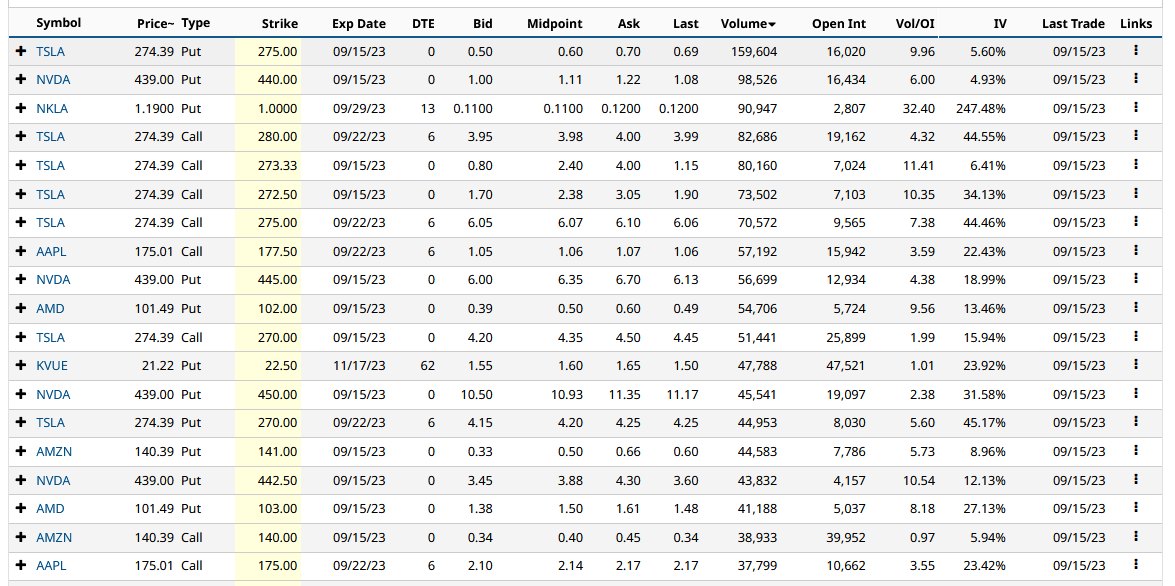
The table above varies, of course. Typically, the most traded stock options contracts are the most traded stocks.
With options, each contract is worth one lot, and each lot includes 100 shares. So, purchasing one lot of a stock worth $2 will cost you $200.
Where do options traders live?
Options traders live, work, and operate globally, and as financial instruments trading becomes more global, it is more accessible to more people than ever.
Options traders predominantly live in places we might typically expect them: North America, Western Europe, and East Asia. But the exciting thing is, based on recent happenings, we can expect options traders’ trade locations to become more diverse. Sub-Saharan Africa, South Asia, and Oceania markets promise to drive growth and global adoption of this trading class.
Professional options traders are most likely clustered around the typical financial centers: New York, London, Frankfurt, Tokyo, Chicago, Singapore, etc.
Are options traders men or women?
Trading is a man’s game. We have not managed to find any info on the number of women or men traders, but we assume it’s the same as in day trading:
On a gender-based analysis, the field appears to be male-dominated, with men constituting 90.5% of day traders in the USA. In contrast, women account for 9.5%.
Source: Zippia.com
Is the options market bigger than the stock market?
A few years ago, the answer to this question would have been a resounding NO, but this isn’t the case anymore. The US single-stock and index options market has grown rapidly over the past few years, setting and breaking previous records yearly.
Goldman Sach reported that the US options market surpassed the stock market in trade volume for the first time in 2020. Historically, the stock market has been more significant than the options market. Still, options trading has become so popular over the last few years, and trading volume superiority alternates between both markets.
What is the largest options market in the world?
Currently, this award goes to the Chicago Board Options Exchange (CBOE). It was created in 1973, and as the name implies, it’s located in Chicago, USA. The CBOE focuses on options contracts for individual interest rates, other indexes, and equities.
Trading on this exchange is done through its hybrid system, allowing customers to trade through the traditional open outcry method or electronically. The Open Outcry method allows trading through visual and oral cues.
The CBOE offers its volatility index to show market expectations on 30-day volatility. The ticker symbol for CBOE’s volatility index is VIX, calculated from both put and call options