
Turning $1000 into a Billion with Daily Doubling: A Closer Look and Analysis
Did you know you could turn $ 1,000 into a billion in 21 days? This phenomenon is no magic trick but the principle of daily doubling. If someone offered you one billion dollars or $1000 that doubled daily for 30 days, you would not take the billion dollars up front (if you made some quick math from the top of your head).
With this daily doubling of $1000, it would only take you 21 days to get to a billion. By day 30, you would have more money than you can count. If you start with $1,000 on day one, you will have $16,000 by day five. On day 10, you would have over half a million, after which the numbers stack up, as illustrated in the table below.
How To Turn $1000 Into A Billion With Daily Doubling – Table
You would come across such in investing, but it would be called the compounding effect here. In this case, the rate is 100% for 21 days to turn $ 1,000 into a billion.
| DAY | USD |
| 1 | 1000 |
| 2 | 2000 |
| 3 | 4000 |
| 4 | 8000 |
| 5 | 16,000 |
| 6 | 32,000 |
| 7 | 64,000 |
| 8 | 128,000 |
| 9 | 256,000 |
| 10 | 512,000 |
| 11 | 1,024,000 |
| 12 | 2,048,000 |
| 13 | 4,096,000 |
| 14 | 8,192,000 |
| 15 | 16,384,000 |
| 16 | 32,786,000 |
| 17 | 65,572,000 |
| 18 | 131,144,000 |
| 19 | 262,288,000 |
| 20 | 524,576,000 |
| 21 | 1,049,152,000 |
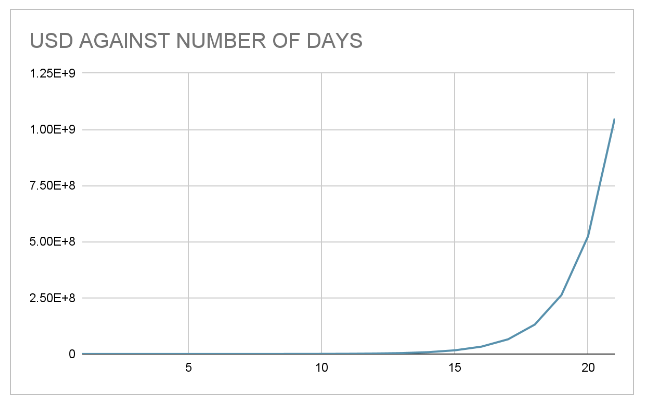
Let us analyze this data plotted in the line chart below. One thing that stands out from the table and chart is that the beginnings were relatively small. You had only 512,000 on the tenth day. You still have just sixteen million on the 15th day compared to the possible billion. But now things start to get interesting when the compounding impact takes effect!
How To Turn $1000 Into A Billion With Daily Doubling – Chart
By the 20th day, you’ve amassed a sizable half-billion bucks. That means you’ll reach a billion on day 21. And from then on, your wealth grows to astonishing proportions that is hard to fathom.
The Power Of Compounding Interest
You’ve now witnessed the power of compounding in action, something Albert Einstein allegedly called the eighth wonder. You can see how $1000 multiplied to over a billion in 21 days. You earn compound interest on savings, computed based on the initial