
Consumer Stocks XLP Day Trading Strategy – When They Open Down And Yesterday Was A Down Day –
Consumer Stocks XLP Day Trading Strategy
This was a long headline, which probably won’t catch many readers. Anyway, the trading strategy has proven to perform well in the past but in the last years up to 2021, it has been rather flat. In trading, boring is good.
The strategy is tested on the ETF with the ticker code XLP.
A day trading strategy when yesterday was a down day and today is a gap down
In plain English the strategy is like this:
Trading Rules
[am4show have=’p2;p3;p58;p59;p130;p138;’ user_error=’Premium Post Access’ guest_error=’Premium Posts’]
- Yesterday must have been a down day of at least 0.25%.
- If XLP opens down more than 0.1% today, go long and exit on the close.
[/am4show]
Fairly simple rules. Here is the result from 2005:
| P/L in% | #trades | #wins | Avg |
| 76.03854 | 225 | 147 | 0.34 |
The equity curve:
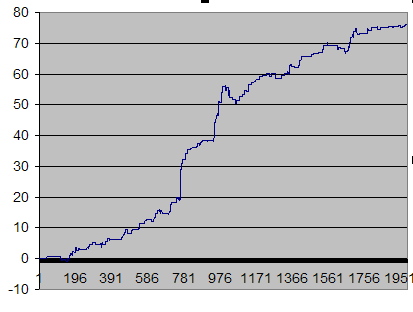
Perhaps worth noting is how well this strategy has performed in turbulent times.
The biggest holdings in XLP are the second most boring stocks, after utilities: PG, PM, KO, WMT, PEP, MO, CVS, CL, COST, and MDLZ.
———————
If you would like to have the Amibroker and Tradestation code for this strategy plus 70+ other free trading strategies published on this website, please click on this link:

For more trading strategies, please click here:
- Free trading strategies
- Monthly trading edges (subscription service)
FAQ:
– What are the key parameters of this trading strategy, and how has it performed historically?
The key parameters include the percentage decline on the previous day and the percentage gap down on the current day. Over the years 2005 to 2013, the strategy yielded a profit/loss percentage of 76.04% with 225 trades, 147 of which were winners, and an average gain of 0.34%.
– In what market conditions did the trading strategy perform particularly well?
The strategy demonstrated strong performance during turbulent periods, such as 2008 and the EU crisis in late summer 2011, while 2012 showed relatively poor results.
– Which holdings make up XLP, the ETF that the strategy is based on?
The largest holdings in XLP include a selection of relatively less volatile stocks, such as PG, PM, KO, WMT, PEP, MO, CVS, CL, COST, and MDLZ.