ETF Sector Rotation Trading Strategy – (VIX, Setup, Rules, Backtest, Results)
Crafting a strategy that adapts to changing conditions is crucial for success. One such strategy gaining attention is the ETF sector rotation trading strategy. In this case, we are going to be focusing on the Consumer Staples and Consumer Discretionary sectors. We make a unique twist to it: Utilizing the VIX level to inform rotation decisions. But does this work? Is it profitable?
Yes, it is possible to construct an ETF sector rotation trading strategy by using the VIX indicator.
In this article, we will delve into the rationale, implementation, and potential benefits of this dynamic trading approach, and backtest a strategy of this type using the VIX as a signal trigger.
Related reading:
- Do Stock Rotational Systems Work
- 100 free trading strategies
- Member trading strategies
- Trading strategies for sale (our best ideas)
Understanding the ETF Rotation Strategy
An ETF rotation trading strategy involves dynamically adjusting investments among different ETFs based on specific market indicators or conditions. Let’s call them triggers. This strategy aims to capitalize on changing trends and offers several benefits:
- Risk Management: Actively adjusting the portfolio in response to market conditions can help manage risk, especially during economic downturns. We define the market conditions in the trading rules.
- Adaptability: ETF rotation allows investors to adapt to different economic cycles, shifting investments to sectors expected to outperform in specific market phases.
- Enhanced Returns: By timely rotating into sectors expected to perform well, investors seek to capture potential gains, potentially leading to enhanced returns.
- Reduced Volatility: The strategy’s ability to avoid poorly performing sectors may contribute to reduced portfolio volatility.
- Utilizing Market Trends: ETF rotation strategies aim to align investments with prevailing market trends, whether bullish or bearish.
That said, sector rotation strategies often tend to weaken over time.
In the strategy we are going to backtest today, we will be using Consumer Staples and Consumer Discretionary sector ETFs. They have ticker codes XLP and XLY.
Consumer Staples ETFs typically consist of stable, non-cyclical stocks, such as those in the food, beverage, and household product industries.
On the other hand, Consumer Discretionary ETFs encompass more cyclical sectors, including retail and entertainment.
The signal triggering the rotation of this strategy is the VIX. Often regarded as the market’s fear gauge, the VIX indicates higher market uncertainty when levels are high, leading investors to seek refuge in defensive sectors like Consumer Staples.
Conversely, lower VIX levels may suggest a more stable market environment, encouraging allocation to potentially higher-yielding Consumer Discretionary stocks.
Related reading:
Sector Rotation VIX Trading Strategy – Trading Rules
The strategy we are going to backtest was developed by Michael A. Gayed in his paper “Actively Using Passive Sectors to Generate Alpha Using the VIX”.
The trading rules are very simple:
[am4show have=’p2;p3;p58;p59;p130;p138;’ user_error=’Premium Post Access’ guest_error=’Premium Posts’]
- We buy consumer discretionary when the VIX crosses over 33
- We sell consumer discretionary and buy consumer staples when the VIX crosses under 12.
[/am4show]
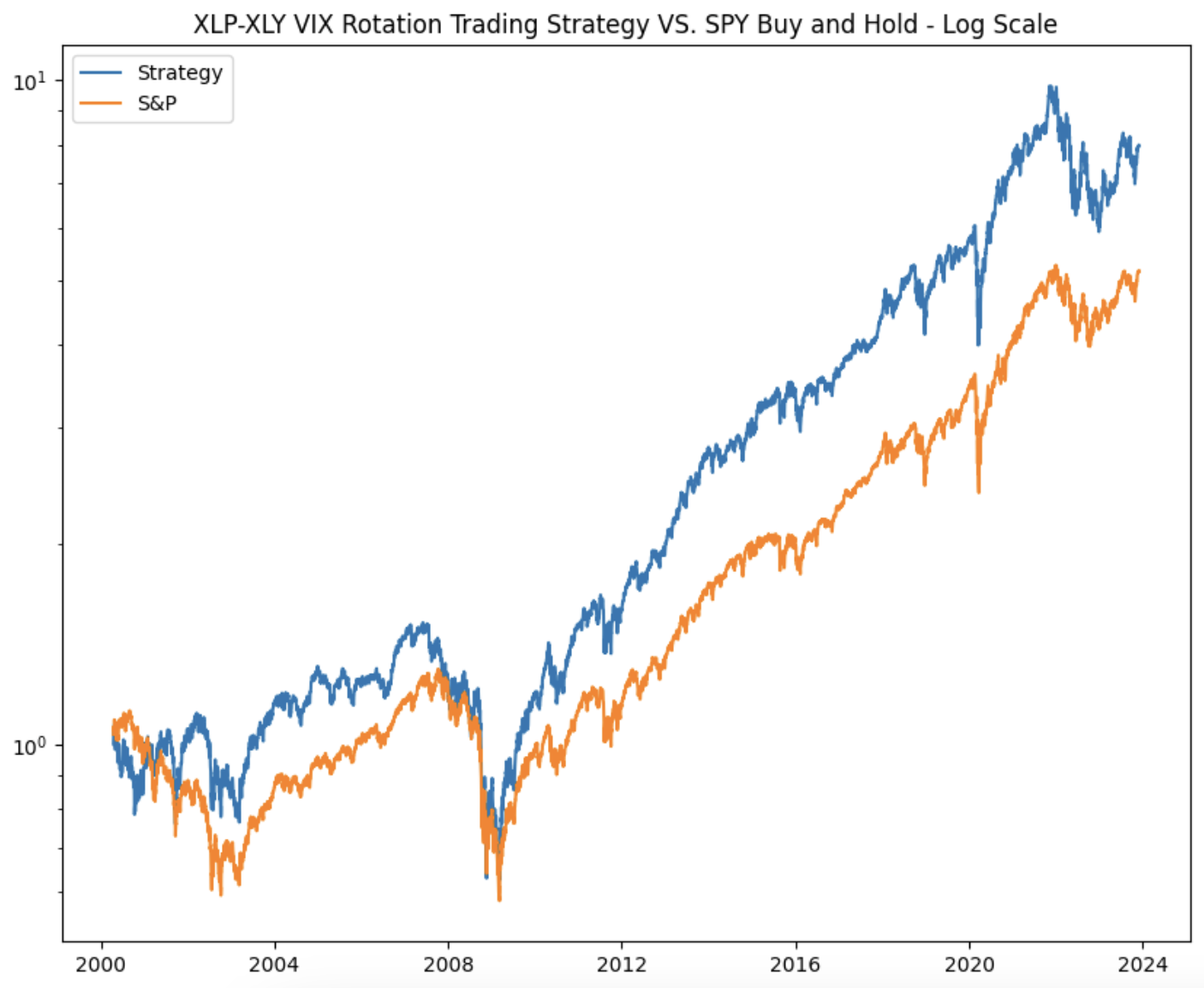
For the backtest, we are going to be using the XLP and XLY ETFs. The data is adjusted for dividends and splits.
Here is the equity curve when we apply the trading rules: