
Hard-To-Borrow Stocks Trading Strategy (Negative Returns)
In the US, hard-to-borrow stocks underperform over 3-, 6-, and 12-month periods. Moreover, hard-to-borrow stocks consistently underperform those that are not hard to borrow.
Is that negative edge big enough to make a hard to borrow stocks trading strategy?
Verdad Research, a money manager, publishes a weekly research every Monday. In a recent paper, called Costly Shorts, they went through the returns of stocks that are hard to borrow.
Let’s look at some of the findings from Verdad:
Hard-To-Borrow Stocks Trading Strategy
Verdad’s model classified stocks based on their borrowability. If you are unsure what we mean by hard to borrow and why it’s significant, please read further below for an explanation.
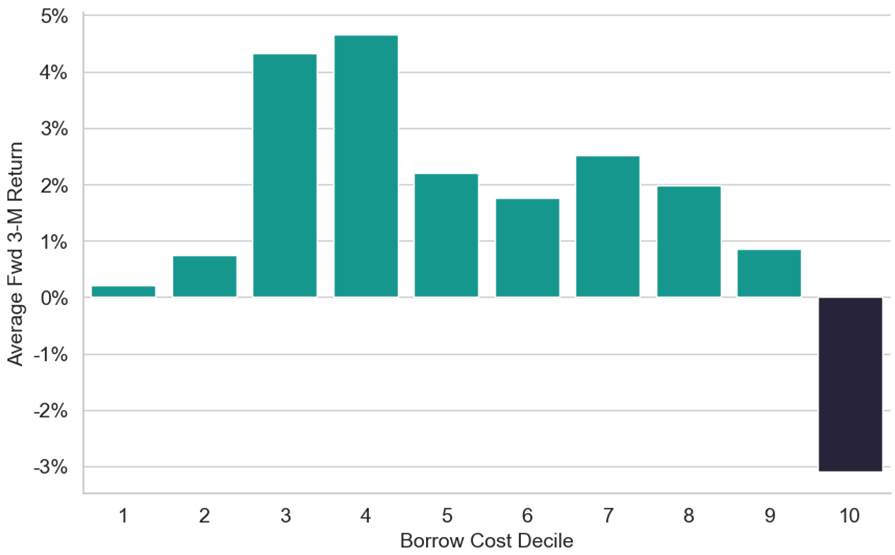
Classifying stocks into deciles of hard to borrow stocks, Verdad generated comprehensive daily short-borrow classifications for a substantial dataset of nearly 30,000 stocks spanning from 2005 to 2023.
Based on this dataset, Verdad made the following conclusion:
“Our analysis shows that, in the US, hard-to-borrow stocks typically show negative returns over 3-, 6-, and 12-month horizons, whereas general collateral stocks tend to yield positive returns over the same periods……. In Japan and Europe, hard-to-borrow stocks do not appear to systematically underperform as they do in US markets.”
Based on deciles Verdad made the following table:
We believe median results might shed some more light on the performance and these two tables tell us that small stocks perform very poor:
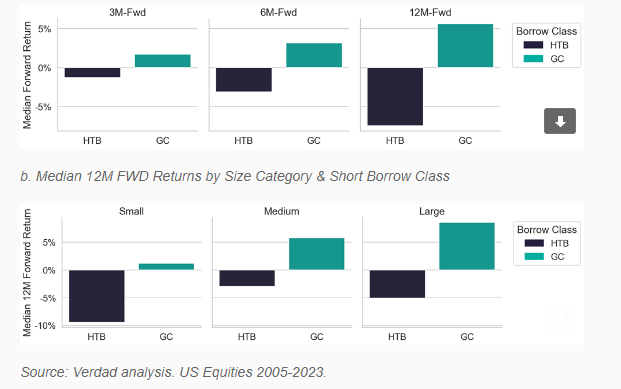
We are not surprised that small caps perform badly: we know from history that volatile small-cap stocks have been the worst performing stocks for over 60 years.
But is the negative edge big enough to turn it into a profitable and robust short selling trading strategy?
Probably not, because you most likely would not be able to get a short locate.
What does that mean? Keep reading to learn more about short selling:
Why do we need to borrow stocks when selling short?
A short sale is a sale of shares, and you can’t sell thin air. You need to have shares to sell, thus you need to borrow from s