
Santa Claus Rally In The Stock Market
Christmas Day is one of the federal holidays in the US. But how does it affect the US financial markets? Is there a Santa Claus rally in stocks? Can we develop trading strategies for this holiday season?
Our trading strategy backtests reveal that there is a Santa Claus rally in the stock market. The stock market shows significantly better performance during Christmas and the days leading up to the new year. The Santa Claus rally is no myth or fiction.
Let’s go on to backtest this trading strategy and holiday period:
The Christmas holiday
From about 1840, celebrating Christmas became more widespread around the world, but it wasn’t until 1870 that December 25 was declared a federal holiday in the United States. Since then, Christmas Day has always been a federal holiday in the US.
The day is often celebrated with festivities ranging from fireworks and concerts to more casual family gatherings and exchanging gifts.
Is the day before Christmas or after Christmas a trading day?
Christmas Day is not a trading day for all US markets, but the day before and after can be trading days, depending on whether they fall on a weekend. The day before or after Christmas is usually a trading day if Christmas Day falls on a weekday.
However, on the trading day preceding Christmas Day, the bond market closes earlier than usual and closes at 2 PM.
What happens if Christmas is on a weekend?
If Christmas Day is on a weekend, the Christmas federal holiday will be observed on the preceding Friday (if Christmas Day is on a Saturday) or the following Monday (if Christmas Day is on a Sunday).
The Santa Claus rally in stocks
In the rest of the article, we look at the Santa Claus Rally in stocks and the stock markets, the turn of the year effect, or simply the Christmas effect. It turns out that the second half of December is a very good month for stocks!
The Santa Claus rally in stocks – trading strategy backtest 1
The strategy is pretty simple and we make the following trading rules:
Trading Rules
[am4show have=’p2;p3;p58;p59;p130;p138;’ user_error=’Premium Post Access’ guest_error=’Premium Posts’]
The last four days of December and the first three days of January are often referred to as the Santa Claus market rally (effect).
[/am4show]
Let’s test if the hypothesis is true.
How has the stock market performed? Below is the equity chart of the S&P 500 from 1960 until today (100 000 invested in 1960 and compounded/reinvested):
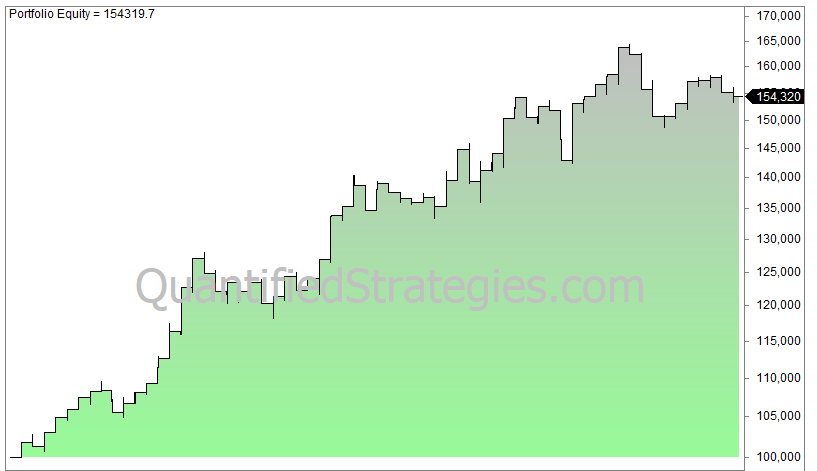
The strategy has produced 0.7% per trade, the win ratio is 66%, the average winner is 2.1%, the average loser is -2%, the profit factor is 2, and max drawdown is 9%.
In other words, it clearly exists a Santa Claus market rally in stocks, but it seems like the best days were a few decades earlier.
The returns are substantially higher than any random seven-day period:
The backtest shows a CAGR of 0.7% while only being invested 2.3% of the time.
The performance was recently weak with three losing years in a row: 2013/14, 2014/15, and 2015/16.
The Santa Claus rally in stocks – trading strategy backtest 2
Let’s test another twist to the hypothesis and increase the holding period:
- We enter at the close on the Friday prior to the