
Buying or Selling Stocks in a Volatile Market: Backtest Analysis with Historical Data
Volatility and bear markets are related: volatility “always” picks up when the market goes down. Is this good or bad for a trader or investor? Should you buy or sell stocks in a volatile market? Let’s find out:
Short-term traders should continue doing business as usual. Long-term investors should buy – not sell.
Very few traders have a bear market trading strategy or a bull market trading strategy, something that makes sense. Normally, we make backtests based on time series over at least a couple of business cycles, and thus it involves both bull and bear markets.
Volatility, the 200-day moving average, and VIX
However, a bull market normally lasts much longer than a bear market. We like to use the 200-day moving average to separate a bull and bear market and the fact is that since 1960 the market has spent 70% of the time above the 200-day moving average.
A bear market is often short and has a spike in volatility, which for many is scary. The ultimate scare happened in March 2020 when covid struck and we witnessed jaw-dropping volatility. This was for many a scary experience (also for us) and we assume many traders either cut down the size of positions or stopped trading altogether.
When you have a volatile market, you most likely are in a bear or falling market. Just look at the graph below:
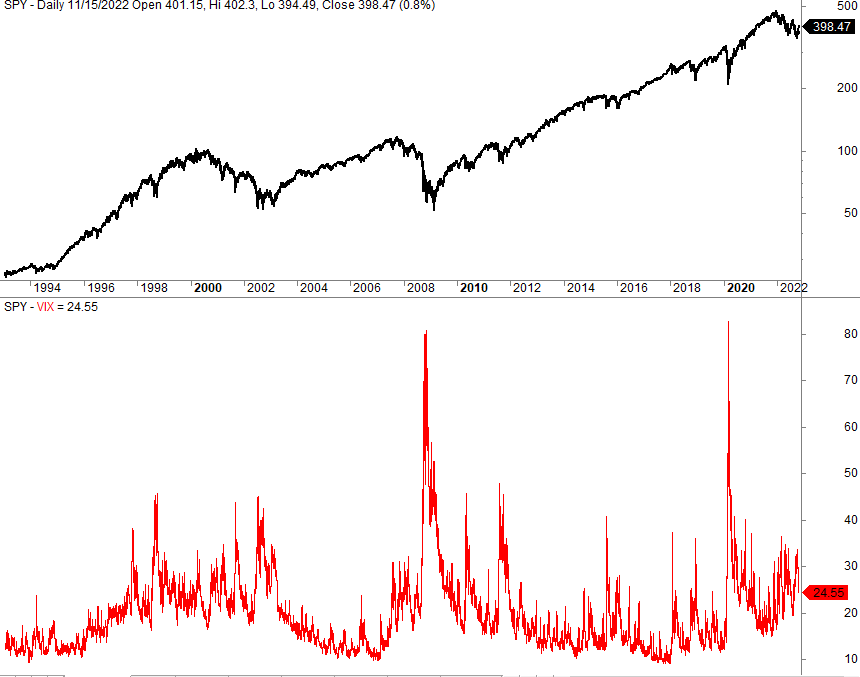
The upper pane is SPY (S&P 500) and the lower pane (red line) is the VIX. As a general rule, when the market drops, volatility (VIX) goes up. Stocks and volatility are inversely related, but at the same time volatility is very mean reverting.
Relevant VIX articles including trading strategies:
- Using VIX To Trade SPY And The S&P 500 (VIX Trading Strategies)
- WilliamsVixFix Explained – Does It Work? (Including trading strategies)
- 4 VIX trading strategies – What Is The VIX And How Does It Work?
- Williams Volatility Channel — What Is It? (Trading Strategy)
Should You Buy Or Sell Stocks In A Volatile Market? Long-term investors (Backtest)
This is an easy question to answer. If you’re a long-term investor and have at least five years until you are going to withdraw money from your account, you should buy when volatility picks up – not sell.
The reason for this is simple. When volatility is high you are most likely in a bear or down market. Average gains are slightly higher in the next 8-24 months than average, thus you are smarter if you buy and not sell.
However, the longer you hold,