
Day Trading with Daily Bars: Assessing Feasibility and Effectiveness – Strategies and Backtesting Insights
You might wonder which time frame to watch when day trading. Instinctively you might believe you need intraday bars, ie bars 5-minute bars, 60-minute bars, etc. However, after reading this article we hope you are reconsidering. Can you day trade with daily bars?
Yes, you can day trade with daily bars. As a matter of fact, this is a very viable option and for most traders a better solution than using intraday bars with a shorter time frame. We would even argue it’s better to use daily bars than intraday bars when day trading.
What is a bar in trading?
Before we start, we’ll briefly explain what a bar is in trading.
A bar is the open, high, low, and close within a certain time period. If you are using daily bars, the open is today’s opening print, the highest trade of the day, the lowest trade of the day, and the final closing price at the end of the official trading day. You can, of course, adjust the length of the trading day yourself if you want to include “unofficial” trading outside regular exchange hours.
If you are using 5-minute bars the open could be the opening price at 10 AM, the high between 1000 and 1005, the lowest trade between 1000 and 1005, and the close price at 1005.
A bar simply compresses data over a certain time frame.
The significance of daily bars
We believe that daily bars are the most significant time frame in trading. This equally applies to day traders as to swing traders.
Why are we of that opinion?
In this post, we’ll argue the case for daily bars, even though you might be a day trader. There are, of course, disadvantages as well, but they are more than offset by the advantages.
Day trading and different bars
Let’s start by showing the exact same time period in S&P 500 (SPY) by using two different time frames:
The first chart is 15-minute bars:
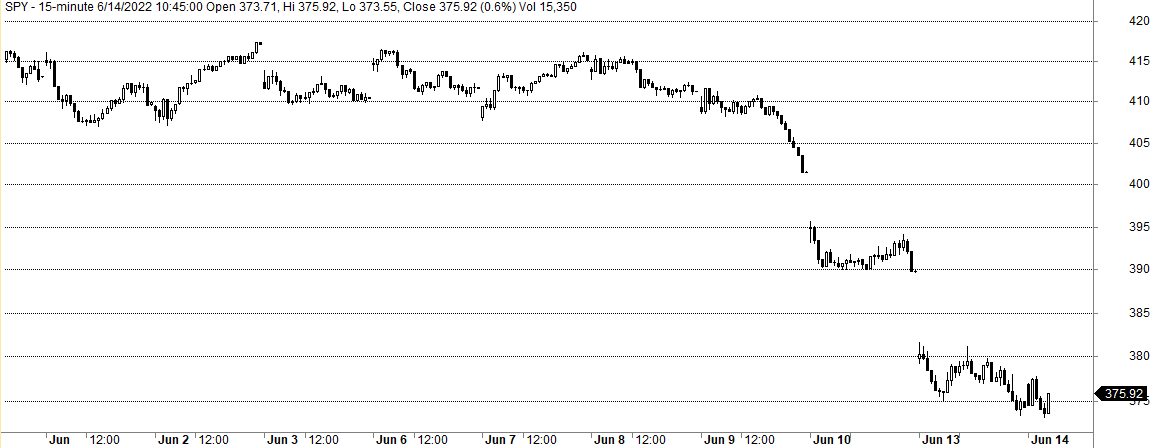
Let’s compress the exact same data into daily bars:

The difference is, of course, enormous. There is a lot less data!
Why could day trading with daily bars be better than intraday bars?
Let’s look at some of the possible benefits, pros, and advantages of using daily bars if you are a day trader:
Less behavioral mistakes
In our opinion, most of the price action is just randomness and noise. The more you stare at the screen(s), the more likely you are to do discretionary trades. In trading and investing, this is called behavioral mistakes. For example, one of the most common biases is the overconfidence bias that comes after a series of wins and gains.
One of the most important factors in becoming a profitable day trader is to be systematic. But the more noise you have, the more difficult it gets. Trading should be “simple”!
- 2 Reasons Why Less Is More In Trading
- Simple Vs Complex Trading Strategies
- Street Smarts Beat Book Smarts In Trading?
Less movement after the open and the close
We have in multiple posts looked at the trading movement intraday. As a matter of fact, the market slows down a lot after the first 30 minutes of the trading day. We believe that the best opportunities for day trading happen before the open, right after the open, and toward the close. We day traded for 18 years, and we concentrated all our trading within these narrow time frames.
Less noise equals more time to research
We believe you are unlikely to succeed as a discretionary day trader and thus you need to constantly find new strategies by using backtesting. It’s much easier to backtest using daily bars than intraday bars. Furthermore, it’s also much more time-effective.
Less trading – more focus
Day trading involves profiting on small movements done repeatedly. Because much of the price action midday is random and slow, you need to focus your energy on th