
Do Candlesticks Pattern Work? Are They Reliable? A Quantitative Backtest Of 23 Candlesticks (Trading Strategy)
Candlesticks are a popular charting tool and are frequently used by promoters using anecdotal evidence. We use candlesticks in our charts ourselves, but not as a predictive tool in our trading strategies. In this article, we ask: do candlesticks work?
Yes, candlesticks work. We test 23 different candlestick patterns quantitatively with strict buy and sell signals. Perhaps surprisingly, some of the candlestick patterns work pretty well. Some of the patterns can highly likely be improved by adding one more variable. We provide the code for a small fee.
Candlesticks are a popular way to display quotes on a chart, something we have done since we read Gregory Morris’ Candlestick Charting Explained back in 1998. However, we have never implemented candlesticks in any of our quantified strategies.
Why do we use candlesticks in our charts? We agree with Mr. Morris, who writes this in the introduction of the book:
However, once you become accustomed to seeing Japanese candlestick charts, you will prefer them because their clarity is superior and allows a quick and accurate interpretation of the data.
Mr. Morris is right. Candlesticks are easy to digest once you get used to them. But do candlesticks have any predictive value? After all, we operate in the markets to make money, not to make nice visual graphs. Candlesticks might be popular, but we like to quantify to check for value.
Candlesticks explained:
If you have never seen a candlestick, it might be a little confusing to start with, but once you get used to candlesticks, you get a much better visual look at the charts – for example, where the stock opened and closed. This is the primary reason, in fact, the only reason, why we use candlesticks when we look at charts.
A black candlestick means the open was higher than the close, while a white candlestick means the close is higher than the open. The difference between the open and the close is called “the body”. The “tails” on both sides are the high and low readings that day (or whatever time frame you are using):
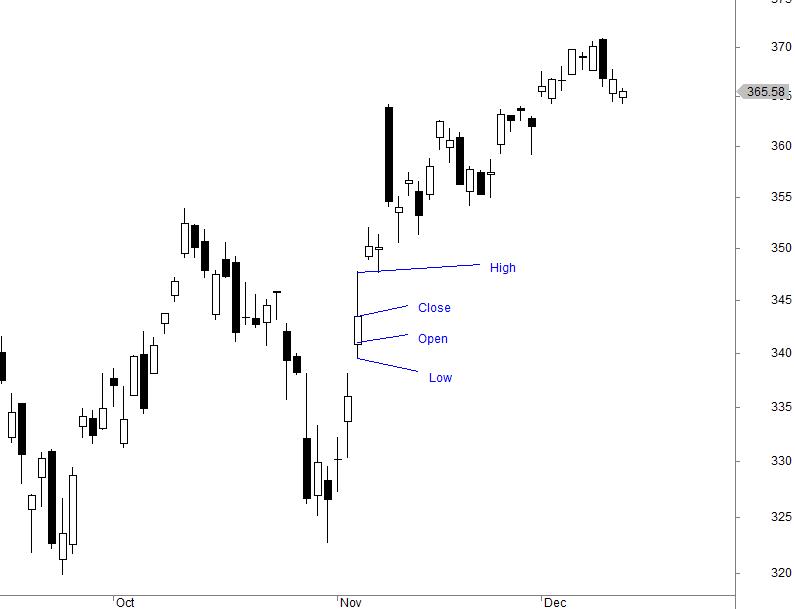
Candlesticks might have an appealing and/or easy interpretation, but does it add any value?
Are candlestick patterns reliable?
A quick search on the internet reveals many articles touting candlesticks’ importance and what formations to look for. Endless articles explain the formations, but as usual, without any empirical evidence about their predictive power. That’s a shame because it’s relatively easy to test candlesticks. Further down in the article, we reveal some quantitative results from 23 formations.
What is the best candlestick pattern?
In the 100% quantified test below there are surprisingly many candlestick patterns that look promising. There are at least 5 patterns that have a decent amount of trades and a high profit factor.
How many candlestick patterns are there?
Exotic names like Hanging Man, Bullish Engulfing Pattern, Shooting Star, Bullish Hikkake, One White Soldier, Bearish One Black Crowe, Piercing Line, and Hammer are just a few of the candlestick patterns that exist.
But how many candlestick patterns are there? We counted at least 64! We suspect that this is not all of the candlestick patterns, and there are probably around 100 patterns available somewhere on the internet.
We have no idea how many candlesticks patterns there are, but if you like to know more about candlesticks, we recommend this page.
We picked the 23 candlestick patterns because we more or less had the backtesting code at our disposal.
Do candlesticks work best in daily or intraday bars? (Best settings)
We recommend using different time frames in trading, but the best time frame for candlesticks seems to be daily bars. Daily bars seem to be much more reliable than intraday and weekly bars. Among many, the reasons are that there are many more transactions in daily bars than intraday ones, and daily bars, in general, attract more attention.
How to quantify and backtest candlesticks (Entry and Exits):
To backtest candlesticks quantita