
Earnings Trading Strategy – Rules, Setup, Performance (Best Options Strategies With Backtest)
Earnings season and Earnings Trading Strategies can be a great time to get insight into different stocks, as well as take advantage of the short-term volatility that follows the release of earnings reports. Experienced traders look forward to the earnings season, as the increased volatility can present outsized opportunities for making good profits. But what is a good earnings trading strategy?
The earnings trading strategy refers to the trading methods short-term traders use to trade during the earnings season. This includes the strategy for market forecast, entry and exits, profit goals, time spent trading, and risk management methods. Trading earnings reports is difficult and risky and may not be suitable for all traders. Be sure it suits your risk profile before you think of the earnings season, and you must have a strategy for every possibility.

In this post, we take a look at trading earnings strategy, and we’ll also include an earnings strategy backtest.
Related reading:
- Plenty of different trading systems for sale, and
- What are the different types of trading strategies? (The link contains access to hundreds of backtested trading strategies)
What are earnings?
Earnings refer to a company’s after-tax net income in a given quarter or fiscal year. It is a company’s bottom line and describes the net profits after tax for the business period under review, which can be a quarter or full year. Earnings are used by investors, especially value investors, to determine a stock’s value, which is why it is perhaps the single most important and most closely studied figure in a company’s financial statements.
Earnings show a company’s profitability over the period and are often compared to analyst estimates, the value in the previous quarter or similar period over the previous year, and the earnings of competitors and industry peers. They show how the company has performed over the period and whether it has outperformed its own past performance, its peers, the industry average, and the current expectations.
At the end of each quarter when earnings are released, analysts study the figures and compare them with the various factors mentioned above.
When earnings deviate from the expectations of the analysts, it can have a great impact on the stock’s price, at least in the short term. Generally, if the earnings beat the estimate, the stock price is likely to rise, and if it falls short of the estimate, the stock price might fall. For example, if the expectation is that a company’s earnings will be $2 per share and come in at $2.50 per share, the stock price is likely to rise for beating the estimate. On the other hand, if the earnings come in at $1.50, the stock will likely fall.
History shows that earnings surprises tend to be more positive than negative
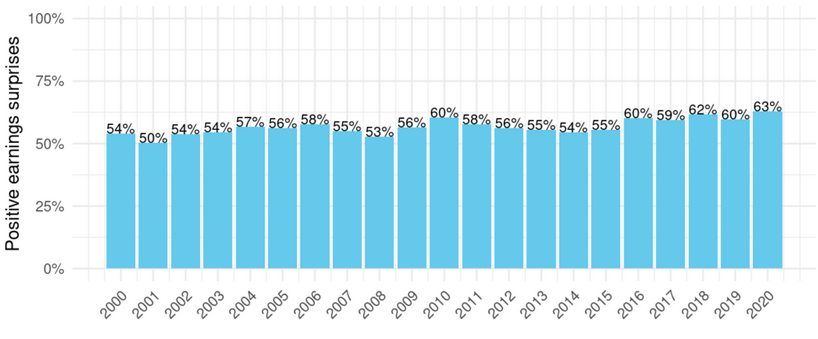
However, it does not always work that way: other factors in the earnings report might influence how investors respond to the earnings. Nonetheless, it is safe to work with the idea that a company that consistently beats analysts’ earnings estimates is more favored by investors than a company that consistently misses earnings estimates.
The only exception is for growth companies that are using earnings to pursue growth — investors can buy into the growth idea. Examples include Amazon and Tesla in their early years.
By and large, earnings are the key determinant of a stock’s price because they can be either invested in the business to increase its earnings in the future or used to reward stockholders with dividends. This is why they are used in many financial ratios, such as the P/E ratio. Given the big impact earning can have on a stock’s share price, the numbers are subject to potential manipulation, but the regulators monitor that.