
End Of Month Effect in Bitcoin – Examining the Turn of the Month (Video)
Yes, our backtests indicate that there is an end of month effect in Bitcoin and this can potentially be a viable turn of the month trading strategy.
The end of month effect, sometimes referred to as the turn of the month effect, is well known in US stocks and most other stock indices all over the world. We showed you how you can use this in a turn of the month trading strategy in a previous article.
In this article, we backtested to look for the same end of month effect in Bitcoin.
Let’s backtest the end of month effect in Bitcoin
We use data from Yahoo!finance. Unfortunately, the dataset starts as late as 2014, and thus our time frame is slightly limited.
To make a turn of the month trading strategy we start by doing optimization of both the entry and the exit: we enter at the close x days prior to the new month, and we exit n days after we enter a new month. Keep in mind that Bitcoin is 24/7 market.
This is the result of our optimization (100 different simulations):
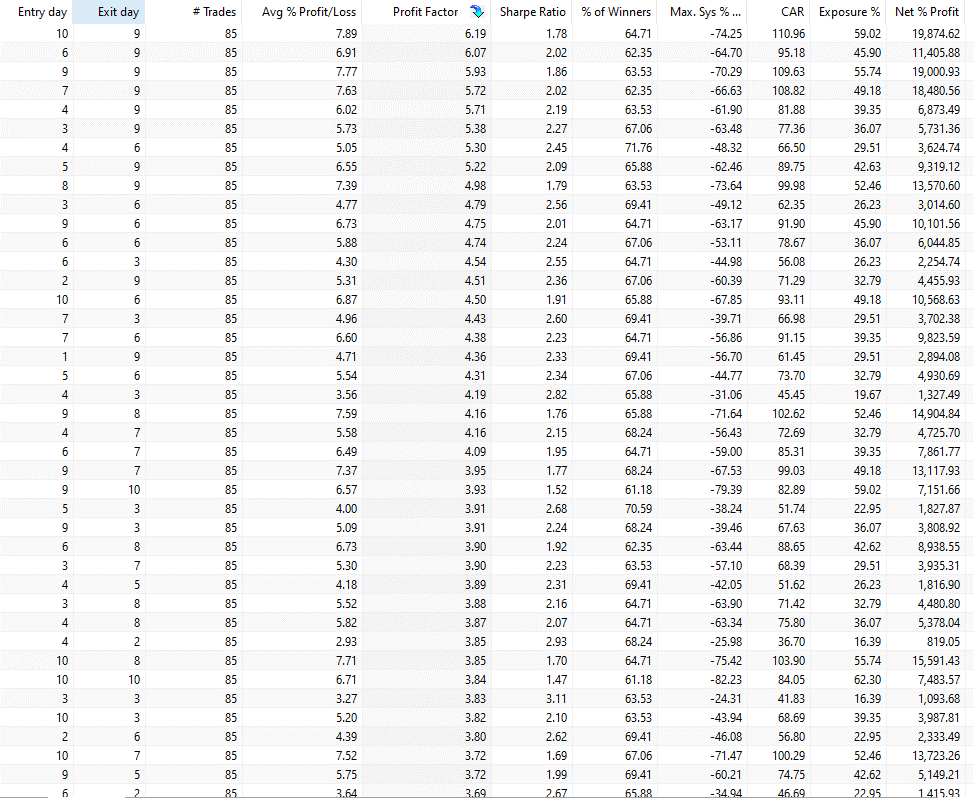
The first column indicates at which last trading day of the month we enter, and the second row is the trading day of the new month we exit. For example, row 1 enters at the close on the tenth last trading day of the month and exits at the ninth trading day of the new month. The table is sorted by profit factor.
The fourth last column shows the max drawdown and that is pretty high for most simulations. The only way to reduce the drawdown is to reduce the holding period.
Let’s formulate an end of month trading strategy in Bitcoin:
Trading Rules
[am4show have=’p2;p3;p58;p59;p130;p138;’ user_error=’Premium Post Access’ guest_error=’Premium Posts’]
- We go long at the close of the third last trading day of the month.
- We sell at the close of the third trading day of the new month.
[/am4show]
Let’s see how this performs if we invest 100 000 a