

Equal Weight vs Market Weight Trading Strategy (Factor, Backtest, Performance, Results)
Equal weight and market weight are two different methods to build an index. The S&P 500 is famously a market-weighted index, like most stock indices. But the question that pops up is: Which type of market weighting performs best – an equal weight vs market weight trading strategy?
In this article, we look at the main differences between equal- and market-weighted indices, backtest a trading strategy, and see how they perform.
If you are interested in these types of investment strategies, please also check out our factor investing strategies.
What is the difference between the equal weight and market weight index?
Equal weight and market weight are two different methods of constructing stock market indices, and they have distinct characteristics:
- Weighting Methodology:
- Equal Weight Index: All components have the same weight.
- Market Weight Index: Components’ weights are based on their market capitalization.
- Impact on Performance:
- Equal Weight Index: Smaller companies have a bigger impact.
- Market Weight Index: Larger companies dominate performance.
- Diversification:
- Equal Weight Index: Offers more diversification.
- Market Weight Index: May be less diversified.
- Rebalancing:
- Equal Weight Index: Requires periodic rebalancing.
- Market Weight Index: Adjusts naturally with price changes.
Each approach has its advantages and disadvantages, and the choice between them depends on the investment goals and preferences of investors.
For instance, the market-weighted portfolio’s performance is often significantly influenced by a few large stocks, which can potentially mislead investors about the overall health of the stock market.
For example, th chart below contains 12 month’s performance of S&P 500 and S&P 500 equal-weight ETFs:
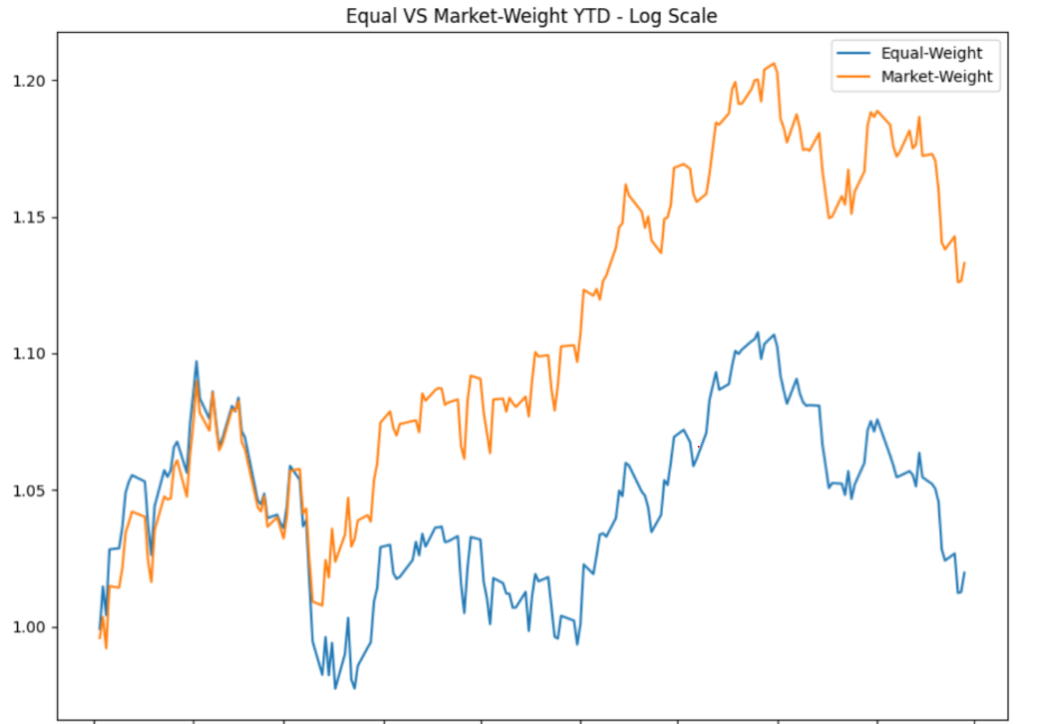
The difference is huge! It is very evident that stock market returns were helped by a few large stocks.
However, beneath the surface, we can see that stocks are just slightly because the equal-weighted index performs poorly.
So a question arises: Can we build a strategy that takes advantage of the market-weighted index when it performs better than the equal-weighted index and vice versa?
Equal weight vs market weight trading strategy – trading rules and backtest
For the backtest we decided to use the SPY and RSP ETFs.
The trading strategy’s trading rules are very simple:
(The trading rules are part of our Silver membership. If you subscribe you get access to this strategy and hundreds of other trading strategies and ideas.)
It’s a monthly rotation strategy.
Here is the equity curve from 2003 until today (we adj