
The First Trading Day of the Month Trading Strategy: Strategies and Backtest Insights
There are many effects and seasonalities in the stock market. One frequently mentioned seasonality is the first trading day of the month effect. Is the first trading day of the month effect a myth or fact? In this article, we look at how the stock market (the S&P 500) performs on the first trading day of the month.
The stock market performs significantly better on the first trading day of the month compared to other days. Furthermore, we have developed two trading strategies based on the first day of the month effect.
Some of the other seasonal trading strategies are covered on our landing page of free strategies:
The first day of the month effect – video
We have made a short YouTube video that explains the first day of the month effect.
The first day of the month effect
Let’s define the first day of the month and look at its performance:
The first day of the month defined
First, we start by defining the first day of the month effect: we are referring to the first trading day of the month, and not the first calendar day. The first trading day of the month could be the third calendar day, for example, if the first calendar day is on a weekend or there is a holiday.
How the first trading day of the month effect performs
First, let’s test the average gain from the close until the next day’s close in the S&P 500, the broadest measure of the stock market, on any day (dividends reinvested):
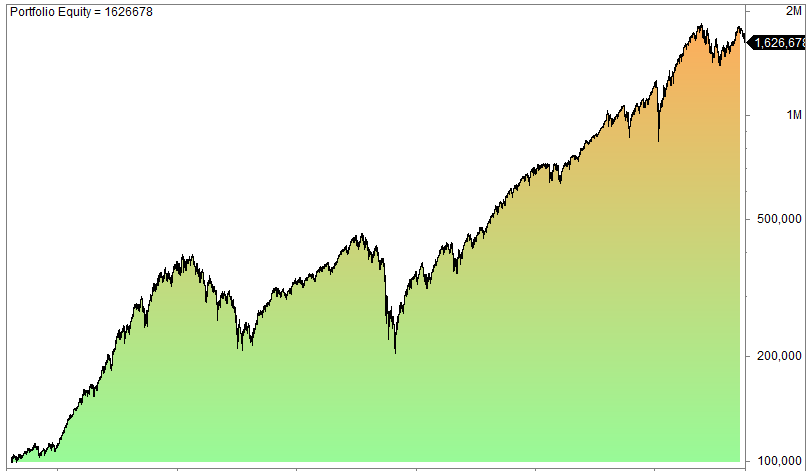
The equity curve above shows the compounded result of 100 000 invested at the close and held until the close the next day. We used the ETF with ticker code SPY to perform the test. The average gain per day is 0.04%.
Thus, the stock market has a nice tailwind, something you also can turn into night trading or overnight strategies:
Let’s test by holding the S&P 500 (SPY) from the close of the last trading of the month until the close of the first day of the month:
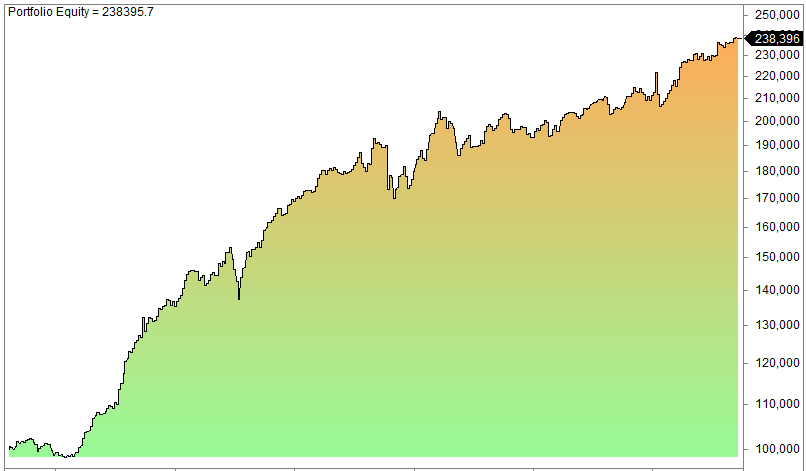
The test is done by investing 100 000 in 1993 and letting it compound all the way until today.The result indicates a solid edge in owning stocks on the first trading day of the month:
The average gain on the first trading of the month is a solid 0.24% – six times better than the average day in the stock market. There obviously is a first day of the month effect.
Is this a tradeable strategy?
Unfortunately not. It’s far too unstable and unreliable to be traded. Furthermore, we see that most of the gains were up until the GFC in 2008/09.
Since then, the strategy has not worked so well, even though the average has been 0.18% per trade:
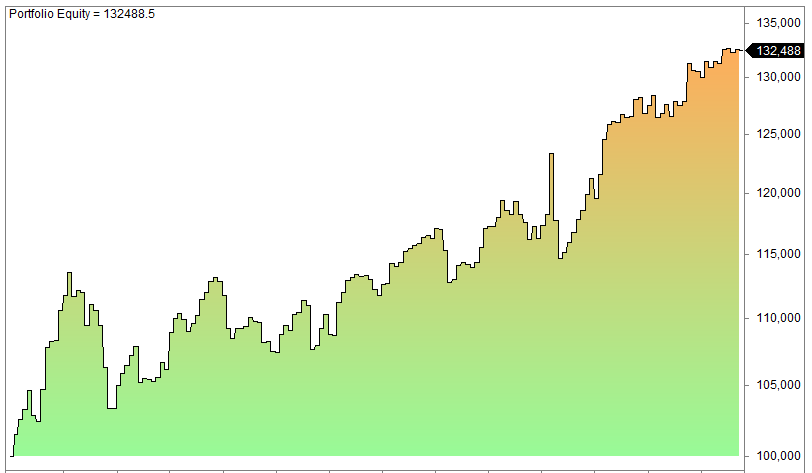
Is there any way we can improve the strategy? Luckily, yes. For that, see further down in the article.
Which first trading day of the month is best?
Let’s look at the performance of the first day of the month for each month for S&P 500. We backtested SPY since its inception.
The table below shows when we enter the trade:
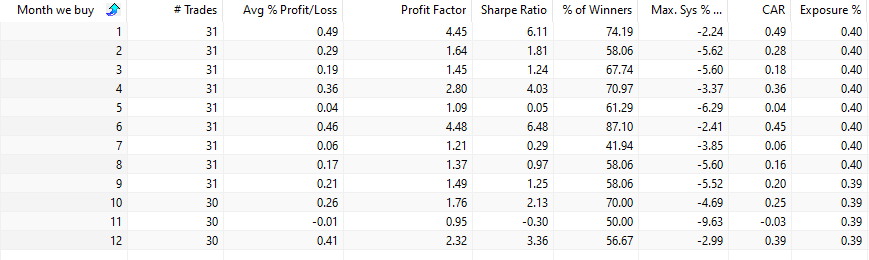
Row one shows the performance on the first of February because we enter at the close of the last trading day of January.
The best first days of the month are February (!) and July.
The first trading day of the month – for members
We have made an improved version of the first trading day of the month. You can read more here: