
Follow Through Day Trading Strategy (Backtest and Example)
What Does A Follow Through Day Mean In Trading?
As a stock trader, you may likely have asked this question several times: “How do you identify a stock rally?” That might have been the question that led William J. O’Neil to develop the concept of a follow-through day for identifying the onset of a rally after a downtrend or market correction. But what does a follow-through day mean in trading?
A follow-through day is a key concept in the market-timing system designed to help you identify a change in general market direction from a downtrend or market correction to a new rally. A follow-through day occurs during a market correction when a major index closes significantly higher than the previous day, and in greater volume. It happens on Day 4 or later of an attempted rally.We backtest follow-through days on the S&P 500 index.
What is a follow-through day?
Developed by MarketSmith founder, William J. O’Neil, who developed the CANSLIM method, the follow-through-day concept is a key concept in the market-timing system. It was designed to help investors and traders identify a change in general market direction from a downtrend or market correction to the next uptrend. A follow-through day occurs during a market correction when a major index closes significantly higher than the previous day while also having a greater volume.
A follow-through day only happens after the market hits bottom, and it confirms that a new market uptrend has begun. Leading up to the follow-through day during a downtrend, the market often makes several attempts to rally, with a major index closing with a gain. The rally attempt remains intact as long as the index doesn’t make a new low, and most times, the follow-through day happens on Day 4, or later, of an attempted rally.
To identify a follow-through day, here is what you do: When a market correction, or even a bear market, is in play, you should look out for any day on which one of the major equity indexes, such as the Dow Jones Industrial Average, the Nasdaq (QQQ), or the S&P 500, gains in price compared to the day before. That day with price gain counts as Day 1 of an attempted rally.
Over the next two days, that index must not fall below the low on Day 1 — as long as it stays above that level, the rally attempt is still alive. By Day 4, or later, of that rally attempt, a follow-through day will occur, and it is characterized by one or more of the major market indexes making a big gain in price and volume, which is higher than it was on the previous day. The occurrence of a follow-through day confirms a new market uptrend.
Ironically, when a follow-through day occurs in the stock market, indicating that a new uptrend is underway, many individual investors who should be aiming to make money from growth stocks tend to remain skeptical. The negative reaction is not surprising anyway, since a bullish follow-through signal comes after a period of bearish sentiment in the market.
Follow-through day – backtest, example, and analysis
Trading Rules
Based on the text further down in the article, we backtest a follow-through day / strategy like this:
Trading Rules
[am4show have=’p2;p3;p58;p59;p130;p138;’ user_error=’Premium Post Access’ guest_error=’Premium Posts’]
- The first day must close higher than the close yesterday.
- Day 2 and 3 must not have a low lower than day 1.
- On the fourth day, the gain is at least 0.75 of the 25-day average of the H-L.
- If 1-3 are correct, then buy at the close.
[/am4show]
Let’s backtest this strategy on the S&P 500. We use the ETF with ticker code SPY as a proxy for the S&P 500. We exit after n-days. This is the result of using an optimization function:
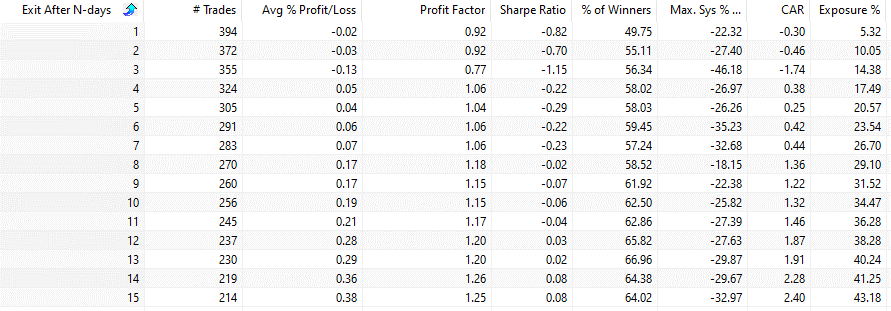
The first column shows the number of days until you exit. For example, the row number “5” is the result and strategy performance metrics by holding the position for five days and then exiting.
The result is not good. The reason is simple: the stock market has over the last three decades been very mean revertive, and thus it’s much better to buy on weakness (a follow-through day buys strength). However, this is for the short term. In the long term, the stock market trends up. Moreover, O’Neil, the inventor of the follow-through day, is not a market timer nor an index trader. O’Neil focuses on stocks and the results might be somewhat different if we backtest on individual stocks.
The results improve slightly if we include a filter, for example, the 25-day RSI should be lower than 55 (to limit buying strength).
If you want the Amibroker code for this strategy (together with over 100 different ideas for other strategies), you can order it here.