

How Does The S&P 500 Perform When Interest Rates Are Rising? (Setup, Rules Backtest, Performance)
The relationship between interest rates and stocks is crucial to understand if you are investing in the stock or bond market. How does the S&P 500 perform when interest rates are rising?
Interest rates and the stock market have an inverse relationship. When interest rates rise, share prices fall, and vice versa. This is a generally believed parading in finance, which we decided to test to see whether it holds up in reality.
This article will show the relationship between interest rates and stocks and backtest different interest rate strategies.
Related reading:
Relationship between interest rates and stocks
Typically, a shift in the interest rate requires a minimum of 12 months to exert a broad economic influence. However, the stock market tends to react much more swiftly to such changes, even anticipating future rate increases. The stock market discounts today what will happen in the future. Sometimes right, sometimes wrong, and sometimes it overshoots both ways.
Gaining insight into the correlation between interest rates and the stock market empowers investors to comprehend the potential impacts of changes on their investments. Most people think these two assets have a negative correlation, but this is not always the case:
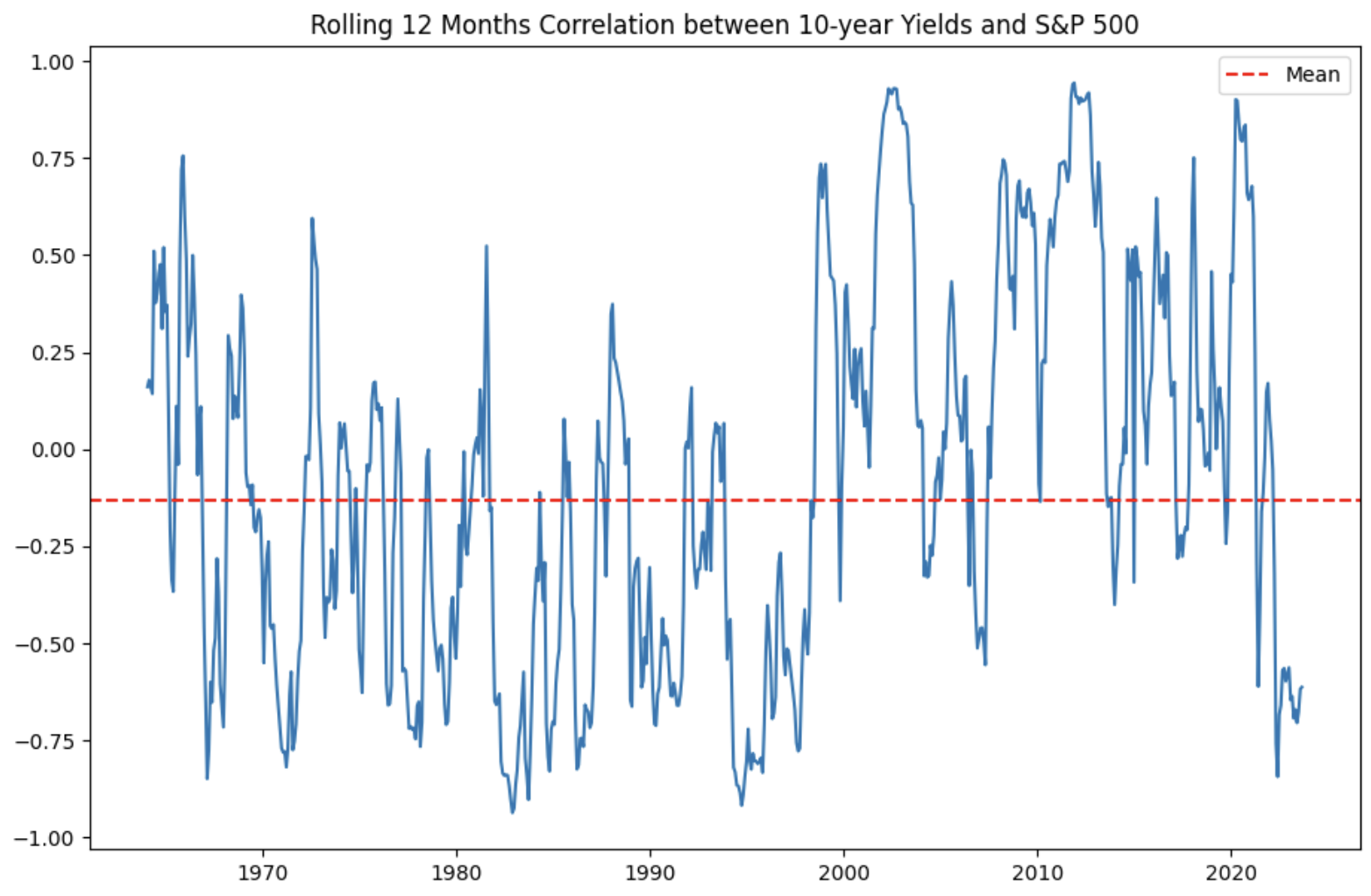
Although the mean is slightly negative, since the 2000s, the correlation has become much more positive, so higher interest rates may not necessarily translate into lower stock prices. We decided to backtest this by creating a few different trading strategies.
How does the S&P 500 perform when interest rates are rising – trading rules
The trading strategy we are going to backtest is pretty simple:
Trading Rules
[am4show have=’p2;p3;p58;p59;p130;p138;’ user_error=’Premiu