
Buybacks – Instead Of Paying A Dividend
How a company allocates capital has a strong influence on how the share price performs over time. In the previous lessons, we looked at dividend investing and showed that dividend-paying stocks have outperformed those that don’t pay a dividend.
But by excluding non-paying stocks, you limit your universe and also exclude many great companies that could pay a dividend but for many reasons chose not to pay a dividend. Berkshire Hathaway is among the group of non-payers. But Berkshire has been such an excellent investment precisely because it has not paid a dividend!
Instead of paying a dividend, Berkshire has reinvested earnings at very high rates of return: Unless you are a very gifted investor, you are unlikely to produce the returns that Warren Buffett has. Thus, investors have been much better off letting the money stayed in Berkshire, and instead selling shares if they needed a “dividend”.
However, Berkshire has bought back shares when Buffett thought Berkshire was trading below intrinsic value.
What are buybacks?
When a company buys back shares, it buys its own shares.
For example, Apple might instruct its treasurer or broker to buy Apple shares in the market. When the treasurer does this, they go out in the marketplace and buy Apple shares on equal terms as all other participants (open market repurchases). This is by far the most common way to buy back shares.
What happens with those shares bought back by Apple?
Those shares are either kept on the books of the company or later canceled/written off. But the effect is obvious: There are fewer outstanding shares. When there are fewer shares outstanding, it means more profits are distributed to the remaining shareholders. A company makes the same profits no matter how many shares are outstanding. If you owned 1% of a company that bought back 3% of the shares during a year, your ownership has increased to 1.03%.
Buybacks are more popular than dividends
Since the 1980s the share of buybacks has increased. S&P Global publishes a report on how companies spend their capital at regular intervals. The table below shows that more and more is spent on buybacks every year:
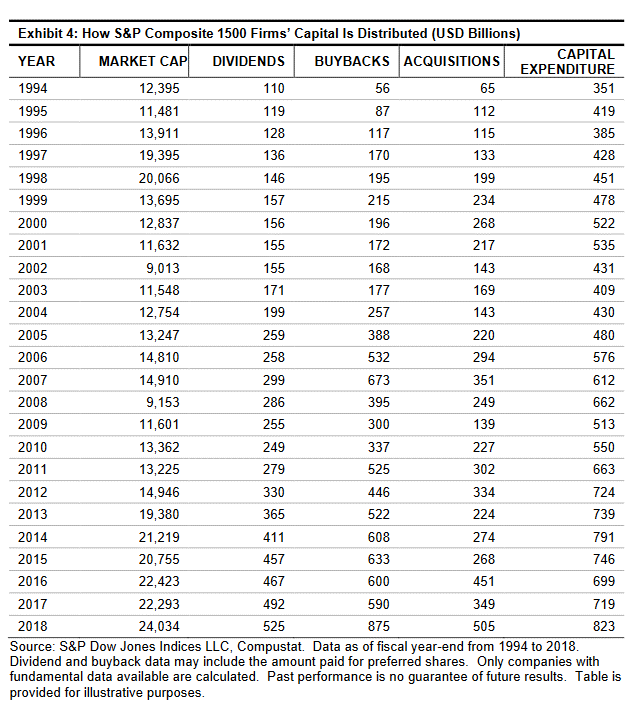
Clearly, since 1994 more capital has been spent on buybacks than on dividends! Yet, both the media and investors focus more on dividends.
If so much capital is spent on buybacks it would be pretty interesting to know how companies that buy back shares fare compared to the overall market.
Are buybacks good for stocks or investors?
S&P has constructed a buyback index that tracks the 100 companies in the S&P 500 with the highest buyback ratio in the trailing 12-month period. The buyback ratio is calculated as follows:
The criterium is defined as the monetary amount of cash paid for common share buybacks in the previous four calendar quarters divided by the total market capitalization of common shares at the beginning of the 12-month trailing period.
How has the S&P 500 Buyback Index performed?
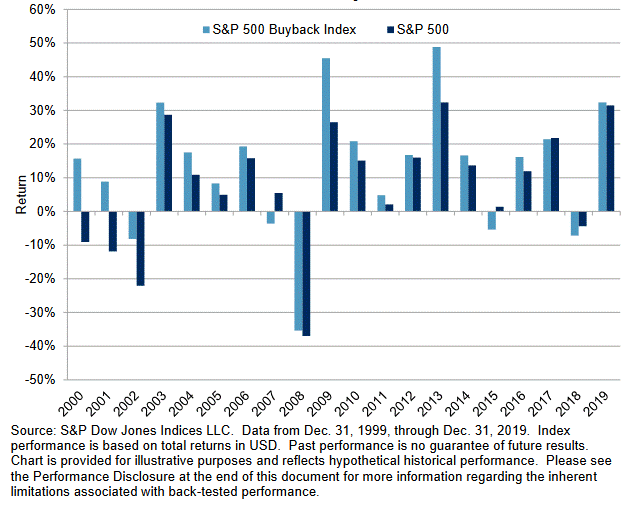
From 2000 until 2019 it outperformed by 5.5% annually, according to S&P. It outperformed in 16 of 20 years, albeit with overall higher volatility than the S&P 500. The two charts below show the returns:
 If we zoom in and look at only the last ten years the performance looks like this (the white line is the Buyback Index and the blue line is the S&P 500):
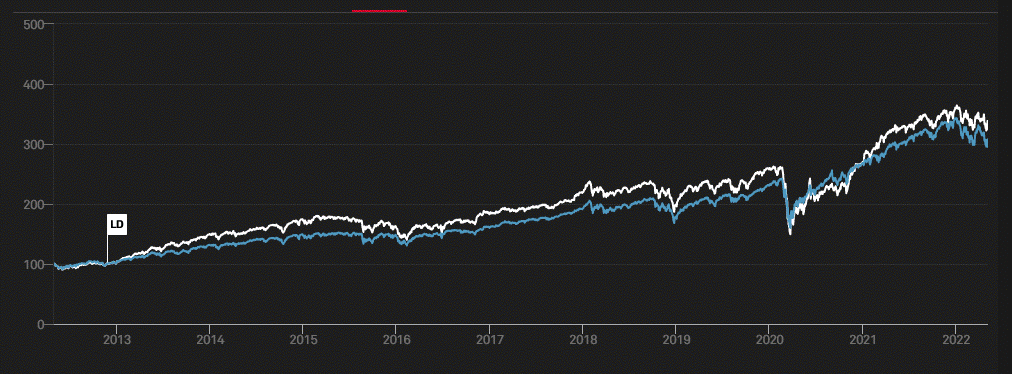
As you can see from the S&P 500 Buyback Index, it looks likely that companies that buy back shares perform better than the market, just like dividend stock does.