
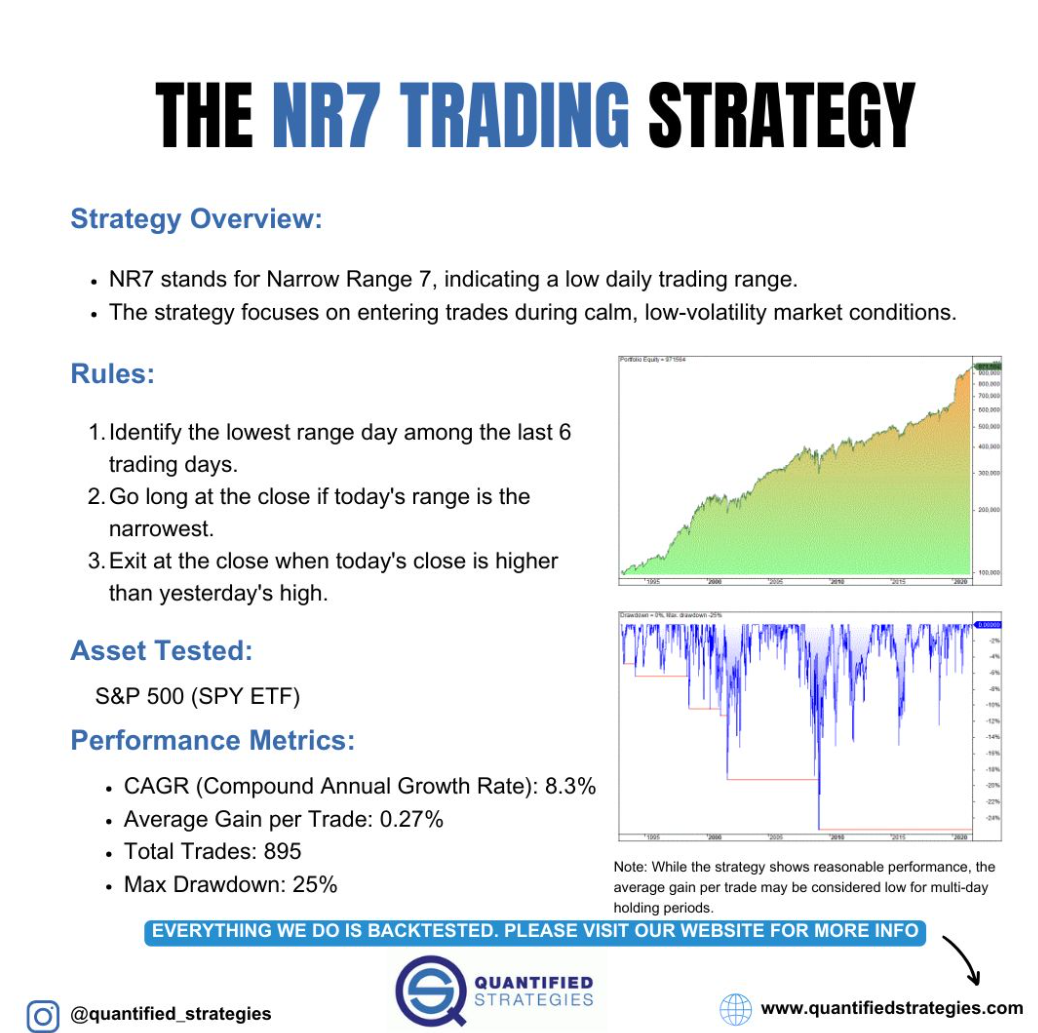
NR7 Trading Strategy – The Narrow Range 7 (But Better and Improved)
The NR7 trading strategy is a narrow-range strategy that is both well-known and popular. If you do a search on the internet, you get multiple hits on the strategy. To our knowledge, the strategy was first developed by Tony Crabel as long back as 1990. The NR7 is a volatility strategy but enters on a day with a narrow trading range (low volatility).
In this article, we backtest the Narrow Range NR7 trading strategy. The strategy works reasonably well, but we improved it by adding one simple parameter.
NR7 strategy video
We also made a video of the strategy and the backtest results.
What is the Narrow Range NR7 trading strategy?
There is an expression in most languages that says it’s calm before the storm. The main idea behind the NR7 is to enter when the daily range is low – when markets are calm (a narrow range trading day – a narrow candlestick). Unfortunately, the strategy doesn’t come with a defined exit strategy – only when to buy.
Thus, we made our own version of the NR7 trading strategy and made the following trading rules listed below. We test the following hypothesis on stocks:
Trading Rules
[am4show have=’p2;p3;p58;p59;p130;p138;’ user_error=’Premium Post Access’ guest_error=’Premium Posts’]
- The range, or volatility, is the difference between the High and the Low (each day).
- If today has the lowest range of the previous last 6 trading days, then we go long at the close.
- We exit at the close when today’s close is higher than yesterday’s high.
[/am4show]
We have one parameter for entry and one exit criterium, and a trading strategy can hardly get any simpler than that (?). We test on the S&P 500 by using the ETF with the ticker code SPY.
If we invest 100 000 and let it compound since the inception of the ETF in 1993 we get the following equity curve and drawdowns:
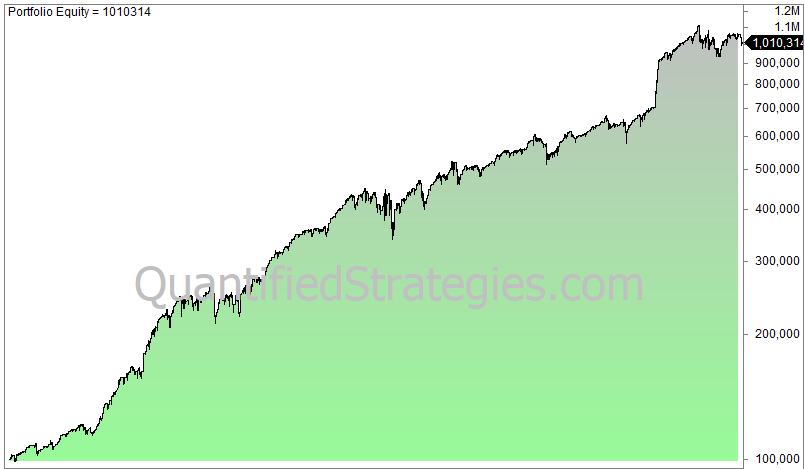
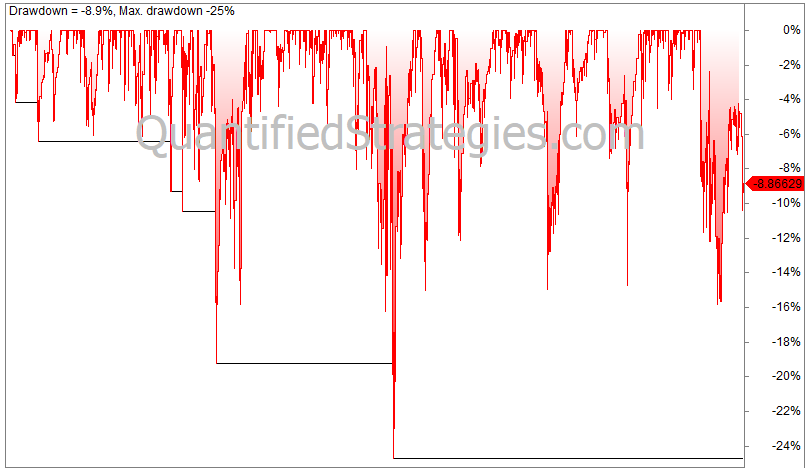
The CAGR is 7.8% (time invested is 35%), the average gain per trade is 0.27%, there are 899 trades, and the