
Sell In May And Go Away – OBX in Norway Explained
Sell in May and go away must be one of the most famous phrases in the stock market. But is it correct? This is the first time I test this. There is a lot of academic empirical evidence showing this anomaly has been in existence for many decades, both in the USA and elsewhere.
I test the following on Norwegian OBX index from 1997 until today (OBX includes the 25 most liquid stocks on Oslo Stock Exchange):
- Buy the open on the first day of May, sell the open first day in October, versus
- Buy the open on the first day of October, sell the open first day in May.
Buying the open in May and selling the open in October gives this accumulated chart:
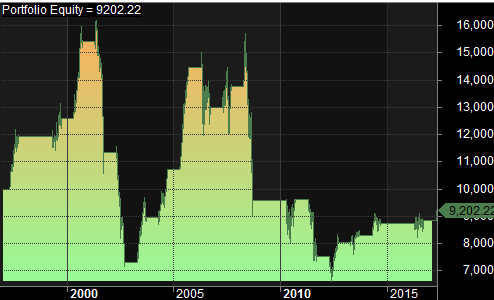
Total return is slightly negative (-0,41% annual return). There are just 5 losing months out of 17, but the average winner is “only” 11.69% versus the average loser of 24.95%. All 5 losers are bigger than 10%: 2001 (-26%),2002 (-35%), 2006 (-10%), 2008 (-30%) and 2011 (-22%).
Buying the open in October and selling the open in May gives this accumulated chart:

Annual return is 11%. Average winner is 16.13% and average loser is 11.31%. 3 losing periods: 2000/2001 (-10%), 2007/2008 (-4%) and 2008/2009 (-20%).
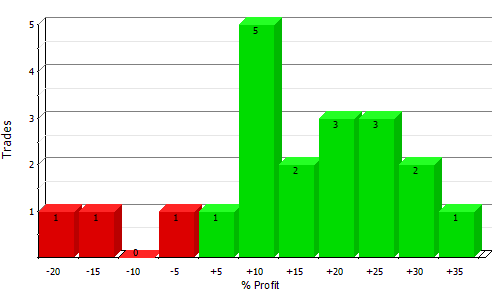
The “skewness” looks nice:
FAQ:
– Is there empirical evidence supporting the “Sell in May and go away” strategy?
Yes, there is academic empirical evidence indicating that this seasonal anomaly has existed for decades in both the USA and other markets.
– What were the average returns for the “Sell in May and go away” strategy in May and October?
The strategy showed an average winner of 11.69% in May and an average loser of 24.95%. However, there were only 5 losing months out of 17.
– What happened when the opposite strategy of buying was tested in October and selling in May?
Buying in October and selling in May resulted in an annual return of 11%. The average winner was 16.13%, and the average loser was 11.31%. There were only 3 losing periods.