
Sell Rosh Hashanah – Buy Yom Kippur Trading Strategy (Rules And Backtest)
The phrase “Sell Rosh Hashanah, Buy Yom Kippur” has been a cornerstone of trading “folklore” for decades, at least since Eisenhower was president.
Its origins trace back to a belief that September, when these Jewish holidays typically fall, is a tumultuous period for stocks. This notion is not without merit. Historical data reveals that September has often been a challenging month for the stock market, prompting traders to exercise caution and avoid excessive exposure during this time. The worst week of the year for stocks is also in September (covered in our member articles).
Furthermore, Yom Kippur, while not an official market holiday, is observed by a significant number of people in the New York area, particularly within the Jewish community. Their absence can impact trading activity as positions are squared ahead of the holiday.
You might also be interested in our extensive library of seasonal trading strategies.
Sell Rosh Hashanah – Buy Yom Kippur Trading Strategy – trading rules and backtest
The trading rules are simple:
[am4show have=’p2;p3;p58;p59;p130;p138;’ user_error=’Premium Post Access’ guest_error=’Premium Posts’]
- We sell short when Rosh Hashanah starts; and
- We buy back when Yom Kippur ends
Basically, shorting the market when Rosh Hashanah starts and covering when Yom Kippur ends.
[/am4show]
We backtested the cash index of S&P 500 from 1928 until today, and we got the following equity curve (the data is not adjusted for dividends):
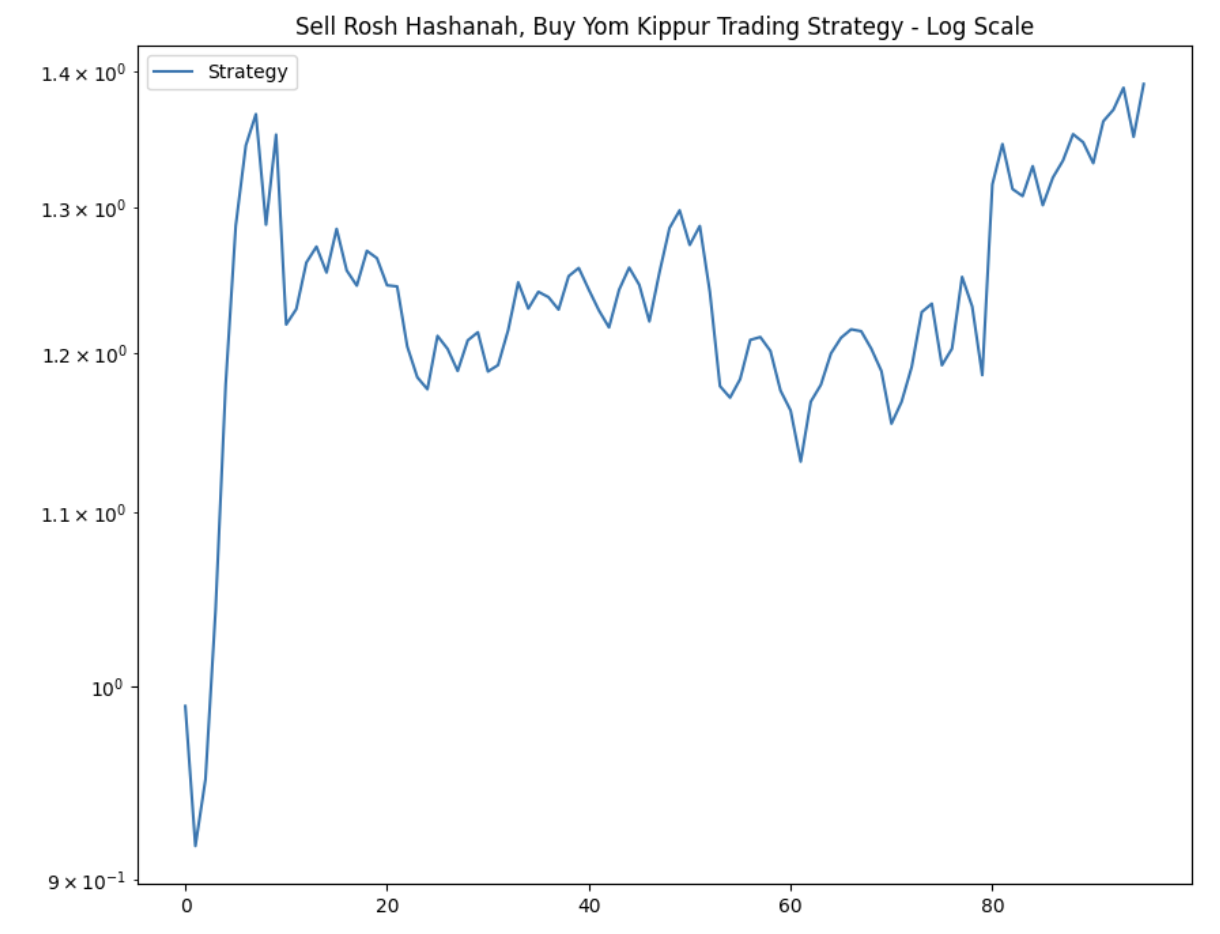
The equity curve shows that this is not a particular profitable trading strategy with erratic returns.
The trading performance and statistics look like this:
- Total return is 39%
- CAGR is 0.34%
- Time spent in the market is 2.52%
- Risk adjusted return is 13.49%
- Win rate is 53.12%
- Average return is 0.39%
When President Dwight D. Eisenhower suffered a heart attack
The adage gained widespread recognition in 1955, a year etched in trading history.
On the eve of Rosh Hashanah, the Dow Jones Industrial Average closed at 483.66. A week later, it had registered a modest 0.78% gain. However, the weekend brought a shocking event: President Dwight D. Eisenhower suffered a heart attack.
As Yom Kippur commenced, the market reacted violently. The Dow plummeted by a staggering 6.54%, marking its second-largest single-day point drop at the time. Those who followed the advice to sell on Rosh Hashanah were shielded from this abrupt downturn.
Unveiling the Empirical Evidence: A Deeper Dive
Recent studies have delved into the empirical evidence supporting this phenomenon.