
Sharpe Ratio Explained (Logic, Examples And Trading Strategies)
What is a good Sharpe ratio? Every trader is looking to find high Sharpe Ratio strategies. The Sharpe Ratio is a popular and widely used indicator for comparing the return and its risk. The name is given by its inventor, William Sharpe, who developed the ratio during the 1960s. Sharpe later won the Nobel Prize in economics in 1990 for his contributions to the financial industry. This article explains what the Sharpe Ratio is and seeks to clarify what a good Sharpe Ratio is.
The Sharpe Ratio measures the excess return compared to the risk-free rate per unit of risk. A good Sharpe Ratio is preferably above 0.75, but be careful if it’s above 1.5.
Risk is measured in terms of volatility. The ratio is used for any asset and its return, but mainly for funds that try to smooth the returns, for example, hedge funds and traders. It’s used less for traditional mutual funds.
A hedge fund’s Sharpe Ratio – the logic behind the Sharpe Ratio
Let’s first explain the simple logic behind the Sharpe Ratio. We use a practical example from one of Europe’s oldest and largest asset managers: The Swedish Brummer & Partners.
They have been 25 years in the business and manage about 10 billion USD spread among about ten different hedge funds across all asset classes. Below is their equity curve, which shows how their Multi-Strategy has performed since 2002:
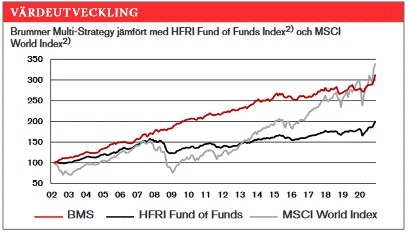
The red line is the Multi-Strategy, a fund that allocates capital to about 10 different funds to diversify and smooth returns, while the grey line is the MSCI World Index.
They both have about the same return, but Multi-Strategy has smaller drawdowns. Because of this, the Sharpe Ratio is much higher: 1.11 vs. 0.39. The difference should give a pretty good idea of what the Sharpe Ratio is all about:
If your strategy is volatile, you need to be compensated in the form of higher returns. When you evaluate an investment, professional managers look at the returns and the associated risks. It doesn’t make sense to earn a little more if you face the possibility of a higher drawdown (and subsequent risk of ruin if you use leverage). All things equal, investors prefer the smoothest returns. Every hedge fund wants a high Sharpe ratio – preferably above 1.
Nevertheless, risk is very much a personal preference.
If you are young, you can take greater risk in your portfolio because you have more time until retirement, while someone closer to retirement might be more conservative to avoid a significant drop just before he or she starts withdrawing money.
The balance is difficult, and no mathematical number has ever predicted the future accurately.