
Some Performance Facts About the S&P 500 Index
By looking at some potential strategies for S&P 500 I found some very interesting facts that I wouldn’t guess beforehand. I used the ETF SPY as a proxy for the S&P 500.
My dataset starts at 1. January 1994 and ends yesterday, 25th of October 2018. The data is adjusted for dividends and taken from Yahoo!.
Here are some interesting numbers:
- Return is about 9.2% per year (CAGR).
- Of 6250 trading days, 3370 are up days, 2831 are down days and 48 are unchanged. Even though SPY managed to gain 9.2% per year, 45% of the trading days are negative (!).
- The average up day is 0.76%. The average down day is minus 0.81%. The average gain per day is 0.042% (over the whole period).
- 865 days with gains bigger than 1%. 212 days with gains bigger than 2%.
- 801 days with losses of more than 1%. 258 days with losses of more than 2%.
- From the top in May 2008 to the bottom in early March 2009, the S&P 500 lost about 50% of its value. There were 99 up days and 104 down days during this period.
- The average up day from May 2008 to March 2009 was 1.79%. The average down day was minus 2.32%. In other words, down days were brutal.
- From May 2008 to early March 2009, it was 51 days with a rise >1%, 30 days with a rise >2%, 76 days with losses >1%, and 45 days with losses >2%.
Volatility explodes during bear markets (this is of course no surprise). Below is the graph showing a 25 day moving average of the absolute values in the daily changes from close to close:
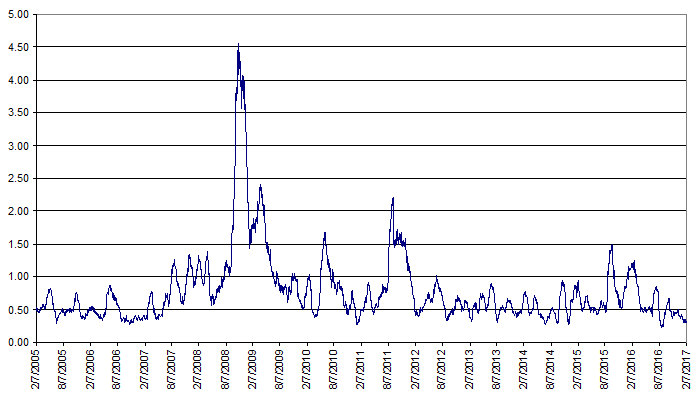 In the midst of the recession in 2008 S%P 500 had daily swings of 4.5%! (This period was, by far, my best time as a daytrader).
If you like this article we recommend reading the anatomy of a bear market.
FAQ:
– How many trading days have there been in the dataset, and what is the distribution of up and down days?
The dataset covers 6250 trading days, with 3370 up days, 2831 down days, and 48 unchanged days. Surprisingly, despite the long-term gains, 45% of the trading days are negative.
– What are the average daily returns for up and down days?
The average up day has a return of 0.76%, while the average down day has a return of -0.81%. The overall average daily gain is 0.042% over the entire dataset.
– How often did the S&P 500 experience significant daily gains and losses?
There were 865 days with gains greater than 1% and 212 days with gains greater than 2%. On the downside, there were 801 days with losses of more than 1% and 258 days with losses of more than 2%.
This is simply what I would publish on the firs page of every financial book Oddmund! Just to daily remind us how markets really work…
Marco Simioni
https://quantfor.wordpress.com/