
Thanksgiving Holiday Trading Strategy | Seasonality
Can we develop a Thanksgiving holiday seasonal trading strategy? Thanksgiving Day is one of the federal holidays in the US. The day after Thanksgiving is called Black Friday and is a day when consumers go on a shopping spree. But how does Thanksgiving affect the US stock markets?
Yes, our backtests reveal that stock market performance during Thanksgiving is higher than any random week.
The US financial markets do not open on Thanksgiving Day because it is a federal holiday. Trading does not take place on any of the U.S. stock exchanges on that day, and the following day, the stocks and bond market also close early.
Related reading: Backtested seasonal trading strategies
(The backtests done below are based on the cash index which is not a tradable instrument. If you trade the corresponding ETF or futures contract the results might differ. As always, do your own backtesting.)
The Thanksgiving holiday
Thanksgiving Day is an annual federal holiday in the United States to celebrate the harvest and other blessings of the past year. It is celebrated on the fourth Thursday of November every year. It is generally believed that the American Thanksgiving is modeled on a 1621 harvest feast observed by the English Pilgrims of Plymouth and the Wampanoag people.
The Thanksgiving holiday is particularly rich in legend and symbolism. Traditionally, the Thanksgiving meal typically includes turkey, bread stuffing, potatoes, cranberries, and pumpkin pie. Regarding vehicular travel, the Thanksgiving holiday is one the busiest of the year, as family members tend to gather together to share the moment.
Is the day before Thanksgiving or after a trading day?
While Thanksgiving Day is not a trading day for all US markets, the day before and after it can be trading days. The day before is a full trading day, while the Friday after Thanksgiving (Black Friday) is a half-day where the stock market close at 1300 local ET time. The Friday is called Black Friday because of its importance for the retail sector.
The Thanksgiving holiday effect in the S&P 500 – backtest 1: the Thanksgiving week
How does the stock market perform around the famous turkey celebrations in November? We test the Thanksgiving holiday effect this way:
-
- We go long at the close the Friday prior to Thanksgiving
-
- We exit at the close on Black Friday (we hold for one week)
We backtest S&P 500 from 1960 and Amibroker returns the following equity curve:
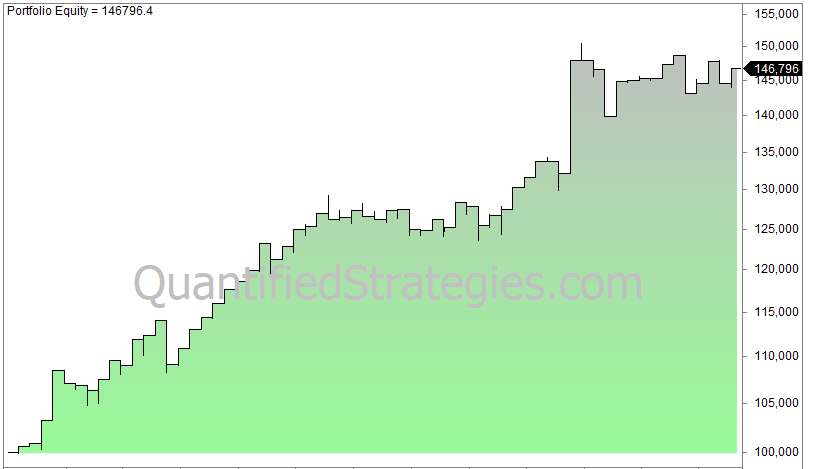
There are 63 trades since 1960, the average gain is 0.64%, the win ratio is 68%, the profit factor is 2.2, and the max drawdown is 7%. This equals a CAGR of 0.6% while being invested just 1.6% of the time. The gain is higher than for any random week during the year.
The Thanksgiving holiday effect in the S&P 500 – backtest 2: the week after Thanksgiving
In our second backtest of the day, we look at the performance the week after Thanksgiving. We test the following:
-
- We go long at the close of Black Friday
-
- We sell at the close one week later
The equity curve looks like this:
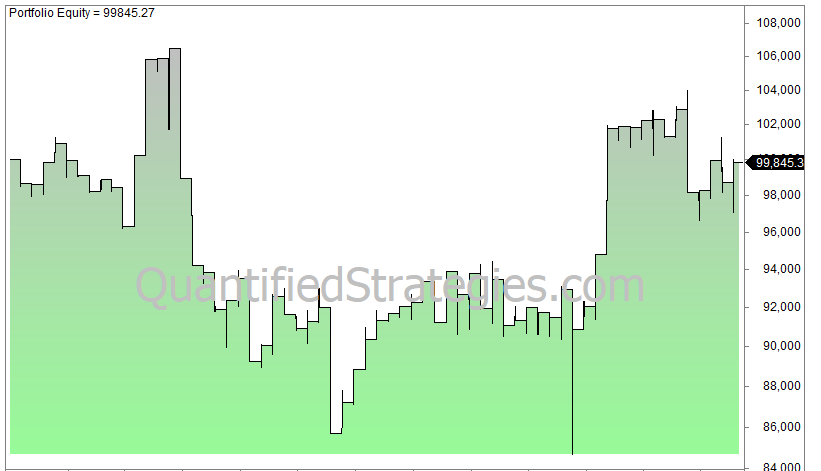
As you can see, the equity curve is pretty erratic. The average gain per trade is a low 0.03%, much lower than any random week.
Thanksgiving effect until December – backtest 3
Let’s test another twist of the Thanksgiving effect:
-
- We go long at the close the Monday p