
Five Exit Strategies in Trading: When to Exit a Trade To Maximize Profits
How and when should you exit a trade? Most articles about trading center around when to buy (or sell short) or how to deal with the psychological aspects. Hardly anything can be found about exits, even though when to exit a trade is probably just as important as the entry. How and when should you exit a trade? What method should you use to exit a trade? What is the best time to close a trade? When to exit a trade? How long should you wait until you exit? This article looks at 5 trading exit strategies.
This article summarizes the 5 exit strategies in trading. 5 main methods of how to exit or close your trading strategies, and we provide multiple examples of how and when to exit a trading strategy. At the end of the article, we do a test by entering randomly but adjusting the exit variable.
How important is it to know when to exit a trade?
Let’s illustrate the importance of exits with some anecdotal evidence from the training course of the proprietary trading firm Bright Trading.
When we started full-time trading 20 years ago, something we covered in our 26 trading lessons, Bright Trading taught its traders how to make money by being on the same side as the specialist. Bright’s course taught the traders how to send opening-only (OPG) orders in a basket of NYSE stocks before the opening each day. This could be done by sending a limit order above and below the estimated opening price in the expectation that you would get a price improvement when the (or if) the specialist opened the stock high or low.
For example, if you sent a short order at 50.13 USD you might get filled at 50.25 instead. If the stock opened lower, the order would automatically cancel and you’d get no shares. Without going into details, this simple strategy worked very well until the financial crisis in 2008/09. We traded this strategy well for many years, while others failed.
The interesting thing is that all traders in Bright’s course had the exact same entry, yet some traders were unsuccessful while others made huge amounts of money. The difference is due to money management, position-sizing, and when and how you exit a trade. The latter is probably the most important. This shows how it can be worthwhile to spend some time on the exits and not only on the entry.
What is the best exit strategy in trading?
We emphasize that there is no best exit strategy in trading except one rule: keep it as simple as possible. The more variables you include in an exit strategy, the more likely you are to curve fit your backtests.
Moreover, the exit depends on the strategy. If you have a short-term mean reversion strategy, it makes sense to sell on strength. Opposite, in a longer trend-following strategy it might make sense to exit on weakness, ie. when the trend is changing.
Hence, we can safely conclude there is no best exit strategy in trading.
Different trading exit strategies
There are, of course, almost unlimited ways to exit a position in trading. Below is a description of the most common techniques of how to exit a trade:
Trading exit strategy 1: An exit based on parameters/variables
When you backtest a trading idea, you use some strictly defined variables about how and when to enter a trade. This could for example be to buy at the close when the two-day RSI is below 10.
When simulating this trading strategy you can employ the “opposite” sell signal: sell when the two-day RSI is above 90. If you backtest this on the S&P 500 since 1993 on the oldest ETF around (SPY) you get this equity curve if you invested 100 000 and compounded/reinvested until September 2021:
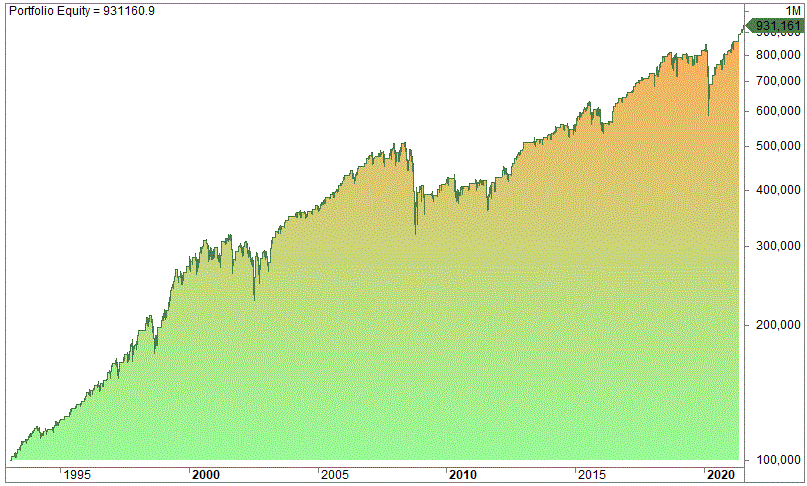 The number of trades is 226, the average gain is 1.05% per trade, the max drawdown is 37%, and the profit factor is 2.1. The exposure time, the time spent in the market, is quite high at 38%, and the reason for that is the relatively high threshold of when to exit. A two-day RSI is of 90 is high and “forces” you to stay in a trade for a reasonably long time.
Let’s change the exit threshold and test any level when the two-day RSI is higher than 50 with intervals at 5 (while keeping the entry variable the same):
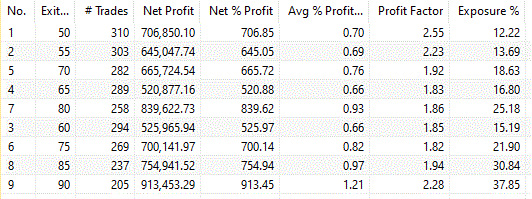 Column 2 in the chart above shows the different values. For example, row 2 shows the result if we exit when the two-day RSI is above 55. This strategy returns this equity curve:
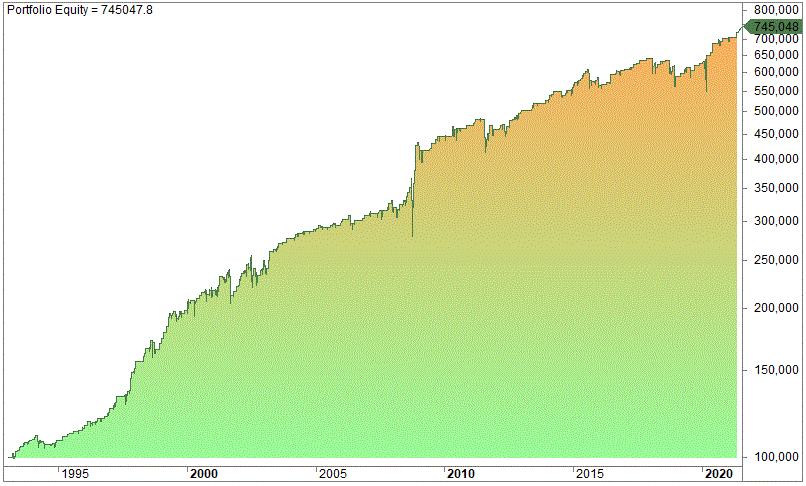 The total return is lower, but the losses and suffering along the way are reduced: the max drawdown is 24%. You get slightly more trades (303), but the time spent in the market is reduced a lot (14%).
By playing around you can see how the different exit criteria changes as the exit variable is changed.
Trading exit strategy 2: Time-based exit
This is one of the simplest possible exits there is. You simply exit after a certain period of time, be it minutes, days, months, or n bars. A time-based exit might be simple, but it’s still one of the most efficient exits you can use. We regard a time exit as a very underrated exit parameter.
One other advantage with a time-based exit is reduced drawdowns. Such an exit makes sure you spend just a small amount of time in the market, and you additionally get out early if it’s just a beginning of a bear market.
Yet another advantage with a time-based exit is the lack of curve fitting. There might be better ways to spend your time than to optimize the exit, and time-based exits are simple but very efficient. We emphasize again the