What happens to stocks when Bonds go up? (Historical Analysis)
What happens to stocks when bonds go up (what happens to stocks when interest rates go down)? Any stock investor or trader should have a basic understanding of the relationship between stocks and interest rates. Why? Because the interest rates influence investors’ risk appetite. When interest rates are high, you need to pay more for a company’s earnings (thus a lower PE ratio).
When bonds go up and interest rates go down, stocks perform well. A higher price for the bond means that the yield and interest rates go down. When interest rates go down, it’s more attractive to own risky assets like stocks. We do a simple backtest to illustrate this relationship.
The relationship between bonds and stocks
It all comes down to interest rates. As an investor, all you’re doing is putting up a lump-sump payment for a future cash flow.
First, you need to understand the theoretical relationship between bonds and stocks. They tend to correlate to one another. When bond prices are up, stocks tend to rise. Higher prices in bonds mean that the yield goes down which is positive for stocks. When bond prices go down, the yield increases, which is not good for stocks.
Let us explain:
An issued bond pays the same coupon until maturity (the coupon is the annual payment to the bond owners). For example, if a bond has a coupon of 5% it will pay this coupon until the bond matures (or is called in), let’s say 20 years. A company or sovereign state might issue a one billion bond and pay 5% annually – 50 million in annual interest payments.
However, during such a long period, the market’s interest rate expectations are not fixed at the same rate. The rates vary – a lot. If the interest rates go down, the 5% loan gets more attractive and as a result, the price of the bond goes up. But the coupon is still 50 million a year, meaning the bond trades with a lower effective interest rate, perhaps 4.5%. For a bond with a coupon of 5% to yield 4.5%, its price needs to go up. Bond prices and yields have an inverse relationship.
Bonds are less risky than stocks
Bonds are less risky than stocks. When a company goes bankrupt, bondholders are paid before equity owners (of what is left).
When rates go down (bonds go up), it gets more attractive to own stocks. When interest rates go up, owning riskier assets like stocks, gold, and Bitcoin is less attractive.
The relationship between stocks and bonds is not constant but varies from time to time. We believe it’s safe to anticipate a higher correlation between bonds and stocks when inflation goes up. We have witnessed a 40-year bullish run with falling rates, in many countries even all the way to negative nominal rates, and as of writing, we are seeing inflation rates at 8% in many Western markets.
What happens to stocks when bonds go up?
We are not fond of anecdotal evidence so let’s do a backtest.
Our backtest is formed on the hypothesis that rising bond prices are positive for stocks. Let’s do a simple backtest to see if we are right or wrong. We backtest the following hypothesis:
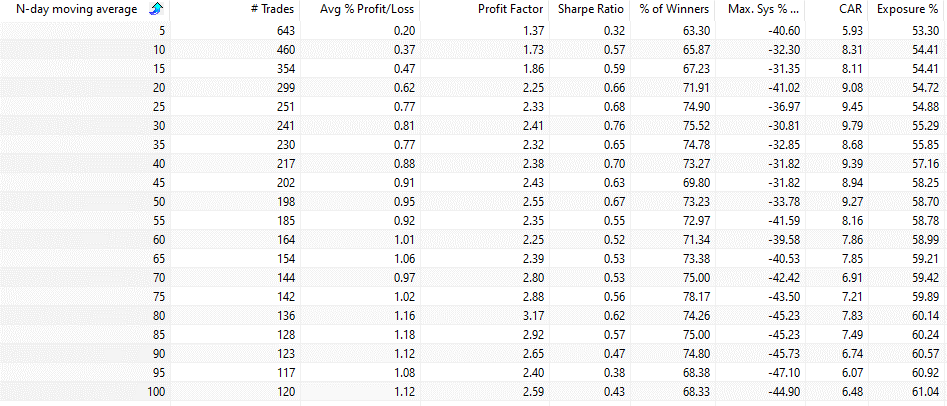
We are long stocks (SPY) when bonds (TLT) are above the N-day moving average, and we sell when it’s below the moving average.
For example, when TLT crosses above its 20-day moving average, we buy SPY at the close. When the close of TLT crosses below its 20-day moving average, we sell SPY at the close and are out of the market until TLT later crosses above its 20-day moving average.
SPY is the ETF of the S&P 500 and TLT is the ETF of the US 20-year Treasury bonds. When TLT goes up in price, the interest rates go down.
We backtest by optimizing the N-day moving average from 5 days up to 100 with 5-day intervals (in total 20 backtests). The results look like this: