Wheat Trading Strategy (Backtest And Futures Example)
Trading agricultural commodity futures contracts, such as wheat futures, offers the opportunity to diversify your portfolio into the soft commodity market. Wheat futures can also be traded for hedging purposes or just speculation. For speculators, the goal is to profit from price fluctuations. Whatever the reason for trading, to trade it successfully, you will need a wheat futures strategy.
A wheat futures strategy refers to the methodologies and techniques you can use to trade wheat futures contracts profitably. Wheat futures are tradable derivative products that represent a contract to buy or sell a specified quantity of wheat on a future date, at a pre-agreed price. The contract trades on the CME Globex platform and is deliverable on expiry. You can use a wheat futures strategy to speculate on the price of wheat, diversify your portfolio, or hedge your exposure in the wheat market.
In this post, we answer some questions about the Wheat futures strategy. We will focus on the SRW wheat futures and also make a backtest
What are Wheat futures?
Wheat futures are standardized, exchange-traded contracts in which the contract buyer agrees to accept delivery, from the seller, a specified amount of Wheat (e.g., 5000 bushels) of a particular type of wheat at a fixed price on a future delivery date. The contract is traded on the CME Group’s CME Globex. There are different types of wheat — Hard Red Winter Wheat (HRW), Hard Red Spring Wheat (HRS), and Soft Red Winter Wheat (SRW).
Here, our focus is on the Chicago SRW wheat futures (ZW). At contract expiration, the seller of the wheat futures contract delivers the specified amount and quality of SRW wheat to the buyer via the exchange. Wheat traders who don’t want to get involved in wheat delivery can close out their positions before expiry or roll them over to the next contract month.
What is a Wheat futures strategy?
An SRW wheat futures strategy refers to the methodologies and techniques you can use to trade the contract profitably. This includes technical and fundamental analyses of the SRW wheat futures market for good market timing. While technical analysis focuses on studying the chart, fundamental analysis involves studying the factors that affect wheat futures.
To succeed in the wheat futures market, you need a robust trading strategy that offers precise entry and exit signals. In addition, your SRW wheat futures strategy must include techniques for position sizing, risk management, and so on.
Wheat futures strategy backtest
A strategy backtest with trading rules and settings is coming shortly.
What is the seasonality of Wheat futures?
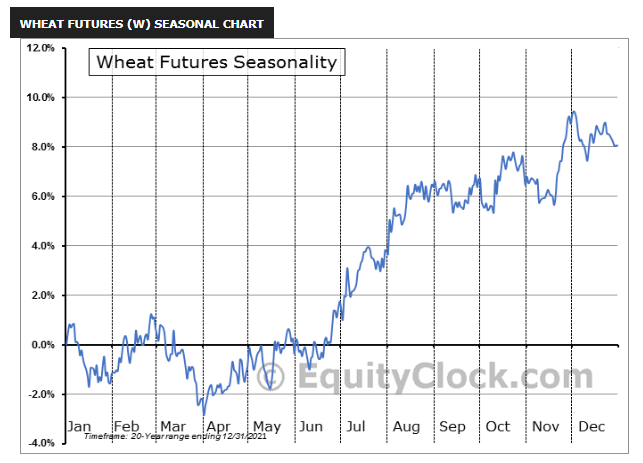
Seasonality in wheat futures refers to the tendency of wheat futures to move in a fairly predictable way during certain periods of the year. The periods here may refer to the months of the year or the four seasons (winter, spring, summer, and fall) of the year.
Wheat futures have been noted to perform better from July to December, as can be seen in the chart below: