
the University of Michigan Consumer Confidence Index and Stock Market Returns – Strategy and Backtesting Insights
Consumer confidence Index tries to gauge the temperature of the economy. It swings from pessimism to optimism – just like Mr. Market who is rather manic-depressive. In the US it’s made by the Conference board and it casts doom and gloom on a monthly basis.
The University of Michigan Consumer confidence index measures optimism (or lack of optimism – pessimism) in the overall economy. Our backtests reveal that when the Michigan consumer confidence is bullish the stock market performs much better than when consumer confidence is bearish.
This article explains what consumer confidence is and at the end, we perform two backtests: one backtest showing that stocks perform well when consumer confidence is bullish, and a second test showing that stocks perform poorly when consumer confidence is bearish.
Before we go on to explain what consumer confidence is and how it’s calculated, we go straight to our backtests and look at the relationship between stocks and consumer confidence:
Consumer confidence and stock market returns – backtests
Let’s look at how stocks perform when consumer confidence is high and low to see if we can find any patterns.
In our backtests, we use US consumer confidence data from the database of OECD and not the specific data from the US Conference Board (see more below).
OECD collects consumer confidence data for all major countries that are published at the end of every month. OECD’s data varies slightly from the US version. The data we use in the backtests below are specific consumer confidence for the US economy (and not OECD overall).
In the graph below we show both the performance of S&P 500 (SPY) and OECD’s consumer confidence from 1993:
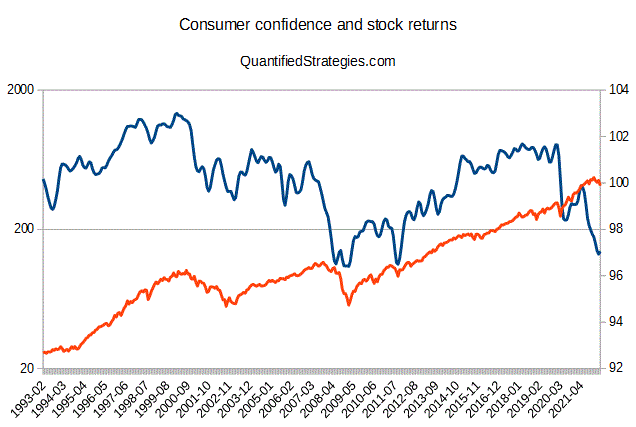
The blue line is consumer confidence (right axis) and the red line is S&P 500 (left axis and logarithmic scale). Clearly, consumer confidence seems to move down before the stock market heads down. Is this visual observation correct? Let’s test and finds out.
How does consumer confidence affect the stock market? – backtest 1
Our first backtest looks at the following:
Trading Rules
[am4show have=’p2;p3;p58;p59;p130;p138;’ user_error=’Premium Post Access’ guest_error=’Premium Posts’]
- We make a 12-month simple moving average of consumer confidence.
- When the last monthly consumer confidence reading is above the 12-month moving average, we are long S&P 500 for the next month.
- When the monthly consumer confidence report is lower than the 12-month moving average, we switch to cash for th