
Should Bitcoin Be a Part of Your Portfolio? Backtest, Allocations, and Simulations Analysis
For a long time, there has been debate about whether a classic investment portfolio should add cryptocurrencies. The debate gained traction when famous institutional investors secured a stake of their capital in Bitcoin. Should Bitcoin be a part of your portfolio? Let’s find out:
Yes, history shows Bitcoin should be a part of your investment portfolio. Our backtests show the importance of diversifying your investment portfolio. Bitcoin offers that with a low correlation to the market, providing superior returns on assets used for the same purpose and positively impacting portfolio metrics. However, there is no guarantee history will repeat itself.
How much crypto should be in your portfolio? This article investigates how adding Bitcoin to certain percentages in a classic portfolio impacts its metrics. We use a starting capital of $100,000. We use the ETF Vanguard Total Stock Mkt Idx Inv (VTSMX) as a proxy for equities. For bonds, we use the EFT Vanguard Total Bond Market Index Inv (VBMFX), and, of course, the BTC spot price.
You might want to click here if you are looking for an investment strategy.
The good old 60-40 classic portfolio and Bitcoin
For decades, the 60% equities and 40% bonds distribution in the classic portfolio has been the investment choice for retirement, that is, for the conservative investor.
This composition uses stocks as a growth engine and softens market volatility with fixed income from bonds. Financial advisors place their clients’ assets in portfolios with risk tolerance profiles, time horizons, and defined financial goals.
To simplify our model in this article, we assume zero cash flows (there will be no income or capital outflow), no rebalancing, and we will not reinvest the generated dividends. Our benchmark will be the Vanguard 500 Index Investor (SP500).
What percentage of Bitcoin should be in the portfolio?
For our first case study and backtest, we use the aforementioned 60-40 classic portfolio, but we add 1% Bitcoin, which will come from the equity percentage. Due to limited Bitcoin market data, our analysis range is from January 2014 to March 2023.
Here are the statistics and performance metrics:
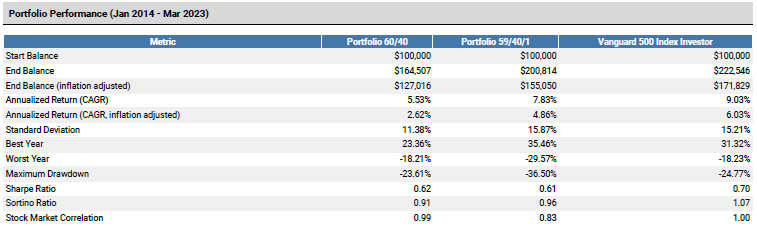
With a CAGR increase of over 2% versus the original portfolio, an almost identical Sharpe Ratio, and a slightly higher Sortino Ratio, the first thing we notice is a significant improvement in the performance of the portfolio model by adding only 1% BTC. The standard deviation was very close to the SP500 at 15.88%.
On the other hand, we cannot overlook the max drawdown, which is over 12 percentage points more than the 60-40 portfolio.
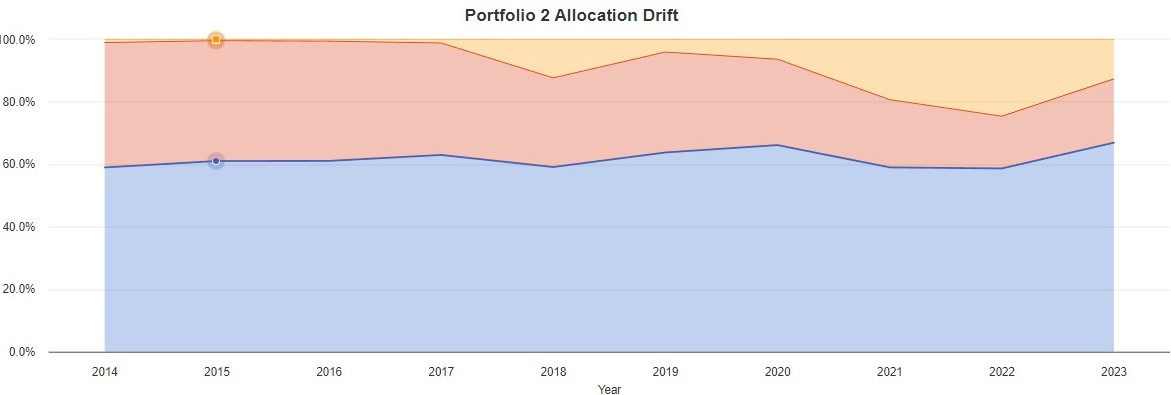
But why does the portfolio improve when adding Bitcoin? The answer is obvious: the percentage of BTC grew over time from an initial 1% to a final 12.34%, with a maximum of 24.58% in 2022.
Remember that in our case study, we decided not to rebalance the portfolio, and this is seen in the following chart:
Here are some interesting graphics of this model and our benchmark: