
Pair Trading Strategy in Liquid ETFs: A Comprehensive Guide (Formula, Backtest, and Real-life Example)
Many traders are pair trading ETFs. Pairs trading is one method of making your strategy less exposed to market fluctuations. Most traders trade stocks, but you can, of course, also trade ETFs. If you are trading ETFs you indirectly have a wide diversification, albeit to different segments of the stock market.
In this article, we look at an ETF pairs trading strategy. We go long the weakest ETF at the close and exit at the close the next day. It looks promising, but probably not a tradeable strategy.
An ETF pairs trading strategy in SPY, EEM, EWG, EWU, and EWJ
Today we test ETF pairs trading.
This Sunday morning I was just testing some ideas on these different ETFs: SPY (S&P 500), EEM (emerging markets), EWG (Germany), EWU (UK), and EWJ (Japan). They seek to copy the performance of the most important stock exchanges in the world.
The rules of the pair trading strategy are like these:
- Every day rank each ETF based on the IBS formula: (c-l)/(h-l).
- Buy on the close the one with the lowest value, short the one with the highest value.
- Exit on the close next day.
In other words, this is a 100% “market-neutral” strategy – a daily pair trade in ETFs.
I write “market-neutral” because no strategy is ever completely neutral unless you’re doing arbitrage. Even though you have the same amount invested long and short, or at least adjusted to the expected volatility, you are still exposed to adverse movement in either position. You are liable to black swans.
The ETF pairs strategy returns this equity curve in %:
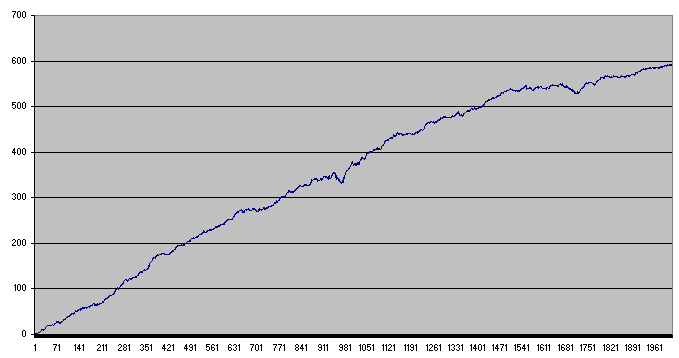
The test period is from 1. January 2005 until the present. No commission and no slippage.
Does anyone trade something similar to this? Obviously, this one is hard to implement because the MOC needs to be sent 15 mins before close. However, for example in Amibroker you can easily program your strategies to send orders just seconds before the close:
The ETF pair trading strategy presented in this article is very short-term. This means it involves both commissions and slippage.
FAQ:
How does an ETF pairs trading strategy work?
The ETF pairs trading strategy mentioned in the article follows specific rules: each day, ETFs are ranked based on the IBS formula, and the strategy involves buying the ETF with the lowest value and shorting the one with the highest value. The positions are exited on the close the next day.
Is the ETF pairs trading strategy market-neutral?
Yes, the ETF pairs trading strategy is considered market-neutral. However, the article emphasizes that true market neutrality is challenging to achieve due to potential exposure to adverse movements in either position, even with an equal amount invested long and short.
How does the short-term nature of the ETF pairs trading strategy impact overall returns?
The article notes that the ETF pairs trading strategy is very short-term, involving both commissions and slippage. The FAQs address the impact of the strategy’s short-term nature on returns and highlight its potential implications for traders.