
Overnight Trading Strategy In The S&P 500 – 2024 Updated
This article presents an overnight trading strategy in the S&P 500. Overnight means entering at the close and exit at tomorrow’s open. We exit at the next open no matter the price movement during the night session.
We have previously written about other overnight trading strategies plus described the night trading session:
- Night trading strategies (overnight edges/strategies)
- The 5-Day Low Overnight Trading Strategy
- 4 overnight trading strategies in the S&P 500
Overnight trading strategy in the S&P 500
In plain English the criteria are like this:
- Calculate a 25 day average of the (High minus Low). That is the “ATR”.
- Calculate the high of the last 10 days.
- Calculate the (C-L)/(H-L) ratio every day (IBS).
- Calculate a band 2.5 times below the 10 day high using the average from point number 1 (ATR). Ie, subtract number 1 (2.5 times) from number 2.
- If SPY closes below the band in number 4, and point 3 has a lower value than 0.5, go long at the close and exit on tomorrow’s open.
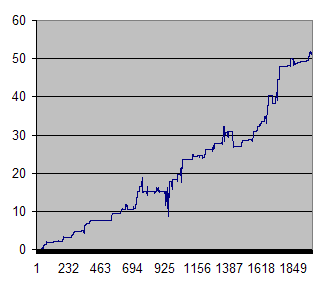
The test period is from 2005 until the present:
| P/L in % | #fills | #wins | Avg % |
| 51.30432 | 273 | 175 | 0.187928 |
Here is the equity curve:
Vice versa for short does not work.
———————–
If you would like to have the Amibroker and Tradestation code for this strategy plus 70+ other free trading strategies published on this website, please click on this link:

For more trading strategies, please click here:
- Free trading strategies
- Monthly trading edges (subscription service)
FAQ:
– What is an overnight trading strategy, and how does it work in the S&P 500?
An overnight trading strategy involves entering a trade at the market’s close and exiting it at the following day’s open. In the case of the S&P 500, this strategy uses specific criteria, such as Average True Range (ATR) and the IBS ratio, to determine entry and exit points.
– What are the key criteria used in the S&P 500 overnight trading strategy?
The criteria include calculating the ATR (a 25-day average of the High minus Low), the high of the last 10 days, the IBS (C-L)/(H-L) ratio, and a band below the 10-day high. If the SPY closes below this band and the IBS is below 0.5, a long position is entered at the close and exited at the next open.
– Is the overnight trading strategy in the S&P 500 applicable to both long and short positions?
The strategy is designed for long positions, and a vice versa approach for short positions does not yield favorable results.