
Keltner Bands Trading Strategy (Backtest)
Keltner Bands Trading Strategy (Keltner Channels) is a lesser-known sibling of the Bollinger Bands which are widely used and pretty famous. Despite being rather unknown, Keltner Bands are still included in most software packages.
In this article, we take a look at Keltner Bands to see what it is, how they are calculated, how they differ from Bollinger Bands, and if it’s possible to make money on Keltner Bands. We test a Keltner Channel trading strategy.
Keltner Bands explained: What are Keltner Bands/Channels?
Despite being not widely known, the Keltner Bands were developed before John Bollinger made the more famous Bollinger Bands. The Keltner Bands were first introduced in the 1960s and are renamed after its innovator, Chester Keltner.
Both bands are based on volatility and based on three separate lines (see below for explanation). The middle line sets the basis for the upper and lower bands that are based on the ATR. The bands expand and contract as volatility (measured by ATR) goes up and down.
Keltner Bands are also called Keltner Channels. The reason for the latter is simple: They are made up of three bands, just like in the chart below:
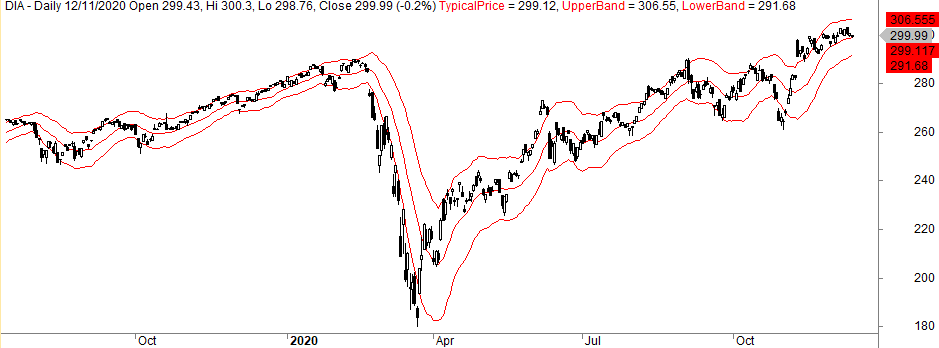
As you can see, most of the price action is inside the bands.
How are Keltner Bands calculated? The Keltner Channel formula
There have been many variations of the bands and channels over the years, but as of now the bands are calculated this way (to our knowledge):
- In the middle of the bands (or in the middle of the channel) we have a line showing the “typical” price or “normal” price. The “typical price” is the high, low, and close divided by three. This deviates from the Bollinger Bands that only use the closing price.
- Based on the “typical” price in number one, two bands above and under (upper and lower bands) are calculated by adding and subtracting the Average True Range (ATR).
- Both numbers one and two are based on x number of days (the period).
(Further below we have included how the formula is calculated in Amibroker.)