
Trading Statistics 2024: Truths And Facts
This article looks at the world of trading, uncovering trading statistics, truths, facts, and realities that shed light on many things you probably didn’t know about trading in stocks, futures, ETFs, and crypto.
Trading in financial instruments is popular, we guess it has always been. The dream of easy money! Not working for the man! Become independent! Trading statistics matter!
The rise in home office working, has also increased the interest for trading. It’s the dream of not working for the man, but being independent.
However, trading is not easy and certainly not for the faint of heart. Trading is actually pretty demanding and difficult. Just look at the results below from our polls, and you’ll understand why most short-term traders lose money. Yes, you heard that right – most traders lose money.
Most of the statistics are based on polls we have conducted on our Twitter profile. Thus, our statistics are based on real numbers and not taken out from the a**.
That said, the reader polls have their limitations. It’s based on anonymity, but we believe it’s a lot better than most of the things you find on the internet. Also, they might be somewhat biased because of the readers that follow us.
If you have any trading statistics that should be included from other sources, not to mention reader polls that we should cover, please don’t hesitate to contact us.
You might also find our guide to crypto statistics, options trading statistics and day trading facts interesting.
The results are interesting, so let’s look at the results for our dive into lots of trading statistics:
How Traders Handle Losing Streaks In Trading?
There will come a time when you encounter a losing streak that causes your capital to take a hit. This is known in trading as a drawdown.
Losing is an unfortunate inevitability in trading, and while nobody enjoys it, it’s a part of the trading process. How you handle a losing streak in trading is extremely important. Most traders fold and give up, but mostly because they don’t have a plan in the first place.
We interviewed a number of traders to understand how they approach and manage drawdowns.
This is what our readers say:
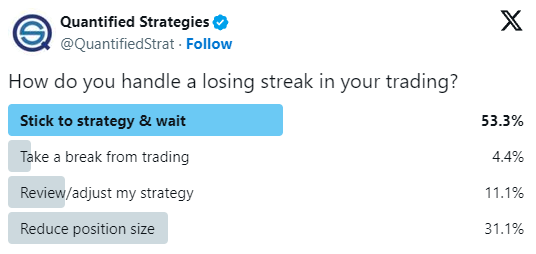
Our Twitter poll shows that most traders handle a losing streak in trading by plugging on despite the drawdown (53.3%), while others reduce the position size (31.1%).
We recommend reading the whole article about how do you handle a losing streak in trading. In that article, we have also explained what we believe is the best thing to do.
How popular is leverage for traders?
In trading, success hinges on a positive expectancy, and leverage can be a powerful tool to amplify your edge. It looks so easy: just add 2x leverage and you double your money!
Unfortunately, very few think about that you could go belly up twice as fast, and for many with certainty.
The delicate balance between greed and fear is paramount. Losing a significant portion of your capital can severely hinder your ability to recover.
We posed the question: Should leverage be a part of your trading strategy?
We asked our loyal followers on Twitter and they indicate that leverage is useful and they use it frequently:
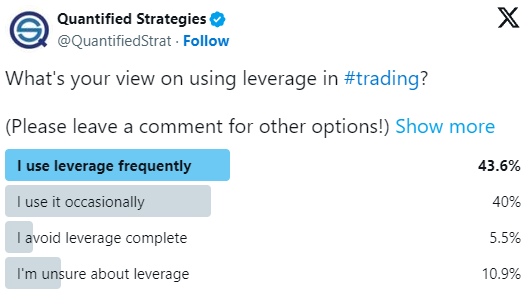
43.6% of the respondents use leverage frequently, and 40% occasionally. Thus, most traders use leverage!
We use leverage ourselves, but we are extremely systematic. If you know what you are doing, we believe leverage in small doses are good.
The most popular way for traders to manage risk
There are a few ways for traders to manage risk. We define risk a s losing money, in the form of temporary or permanent drawdowns.
Of course, no one knows if it’s temporary or permanent, hence traders seek alternatives to lower drawdowns as much as possible.
In a recent Twitter poll we asked our readers what they favorite risk management tool is:
- Stop loss orders
- Position sizing
- risk reward ratio
- diversification
You can, of course, use many of these tools together. However, personally, we are no fans of stop loss orders. It’s probably the most overhyped risk tool there is. We like to use strategy diversification as our main tool as an alternative to a stop loss.
The how do you manage risk in trading? poll looks like this:
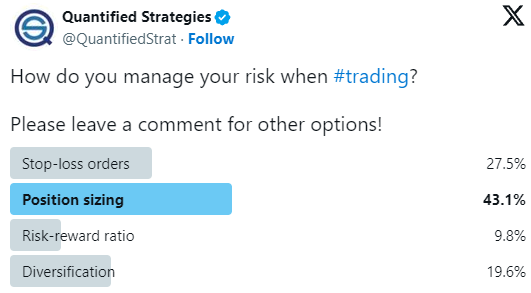
43.1% of traders use position sizing as their main risk tool, while an ordinary stop-loss order came in at second with 27.5%.
How Often Do You Review And Adjust Your Trading Strategy?
Trading should be a constant feedback loop, as indicated in Annie Bets fantastic book called Thinking In Bets.
As part of the feedback loop traders should always review and perhaps adjust a trading strategy, but only as long it’s based on rational decisions. Be careful if you find yourself fiddling too much.
It’s too easy to fiddle with a trading strategy, and this should be avoided. Don’t fall for the temptation of making a good trading strategy “perfect”, and thus ruining it due to curve fitting.
We asked our followers on Twitter the following question:
How often do you review and adjust your trading strategy?
We find the poll promising:
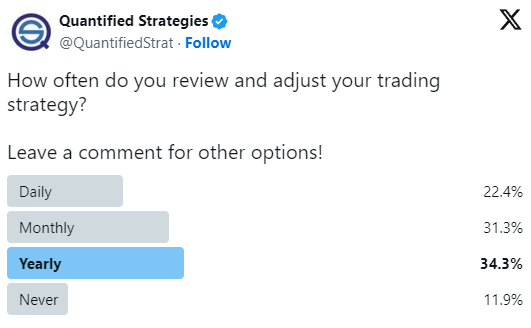
34.3% adjust and review their trading strategy annually, while monthly come in a second at 31.3%.
A strategy should in most cases never be adjusted monthly, it’s too frequent, but annual is ok.
Best Asset Classes For Trading Opportunites
All assets are not the same. You can’t expect a certain trading strategy to work on all assets.
We asked:
Which Asset Class Offers The Best Trading Opportunities?
This was the question we asked our 12 000 followers on Twitter (the followers we hade at the time we conducted the poll).
The result of the reader pool looks like this:
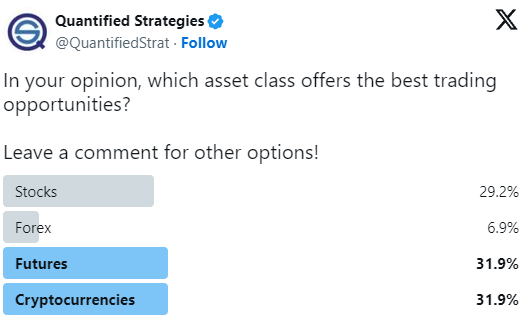
Crypto and futures offer the best opportunities for trading with 31.9% of the respondents each. Perhaps surprisingly, forex came dead last with only 6.9%.
Which Trading Style Are Most Popular?
Each trader normally have their own trading style. This could be based on discretionary trading, or perhaps systematic trading. The latter is what we believe is the best approach.
Again, we asked our Twitter followers, about 12 000 at the time of the poll, “Which trading style do you prefer?”
The result of the poll looks like this:
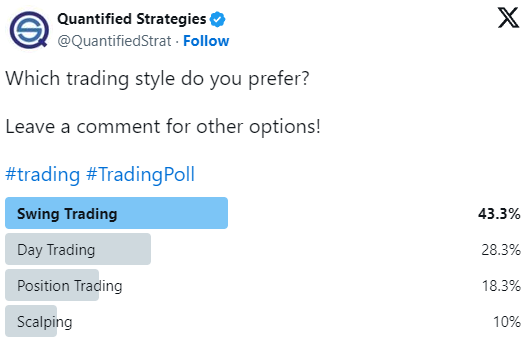
43.3% of traders prefer swing trading as their trading style, while 28.3% prefer day trading.
Which Trading Platforms Are Most Popular Among traders?
Which trading platform is for many one of the major decisions they take. There are plenty to choose from. Personally, we use Amibroker and Tradestation (we have covered Amibroker vs Tradestation in a separate article).
Over the last year, TradingView, has become very popular.
There a switching costs because each platform normally has their own coding, thus it matter which choice you make.
We tried to establish this:
Which Trading Platform Do Traders Use?
The result from our Twitter poll ended like this:

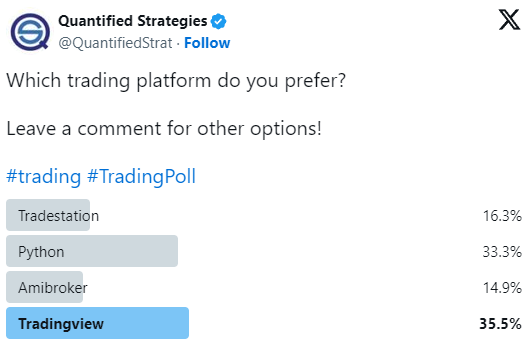
TradingView is the most preferred trading platform with 35.5% of the votes, while Python came in at second with 33.3%
Which asset class do traders prefer?
We are stock traders, but others might prefer to trade other assets.
We asked our Twitter followers the following question: Which asset class is the most popular for traders?
The result looks like this:
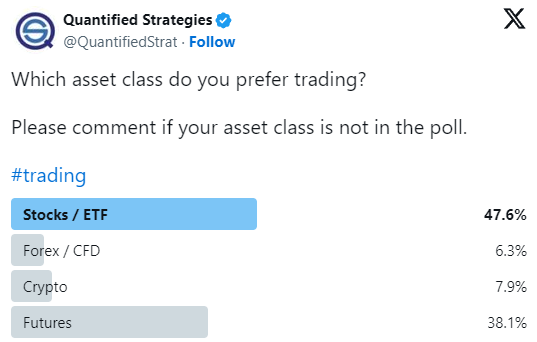
47.6% of traders prefer to trade stocks, while futures is the second most preferred asset at 38.1%.
The Importance Of Backtesting For Traders?
All trading strategies on this website are backtested. Thus, it’s no surprise that we are fans of backtesting, and perhaps our followers are biased toward backtesting.
Nevertheless, we decided to ask our readers the following: How important is backtesting to your trading?
The result is perhaps as expected:
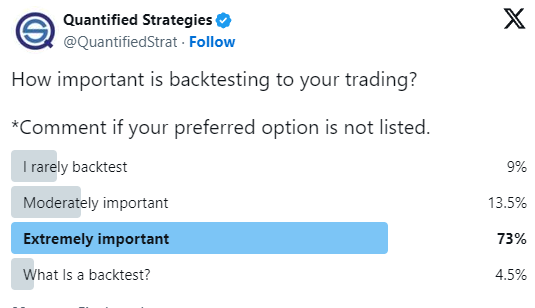
73% of traders rank backtesting as extremely important, and 13.5% as moderately important.
What Are Traders Biggest Challenges?
As a trader, you face challenges every day. Not only is it difficult to find profitable trading strategies, but you also need to fight the demons inside: how do you handle inevitable losses?
We wanted to find out and asked our readers the following question: What is your biggest trading challenge?
The poll we ran left no surprises:
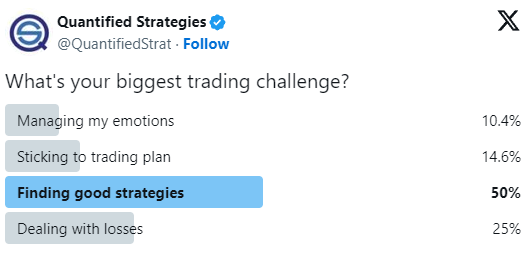
50% of traders regard finding good trading strategies as their biggest trading challenge, and 25% says dealing with losses is their biggest trading challenge. 14.6% says sticking to the trading plan is the main obstacle, and 10.4% says managing emotions are their biggest trading challenge.
Traders Biggest Challenges When Backtesting Trading Strategies?
Backtesting is far from as easy as it seems, and there are many aspects you need to consider.
Because of this, we decided to ask our readers the following: What is your biggest challenge when backtesting trading strategies?
The result is indicated here:

34.9% of traders say that applying the strategy to real time trading is their biggest challenge when backtesting strategies, and 31.7% voted that finding good historical data is the most challenging.
How long traders have been trading
Most traders lose and quit after a short period of time. Because of this, we decided to run a poll where we asked our Twitter audience the following question: How long have you been trading?
This was the result:
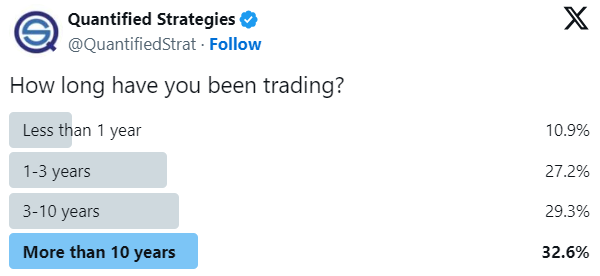
61.9% have been trading for at least three years. More impressive is that 32.6% have been trading for more than 10 years! We assume that they are not unprofitable traders when they on plugging year after year.
Trading Statistics – conclusion
To gather trading statistics is not easy, but we believe anyone can find some important takeaways from this article.
If you have any trading statistics that should be included from other sources, not to mention reader polls that we should cover, please don’t hesitate to contact us.