
Unfilled Gap Trading Strategies – Gap Up / Gap Down (Backtest)
An unfilled gap trading strategy happens when all the price action today is either lower than yesterday’s low (gap down) or higher than yesterday’s high (gap up). They are also profitable if we base our buy signals on additional criteria.
We do many backtests to measure profitability, and we give you some ideas on how you can take advantage of them. We only backtest the S&P 500.
What is an unfilled gap trading strategy in trading? There are many traders trading solely on gaps because most of the time a gap up or down means increased volatility, and this equals more prey for good traders. In this article, we look at some statistics about unfilled gaps. Is it possible to make money in trading if you trade gaps?
Most traders know what a gap is, but an “unfilled” gap might be lesser-known. This article looks at unfilled gaps in trading.
What is a gap in trading?
Gaps normally happen overnight when the market is closed. When the market opens again the next day, news and other noise may have made the price go up or down.
Some markets have more frequent gaps. This is typical in markets that have huge movements between the official/regular trading hours and the open the next day, for example, gold. The stock market has fewer gaps.
We recommend our previous article about gaps if you want to read more about gaps:
- Gap trading strategies (How to trade gaps with backtested examples)
What is an unfilled gap in trading?
If the gap is not filled during the first day we label it as unfilled. For example, if the S&P 500 opens below yesterday’s low and never trade above yesterday’s low, it’s an unfilled gap. Here is an example in the S&P 500:
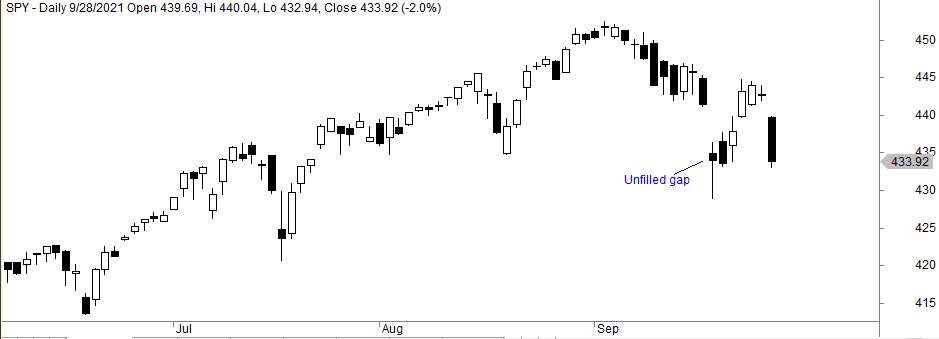 It’s an unfilled gap for three days (the gap fills on the third day after the gap down).
Other versions of unfilled gaps in trading
Please be aware that other traders might define an unfilled gap differently. Some traders consider the gap unfilled as long as today’s high is lower than yesterday’s close (an unfilled gap down). Opposite, we have an unfilled gap up when today’s low is above yesterday’s close.
This definition of an unfilled gap leads to many more trades or signals. Obviously, more trades might lead to other results than we have in this article. There are no exact answers in trading, and you might want to backtest other versions yourself.
How long does it take for an unfilled gap to fill?
This is an example of a filled gap:
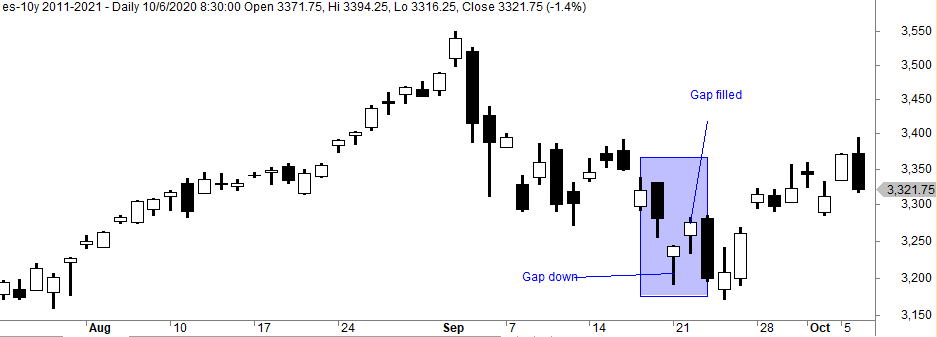 The S&P 500 gaps down, but the gap is filled on the next day after the gap down.
The gap is filled when we see trades between the low and high of the two days that formed the gap (on a