
When XLP Diverges From Recent High And Low: A Mean Reversion Trading Strategy Explained
A while back I wrote about a day trading strategy in SPY. This one works pretty well on XLP as well, with some modifications:
The high and low divergence mean reversion trading strategy
The strategy is like this in plain English:
Trading Rules
[am4show have=’p2;p3;p58;p59;p130;p138;’ user_error=’Premium Post Access’ guest_error=’Premium Posts’]
- Calculate a 25 day average of the (High minus Low – (H-L)). That is the “ATR”.
- Calculate the Low of the last 10 days.
- Calculate the (C-L)/(H-L) ratio every day (IBS).
- Calculate a band 2.5 times above the 10 day low using the average from point number 1 (ATR).
- If XLP closes above the band in number 4, and point 3 has a higher value than 0.8, then go short at the close.
- Exit on tomorrow’s close.
Vice versa for long except the value in number 3 must be below 0.33.
[/am4show]
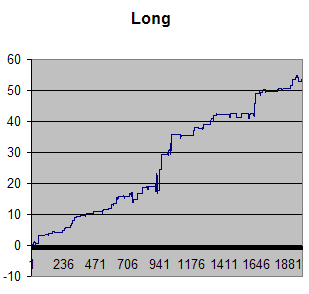
Test period from 2005 until 2013. Here are the results:
Long:
| Total % | #Fills | #Wins | Average | |||
| 53.57363 | 161 | 106 | 0.333 |
Profit curve:
Short:
| Total P/L | #Fills | #Wins | Average | |
| 49.03834 | 237 | 141 | 0.207 |
Equity curve:
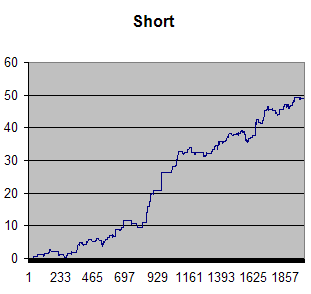
By the way, this strategy has been horrible in 2013 on the short side (live trading).
——————–
If you would like to have the Amibroker or Tradestation code for this strategy plus 70+ other free trading strategies published on this website, please click on this link:

For more trading strategies, please click here:
- Free trading strategies
- Monthly trading edges (subscription service)
FAQ:
– What is the core concept of the high and low divergence mean reversion trading strategy?
The core concept of this strategy involves calculating the average true range (ATR), the recent low of the asset, and the (C-L)/(H-L) ratio daily. It uses these metrics to determine whether to enter long or short positions based on specific criteria.
– How is the ATR (average true range) calculated in this trading strategy?
The ATR is calculated by finding the average of the daily differences between the high and low prices over a 25-day period. It serves as a measure of price volatility.
– What are the specific entry and exit criteria for long and short positions in this strategy?
For long positions, XLP must close above a certain band, and the IBS value should be below 0.33. Conversely, for short positions, XLP must close above a different band, and the IBS value should be above 0.8.


Question: In your formula point #4:
Calculate a band 2.5 times above the 10 day low using the average from point number 1 (ATR).
Is the actual calculation of the Upper Band as follows:
(pseudo code)
UpperBand = 2.5 * LowestLow (past 10 days) + Moving Average(H+L, 25)
I am having some difficulty in reproducing your results on XLP, and it would be greatly appreciated if you could just clarify that one point.
Thanks in advance.
Hi,this is correct formula:
UpperBand = LowestLow (past 10 days) + ( 2.5 * Moving Average(H+L, 25) )